Light Up Your Cruising Nights
July 7, 2016
Informed estimates are that barely 10% of Canadian pleasure craft have underwater lighting but in Florida it’s a far higher percentage. And, among new luxury cruisers in Florida, the number equipped with underwater lighting is probably more like 90%.
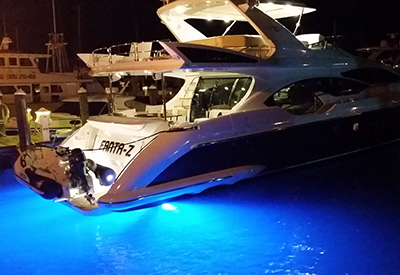
Walk the docks at night and what used to be dark and maybe even a bit dangerous is now a remarkable display of light that transforms those dark harbour waters into something like a luxury hotel swimming pool.
The question is, will this work in Canada? And, is it affordable?
Well yes, underwater lighting will work very nicely in Canada (or anywhere else for that matter), and depending on what you want it can be quite reasonably priced.
 What is the benefit?
First, underwater lighting is “cool.” It is new, eye-catching and can be pretty dramatic, but there are a whole range of benefits that you might not have considered. Swimming in light at night is just one of them.
On the docks at night in a marina or yacht club, the added lighting offers a significant safety benefit. Another safety aspect that I ran into first hand, was boating in a crowded waterway, late at night last summer. It was in a passage wide enough to allow unrestricted speeds, but it was still narrow, with lots of lights on the nearby shore reflecting on the water and several boats moving at various speeds.
It was very hard to pick out the running lights from the other reflected light and my big concern was being rear-ended by another, faster vessel. We have been advised that running with your underwater lighting on, is not illegal or restricted.
If our vessel had been better lit, I would have felt a lot safer.
We understand that white lights attract fish and some anglers use them in Florida, but we caution Canadian boaters that practice is illegal here.
Swimming in the light is much more comfortable and safe because you can more easily see the boarding ladder and you are less likely to slip or fall. Then, tow sports boats look really good with their lighting on and those boats are designed for swimming and easy access to the water.
Don Hood of Imtra, who sells Lumishore LED Underwater Lighting in Canada, mentioned that so far more power boaters have added lighting than sailors, but if you have ever run aground, snagged an old piece of line in your prop, or had a rudder issue, a well-placed underwater light can make the task of diving to trouble-shoot far easier.
He added that, for people using their boat as a floating vacation home, the night lighting is a very welcome addition.
The lighting is not just white. When choosing underwater lighting, colour is key and so is output. Many LED units are available in blue or white, but green and red are available.
We learned that red doesn’t penetrate water well but green does. Then again, with green and white you will see pigmentation in the water. Blue doesn’t show particles in water and for many reasons, blue is probably 90% of all sales.
That said, really big and elaborate systems are available that can change colours, and some can “strobe” in time to your music.
 Entry level and boat sizes
The new LED marine lighting is transforming the experience of boating at night. LED lighting draws relatively little current compared to conventional incandescent lighting or halogen bulbs, and for smaller power boats, the entry level starts with a simple single LED fixture that goes into the drain plug hole (replacing the drain plug). You just need a bit of fused wiring and power to at least light up the stern enough to see the lower unit, some of the surrounding water and what is in it.
We also spoke to Paul Sichewski at Luxor Marine RV in Kitchener who also offers LED lighting including drain plug models. He told us that the most common question potential buyers have is, “Do I have to drill big holes in the boat to install underwater lighting?”.
As soon as you move up from the drain plug single light that passes through an existing hole, you will need to drill some sort of hole for the wires.
Going up in size and power, you can choose models that are surface mounted and just require a small hole for wires, or ones that require a slightly larger diameter hole for a shaft that fastens all the way through the thickness of your transom, but with a small diameter hole. The shaft on some models is as small as ½” even though the light fixture seems to be perhaps 3” or more in diameter. You bed the fixture in sealant and tighten it through, then connect the wires inside the boat.
As the light output levels go up, the fixture sizes increase and the hole for the shaft may as well. This is because a significant part of the LEDs themselves and the electronic components needed to run them, are installed in the shaft, not outside the boat.
Obviously, you don’t want a fixture that protrudes and could be damaged if a piece of debris sweeps past for example.
Then, that raises the matter of lighting that is designed for the hull sides. Lights need to be flush and smooth for the water flow, very water-tight and something else; able to withstand higher operating temperatures.
That can be true for transom mounted lights as well if you plan to run with them on. At rest, the water cools the fixtures but when moving, they may no longer be submerged and the heat can shorten the life of the LEDs.
Several suppliers added that people should not overpower the lights. That can also shorten their life. Best guidance seems to be to drive them to about 75% of capacity.
You can vary how much light you get too. There are small lights like 6 watt models but 18 watt models are more popular and you can choose 27 or 60 watt models. A single light can still offer useful illumination but two or three across the transom gives the best illumination spread.
Some other basic information is that typically, you will be paying $300 to $1800 a light. One supplier pointed out that the consumer does not see technology but you basically get what you pay for – less expensive imported lights may leave you with no recourse. Trust your dealer.
 Especially on smaller boats, a capable DIY owner can do the installation on a trailer but for larger vessels, we recommend you buy from a reputable yard that will haul your boat and install the system correctly. The wiring is fairly simple but you need a good seal and a dealer who offers warranty coverage is always the best bet.
We contacted Jon Moles at Toronto Yacht Services to ask what an owner might expect for a turn-key installation and Jon suggested some fast ball-park figures. A boat in the 20’ to 30′ range might be $1,500, a 30 to 40 footer perhaps $2,000 to $3,000 and it goes up from there, depending on how much light and how much complexity.
Given the rough costs and benefits, make this the summer you light up your cruising nights. There’s plenty of time to have them installed for launch day!
Andy Adams is Managing Editor of Canadian Yachting magazine; 416-574-7313 aadams@kerrwil.com.

![Guide to the Canadian Electrical Code, Part 1[i], 26th Edition– A Road Map: Section 74 — Airport installations](https://electricalindustry.ca/wp-content/uploads/2026/05/EIN-Stock-Guide-Code-Canada-Map-1200-768x403.png)




![Guide to the Canadian Electrical Code, Part 1[i], 26th Edition– A Road Map: Section 74 — Airport installations](https://electricalindustry.ca/wp-content/uploads/2026/05/EIN-Stock-Guide-Code-Canada-Map-1200.png)