Record-low Price Tops Wind Energy News in 2017
January 31, 2019
News about record-low costs tops the 2017 year-end review of wind energy in Canada. In December, a competitive electricity-supply auction in Alberta yielded the lowest-ever price paid for wind energy in Canada (weighted average of $37 / MWh) and also made wind energy the lowest-cost option for new electricity generation in the country. This came on the heels of a major U.S. study which found that wind power costs had plunged 67 percent between 2009 and 2017.
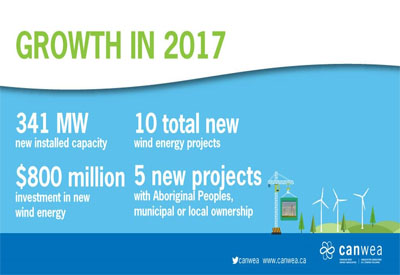
In terms of new development in 2017, utilities and developers energized 10 new wind energy projects in Nova Scotia, Ontario, and British Columbia, collectively bringing enough new clean electricity online to meet the needs of more than 90,000 homes. Over the last five years, Canada’s installed wind energy capacity has grown by an average of 15 per cent annually – reaffirming wind energy’s leading role in Canada’s ongoing efforts to fight climate change by providing clean, cost-competitive electricity.
Taken together, the new projects represent more than 340 MW of new capacity and approximately CAD$800 million in investment. The projects created employment for approximately 3,500 people in construction and in operations and maintenance. Municipalities and communities have ownership stakes in half of the new projects, which is a reflection of a growing global trend towards greater community involvement in wind energy development.
As of the end of 2017, Canada had 12,239 MW of total installed wind capacity, producing enough electricity to supply six per cent of Canada’s electricity demand and power 3.2 million homes.
In 2018, the Canadian Wind Energy Association (CanWEA) expects over 600 MW of new wind energy capacity will come online and these numbers will continue to grow in future years.
In the December auction in Alberta noted above, the grid operator announced that three companies will together invest CAD$1 billion to build four new large wind farms in the province by the end of 2019. Together those facilities will generate 600 MW of clean electricity, reducing the province’s reliance on coal power.
Quote
“From Nova Scotia to British Columbia, wind once again proved in 2017 that it is a reliable, scalable solution to climate change that is delivering low-cost energy and local economic benefits to communities across Canada. We’re pleased to be delivering clean and affordable energy to Canadians.”
Robert Hornung, President, Canadian Wind Energy Association
Background
- On December 13, 2017, the Alberta Electric System Operator (AESO) and the Government of Alberta announced the implementation of the first phase of the Renewable Electricity Program (REP), which has resulted in the lowest-ever price for wind energy generation in Canada.
- In November 2017, Lazard’s Levelized Cost of Energy Analysis found that the levelized unit energy cost of wind power declined in the United States by 67 percent between 2009 and 2017.
- Canada is the ninth largest wind power producer in the world.
- Over the past decade, on an installed megawatts basis, Canadian developers and utilities have commissioned more wind power than any other form of electricity generation. Visit the Wind Markets section of CanWEA’s website to learn more.
- Ontario continued to lead Canada in installed wind energy capacity, adding 119 MW of new wind in 2017, bringing that province’s total installed capacity to 4,900 MW.
- The 179 MW Meikle Wind farm, in northeastern British Columbia, proved to be the largest wind farm commissioned in Canada in 2017. The facility increased the province’s wind-power capacity by more than one third, to almost 674 megawatts, and made B.C. the 2017 growth leader.
- A trio of Nova Scotia communities took advantage of that province’s community feed-in tariff program to bring three new facilities online—collectively totalling 13.35 MW. Nova Scotia ended the year with 610 MW of wind energy capacity on the grid.
- As of the start of 2018, 295 wind farms, comprised of 6,415 individual turbines, are operating in Canada. These facilities bring economic development and diversification to over 100 rural communities through land lease income, property tax payments, ownership revenue and community benefits agreements.
https://canwea.ca/news-release/2018/01/30/record-low-price-tops-wind-energy-news-2017/






![Guide to the Canadian Electrical Code, Part 1[i], 26th Edition– A Road Map: Section 76 — Temporary Wiring](https://electricalindustry.ca/wp-content/uploads/2026/05/EIN-Stock-Guide-Code-Canada-Map-1200.png)