ABB Drives Sustainable Transit with Ontario Line
July 2, 2024
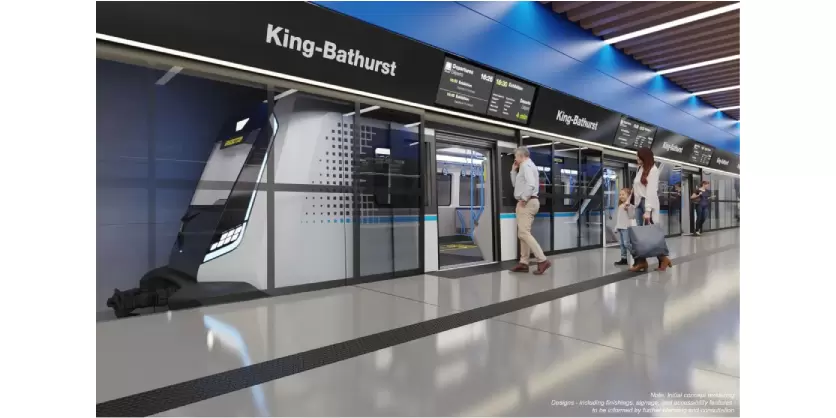
Photo: Side view of the exterior of an Ontario Line subway train behind the transparent platform-edge doors, which are opening in sync with the train doors. – Photo credit Metrolinx and Connect6ix
By Krystie Johnston
ABB’s contribution to the Ontario Line is part of the solution for sustainable transit and a sustainable future
ABB was recently awarded a contract to provide the traction power supply solution for the Ontario Line subway project in Toronto. With their innovative solutions, the company is driving sustainable transit, shaping the future of urban mobility. Jose Dos Santos, Rail Segment Manager for the Americas at ABB discusses the technology behind the power solution and the broader trends shaping the future of electrifying transit.
“Working with a purpose is what motivates me every day. Contributing to the overall reduction of global carbon emissions and for a greener future is one of my main drivers.” Says Dos Santos.
Metrolinx reports that the Ontario Line will reduce approximately 28,000 car trips every day, thereby reducing fuel consumption by about 7.2 million liters per year1. This line will not only impact residents but will contribute to a more sustainable future beyond the GTA.
Most people that live or visit the GTA will agree that traffic can make travel in the area challenging. Navigating through the city and securing parking are challenges among residents and visitors. With the Ontario Line projected to have a ridership of almost 400,000 boardings daily, it will provide commuters with an efficient way to navigate the city. It will also make walking distance to transit accessible for more than 227,000 people and help reduce rush hour crowding1. These are just some of the benefits it will offer.
Phil Verster, President, and CEO of Metrolinx says, “The communities we serve are at the heart of everything we do and why being a good neighbour is so important. Metrolinx is currently undertaking the largest transit transformation in North America, building the infrastructure that will better connect our communities to each other, to services, to resources and to jobs. We are building for the future.”
As the government invests in infrastructure, they are looking for ways to be more energy efficient and reduce their carbon footprint. Electrification of transit can be a cost-effective way to do that. “We are pleased to be part of this project in Toronto. Our products and solutions for rail transportation are energy efficient and are designed for heavy duty traction applications. This equipment will play a key role in ensuring that public transportation infrastructure is part of the solution for a great, sustainable future,” says Dos Santos.
Dos Santos adds that ABB is not only supplying the equipment, but they are also providing the local service and expertise in rail transit. “Local service is extremely important, because if the power goes down, we have the support and the solutions. The riders only see the train when it gets to the station, they do not see what is behind it – the electrification of the rail, or how it feeds the train. There is a lot that goes on behind it, and that is where ABB is.”
ABB’s traction power supply solution for the Ontario Line has been designed to adhere to the highest standard, meaning these products provide interoperable and future-proof solutions, ensuring the safety and reliability of the rail system.
This project and others like it are driving sustainable transport in urban areas, but there is still much work to be done. “If we look at the at the market, less than 1% of Canadian railways are currently electrified, and this is due to the high cost of implementation. The expense could range from $38 million to a maximum $640 million per kilometer for all ongoing electrification initiatives in Canada today. So, it is quite extensive,” says Dos Santos.
Despite the prohibitive costs associated with electrifying rail in Canada, moving this way is a key step towards achieving sustainable transportation in this country. The benefits of reducing greenhouse gas emissions will both support the country’s economy and will also provide a more sustainable future for its citizens. Electrifying passenger rail is a good starting point, but there is a long way to go to decarbonize the rail sector across Canada, especially for freight.
“The emissions from freight are projected to exceed those from passenger transportation by 2030. The rail sector accounts for 4% of Canada total transportation related to Greenhouse Gas emissions, and 98% of these emissions are because of transportation of freight. Electrification, to me, is the way to address this situation. And I am very optimistic for the future because of that,” says Dos Santos.
The future of rail in Canada and reducing emissions in this sector is dynamic and ever evolving. A growing country, paired with advancements in energy and technology will shape this sector from coast to coast, with no one-size fits all solution.
“Since Canada is the only country in the G7 that has no high-speed rail, you will hear a lot of arguments that the cities are too far apart. But despite this skepticism about Canada’s ability to build high speed rail infrastructure, I see potential there. I believe that with the right technology and investment, Canada can indeed enhance its rail systems to meet the global standard of efficiency and speed,” says Dos Santos.
For now, in Toronto, ABB’s contribution to the Ontario Line is part of the solution for sustainable transit and a sustainable future. Each additional installation moves us forward on the path to net zero.
Editor’s Notes
More Information
To learn more about ABB and their sustainability efforts for transit and beyond, visit https://new.abb.com/ca/segments/railway
Related Story
Decarbonizing the Rail Sector: A Clear Trend for Tomorrow
Rail in Canada is making progress on the pathway to decarbonization – and governments, industry, and stakeholders are rethinking the future of rail. Net zero goals are being set around the globe, with many counties targeting partial to complete emission reductions into the not-so-distant future. Every industry has a responsibility to engage in these efforts and there are many ways to move forward, and Canada is gaining traction.

![Guide to the Canadian Electrical Code, Part 1[i], 26th Edition– A Road Map: Section 74 — Airport installations](https://electricalindustry.ca/wp-content/uploads/2026/05/EIN-Stock-Guide-Code-Canada-Map-1200-768x403.png)



![Guide to the Canadian Electrical Code, Part 1[i], 26th Edition– A Road Map: Section 74 — Airport installations](https://electricalindustry.ca/wp-content/uploads/2026/05/EIN-Stock-Guide-Code-Canada-Map-1200.png)