Centerline Windsor Ltd: A Sustainable Lighting Upgrade for a World-Class Canadian Manufacturing Campus

April 20, 2026
A four-building lighting transformation that doubled visibility, reduced energy waste, and strengthened Centerline’s commitment to innovation and sustainability.
For nearly seven decades, Centerline Windsor Ltd. has been one of Canada’s most respected advanced manufacturing companies – a global automation leader trusted by automotive OEMs around the world. Founded in 1957 by the Beneteau family, whose Canadian legacy continues to maintain leadership, Centerline has grown from a single shop into a multinational enterprise with 800+ employees, four major buildings on Morton Drive in Windsor, and a reputation as a true center of excellence for precision automation.
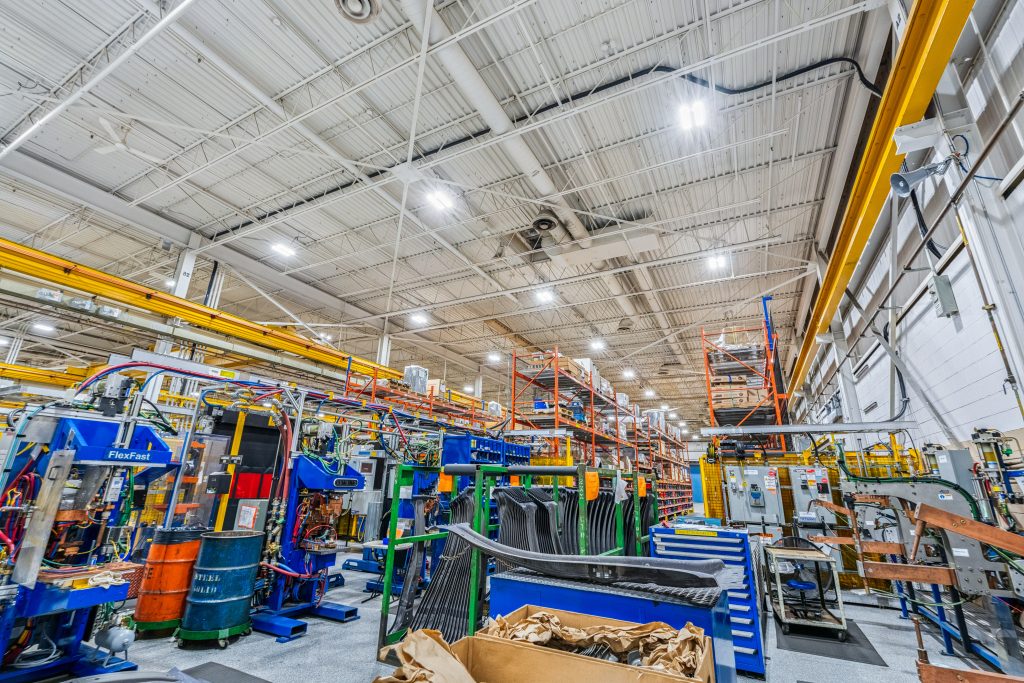
Like any long-running facility, Centerline eventually reached a natural point where the lighting system needed to evolve again. For Centerline, that moment arrived when the company’s aging Philips FBX20 linear high bays, installed in 2009, finally reached the end of their useful life. Light levels had dropped, maintenance was constant, and despite repeated cleaning efforts, the fixtures simply could not support the visual demands of modern CNC machining, precision welding, and robotic assembly.
This case study highlights how Centerline partnered with Wesco and LEDVANCE to place their trust in industry leaders to modernize lighting across all four buildings, dramatically improving light quality, unlocking major energy savings, and reinforcing the company’s decades-long commitment to technological leadership and sustainability.
A Manufacturing Legacy Built on Innovation
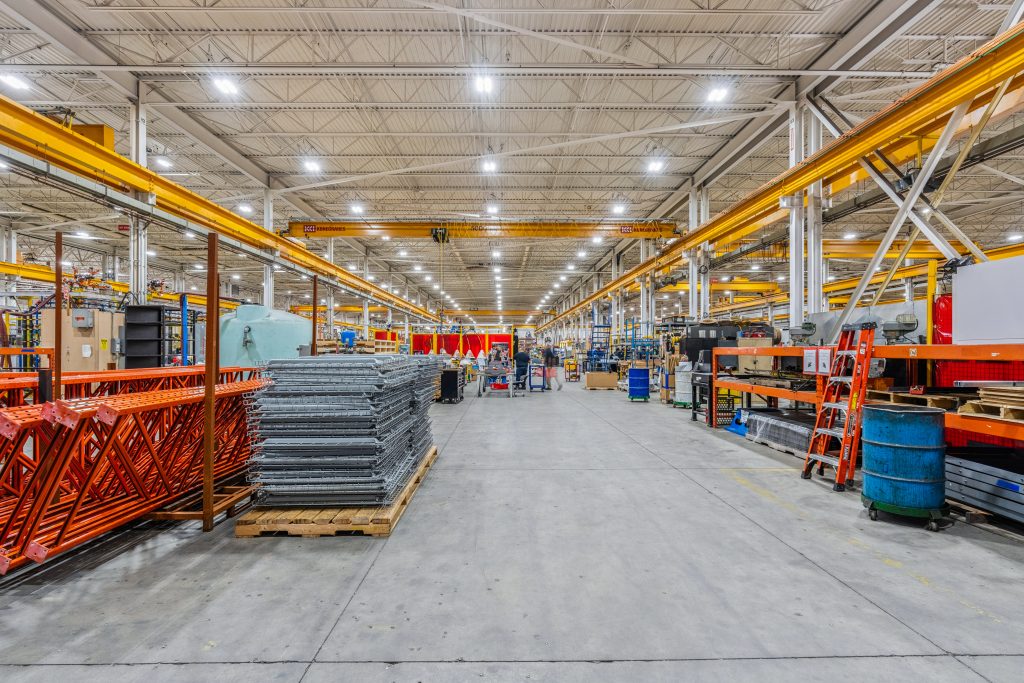
Walking through Centerline’s facilities feels like stepping into a behind-the-scenes episode of How It’s Made – sparks from robotic weld cells, high-precision machining centers, and automated assembly lines performing complex technical operations. Their machinery has even appeared in scenes of Mission Impossible, underscoring their engineering innovation and sophistication through their large-scale robotic systems and advanced engineering capabilities. Centerline has always prided itself on staying ahead of technology trends, and nowhere is that more apparent than in the attention paid to the working environment.
Few people embody that dedication more than Jim Romanowski, Corporate Facilities Manager, who has been with Centerline for 34 years. Jim knows every building, every machine, and every fixture. Over the decades, he has led the company through multiple lighting transitions – from 400 W metal halides, to T5 fluorescents, to the first generation of LED retrofits in 2009, and now to today’s advanced, sensor-integrated LED systems. And he’s continuously operated with one priority in mind: “I’m always looking for ways to save energy, costs and improve our facilities,” he says. For Jim, staying ahead of each technological wave is essential to maintaining a world-class manufacturing environment.
When Jim noticed increasing complaints about reduced visibility on the floor – especially from older machinists who struggled to read small engraved numbers or fine part details – he knew it was time for a change.
The Challenge – Declining Light Levels, Rising Costs
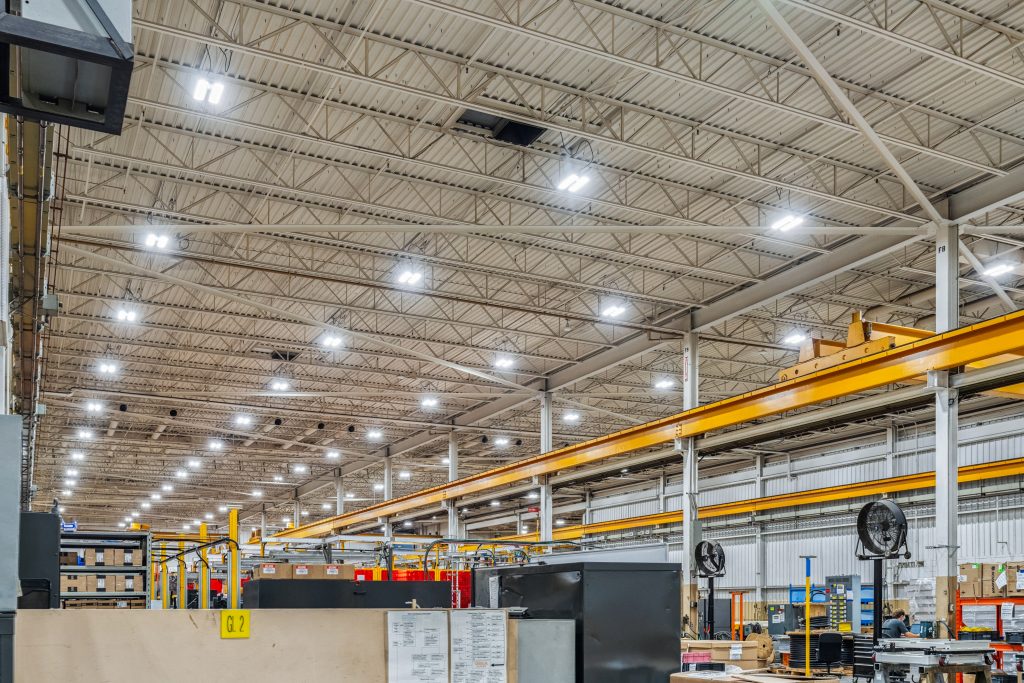
By 2023–2024, the Philips FBX fixtures were showing their age. Light output had diminished significantly. Some fixtures were dirty or clouded from years of manufacturing by-products. Others were failing outright, forcing frequent relamping and lift rentals. Dark spots had begun forming over key work areas, posing potential safety and accuracy issues.
Jim’s team took initial measures, including deep-cleaning hundreds of fixtures, which temporarily boosted light by 5–8 foot-candles. But the reality was clear: the system was beyond its design life. The average measured illuminance sat at approximately 27 foot-candles, far below what a modern facility of this calibre requires.
Energy waste was also escalating. The older LEDs ran continuously across all shifts, and without integrated controls, the entire shop remained fully lit even when sections were unoccupied. As Jim put it:
“Before, at midnight, the entire shop was lit up. Now it doesn’t need to be.”
Across four buildings – 415 Morton, 595 Morton, 655 Morton, and 6290 Morton – Centerline needed a solution that improved visibility, enhanced safety, reduced operating hours, and aligned with the company’s long-term sustainability goals.
The Solution – 887 Smart High Bays with Integrated PIR Controls
After evaluating several alternatives, Jim selected LEDVANCE LNHIBA6A High Bays with integrated PIR occupancy sensors. A total of 887 new smart high-bay fixtures were installed across the four buildings, replacing aging Philips FBX20 units one-for-one. In total, 887 new smart high bays were installed across four buildings, delivering higher light output, better uniformity, and significant energy savings through automated dimming and shutoff in unoccupied zones.
A key partner in the solution was WESCO. Distributor partner Randy Lafreniere, Industrial Account Specialist at WESCO’s Windsor branch, supported the project from the earliest planning through delivery, ensuring product availability, coordinating timelines, and keeping all four buildings supplied with the correct quantities. Closely working in tandem with leading partner LEDVANCE and Centerline to ensure all four buildings are fully provided with the right quantities at the right time. His involvement eliminated friction, prevented delays, and allowed Centerline’s maintenance team to proceed without interruption.
Jim’s decision came down to three factors:
1. Light Quality and Visual Precision
The new LEDVANCE high bays immediately doubled average light levels, raising the manufacturing floor from ~27 fc to ~62 fc. The 5000K CCT provided crisp, high-contrast visibility ideal for machining and inspection tasks.
2. Fully Integrated Occupancy Controls
Every fixture includes an onboard PIR sensor. The behavior is simple but powerful:
- After 30 minutes with no motion, the fixture dims to 50 percent.
- After an additional 15 minutes, it reduces further or turns off.
Jim joked that the system effectively turned “each high bay into a smart light.” For the first time in years, the facility had an automated lighting strategy without costly wiring, empowering the facility with a retrofit that finally gave him and his team the controls they had always wanted
3. Trust in the Brand
Having worked with LEDVANCE and SYLVANIA products for decades, Jim felt confident in the reliability and longevity of LEDVANCE’s high bays.
“I really like the products – the features, the versatility, the quality. We trust the brand; their solutions deliver,” he said.
Team-Led Installation with Zero Disruption
One of the most impressive aspects of the project was that Centerline’s own maintenance team completed the entire installation in-house. Across four active manufacturing buildings – each with machining centers, robotics, welding lines, and full production schedules – the team coordinated fixture replacements zone-by-zone.
Fixtures arrived exactly when needed, existing wiring, such as twist-lock connectors and 208 V circuits, was reused, and downtime remained near zero. Programming the integrated sensors with their standalone controls and remotes was straightforward as well.
“We put them up, programmed them, and after a few, we had the hang of it,” Jim explained.
What mattered most to him, though, was recognizing the people behind the work.
“A big thanks to my team,” Jim said. “We’re a small group, but we didn’t shut down operations; we didn’t miss a beat. Our team made this happen, and I’m very proud of the work they did.”
The Results – Higher Visibility, Lower Costs, Stronger Sustainability
The transformation was immediate and dramatic:
- Light levels doubled, improving safety and accuracy for machinists, welders, and inspectors.
- Older employees who previously struggled to read small engravings reported a dramatic improvement in visibility.
- Energy savings rose sharply due to occupancy controls.
- Many areas now dim or turn off during low-activity periods, reducing unnecessary runtime by 75 to 80 percent overnight.
- Maintenance costs dropped significantly.
- The team eliminated frequent relamping, fixture cleaning cycles, and lift rentals.
- Centerline’s sustainability mission advanced.
- Freshly repainted walls increased reflectance, enhancing the overall effect.
Over the decades, Jim has delivered substantial energy and maintenance reductions through multiple lighting upgrades, and this latest retrofit continues that momentum.
A Culture of Continuous Improvement
Centerline’s leadership views this retrofit as part of its long-term strategy to reinvest in its facilities, support employee well-being, and maintain a world-class environment for precision manufacturing.
Jim is proud of its commitment to lighting innovation and sustainability:
“We’ve always followed the technology. We’ve saved money on wattage, installation time, and now sensors. I’m proud of our team, and we’re looking forward to doing even more with LEDVANCE.”

![Guide to the Canadian Electrical Code, Part 1[i], 26th Edition– A Road Map: Section 74 — Airport installations](https://electricalindustry.ca/wp-content/uploads/2026/05/EIN-Stock-Guide-Code-Canada-Map-1200-768x403.png)


![Guide to the Canadian Electrical Code, Part 1[i], 26th Edition– A Road Map: Section 74 — Airport installations](https://electricalindustry.ca/wp-content/uploads/2026/05/EIN-Stock-Guide-Code-Canada-Map-1200.png)