Common Lighting Pitfalls and How to Avoid Them

May 4, 2026
By CSC LED
Fast-paced projects leave little room for error. Even experienced teams can encounter common lighting pitfalls that slow down installs, create uneven results, or add unnecessary costs.
Understanding what to look out for—and planning ahead—can save time, reduce rework, and improve the final outcome. Here are five areas where projects often run into trouble, and how to prevent them.
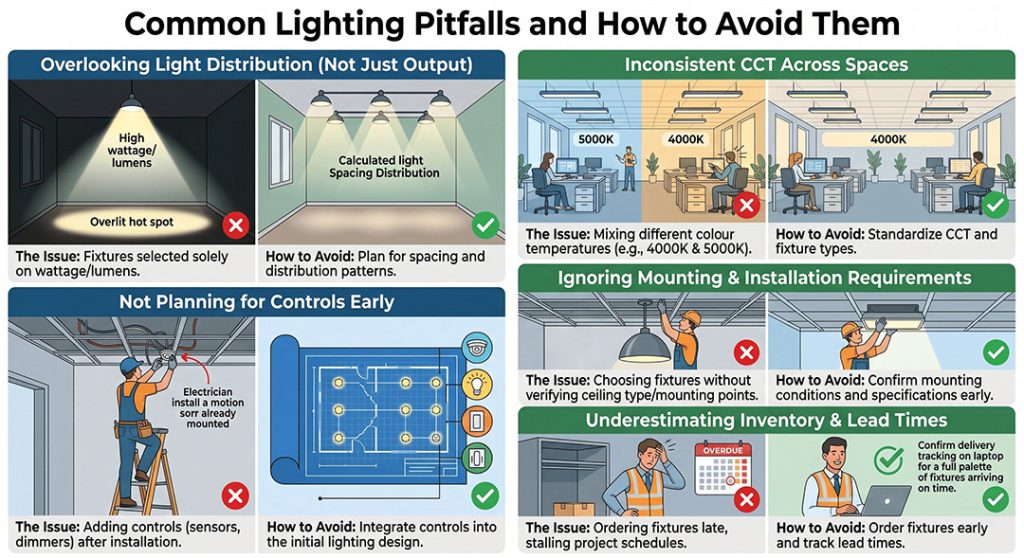
1. Overlooking Light Distribution (Not Just Output)
The Issue: Fixtures are often selected based solely on wattage or lumens, ignoring how the light spreads across a space.
The Result: Dark spots, overlit areas, or uneven lighting can create visual discomfort and reduce efficiency.
Educational Point: Beam angles, optics, and distribution patterns are just as critical as raw output. The right fixture in the wrong distribution can ruin a design.
How to Avoid It: Planning for light distribution from the start ensures spaces are evenly illuminated. CSC LED offers interchangeable optics, beam angle-selectable products, and complementary photometric layout services that allow installers and designers to visualize coverage before the first fixture is mounted.
2. Inconsistent CCT Across Spaces
The Issue: Mixing 4000K and 5000K fixtures, or switching between fixture types, can happen unintentionally.
The Result: Spaces feel visually inconsistent, impacting aesthetics and occupant comfort.
Educational Point: Consistent CCT is key to creating professional-looking, comfortable environments.
How to Avoid It: Choose fixtures with selectable CCT to allow for on-site adjustments if needed. CSC LED offers a wide range of products with this feature, giving teams the flexibility to maintain consistent colour temperatures across offices, warehouses, and common areas without extra trips or reordering.
To further ensure consistency, source all fixtures from a single supplier. Industry standards allow for up to a ±10% variation in CCT output, which can lead to noticeable differences when mixing products from multiple manufacturers.
3. Not Planning for Controls Early
The Issue: Motion sensors, photocells, or dimming controls are often added after fixtures are installed.
The Result: Complex wiring, installation delays, and missed energy-saving opportunities.
Educational Point: Controls should be part of the lighting plan, not an afterthought. Early consideration improves efficiency and reduces installation headaches.
How to Avoid It: Choose fixtures with tool-free, plug-and-play controls like twist-in sensors. CSC LED’s compatible sensor solutions make it simple to integrate lighting controls across multiple spaces, keeping installations fast and flexible.
4. Ignoring Mounting & Installation Requirements
The Issue: Fixtures are chosen without fully considering mounting conditions, such as ceiling type, height, and mounting points.
The Result: Delays, extra labour, or costly adjustments are often required on-site.
Educational Point: The right installation method reduces both time and risk. A fixture that can adapt to multiple mounting scenarios saves headaches.
How to Avoid It: Opt for products with versatile mounting options. CSC LED’s fixture series are designed to accommodate multiple mounts and installation types, including retrofits and new builds. This flexibility reduces the need for custom hardware and speeds up deployment.
5. Underestimating Inventory & Lead Times
The Issue: Waiting for fixtures or accessories to arrive can stall even the best-planned project.
The Result: Delays, missed deadlines, and frustrated installers or owners.
Educational Point: Product availability is just as important as specification. Knowing that stock is ready to ship keeps projects on schedule.
How to Avoid It: Partner with a supplier that maintains large, coast-to-coast inventory with same-day shipping. CSC LED’s extensive stock ensures that whether you’re working on high-output industrial spaces or smaller interiors, the products you need are on hand when you need them.
Final Thoughts
Lighting challenges on job sites often stem from things that can be overlooked in the rush to get work done. By considering distribution, colour consistency, controls, mounting, and inventory early, teams can avoid common pitfalls and deliver spaces that perform as intended.
Working with a supplier like CSC LED—one that offers layout support, flexible fixtures, versatile mounting, and reliable inventory—helps ensure projects move smoothly from start to finish, with fewer surprises along the way.