IP Ratings in Lighting: What They Actually Mean in the Field

By CSC LED
IP ratings are among the most frequently referenced specifications in lighting, yet they are often misunderstood or oversimplified. While they may appear to be just another number on a specification sheet, IP ratings play an important role in determining where a fixture can be installed and how it will perform over time.
Whether the application is a warehouse, parking garage, food processing facility, or office space, selecting the appropriate level of ingress protection helps ensure reliable operation and long-term performance.
What Is an IP Rating?
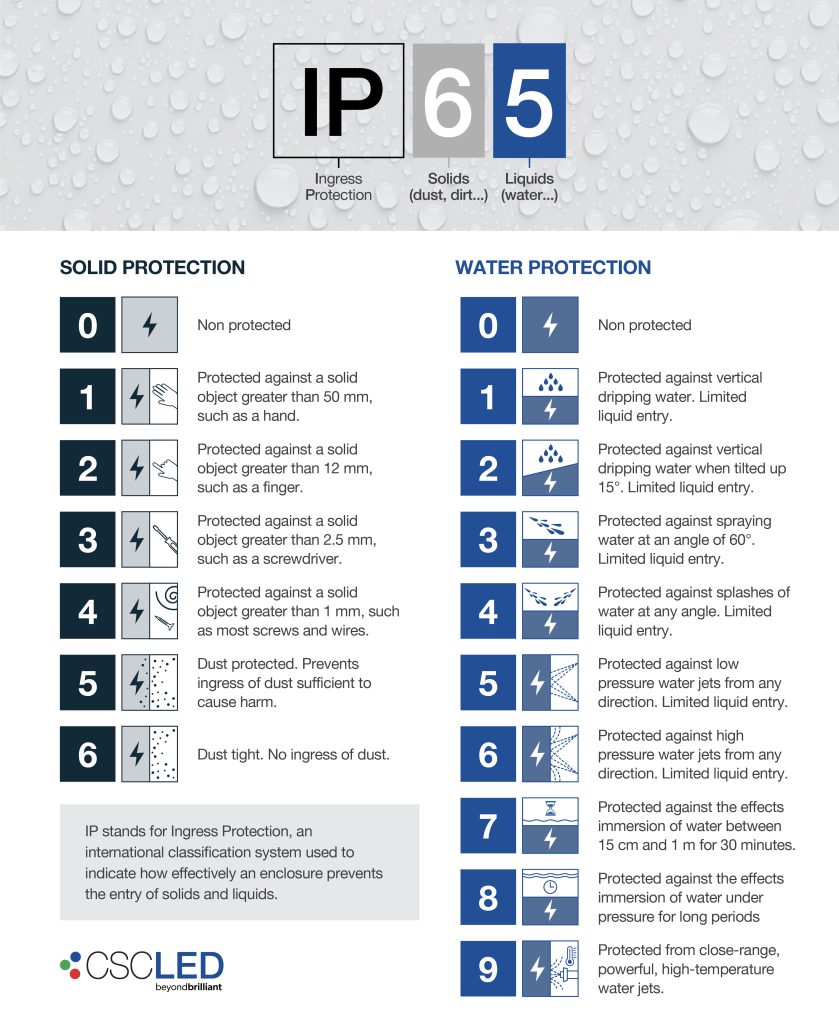
IP stands for Ingress Protection, an international classification system used to indicate how effectively an enclosure prevents the entry of solids and liquids.
An IP rating consists of two digits:
- The first digit indicates protection against solid particles such as dust and debris.
- The second digit indicates protection against water and moisture.
Together, these numbers provide a standardized way to compare the environmental protection offered by different fixtures.
For lighting professionals, IP ratings help answer a fundamental question: Is this fixture suitable for the environment in which it will be installed?
Common IP Ratings in Lighting
While many IP ratings exist, a few are particularly common across commercial, industrial, and architectural applications.
IP20-rated fixtures: This rating provides protection against larger solid objects but offer no protection against water.
These fixtures are typically used in dry, controlled indoor environments where exposure to moisture is not expected, such as offices, meeting rooms, classrooms, and residential living spaces.
IP65-rated fixtures: These are fully protected against dust ingress and are designed to withstand water projected from low-pressure jets.
This level of protection makes IP65 one of the most commonly specified ratings for commercial and industrial lighting applications. It is frequently found in warehouses, manufacturing facilities, parking garages, and exterior building applications where exposure to dust or occasional moisture is expected.
IP66-rated fixtures: Like IP65, IP66 fixtures are completely protected against dust. However, they provide a higher level of protection against water intrusion and are designed to withstand stronger water jets.
IP66 is often specified for harsher outdoor environments, washdown areas, agricultural facilities, and industrial applications where fixtures may be exposed to more aggressive cleaning procedures or weather conditions.
Matching the Rating to the Environment
Selecting the right IP rating is less about choosing the highest number and more about understanding the conditions the fixture will face throughout its service life.
A dry indoor environment may only require an IP20 fixture, while a warehouse or manufacturing facility may benefit from IP65 protection. In outdoor or washdown applications, IP66 may be more appropriate.
The goal is to align the fixture’s level of protection with the realities of the installation environment. Under-specifying can lead to premature failure, while over-specifying may add unnecessary cost without providing meaningful benefits.
What IP Ratings Don’t Tell You
While IP ratings provide valuable information about a fixture’s resistance to dust and moisture, they do not measure overall fixture performance.
An IP rating does not indicate:
- Impact resistance (IK rating)
- Surge protection
- Optical performance
- Long-term structural durability
As a result, two fixtures with the same IP rating can perform very differently in the field. IP ratings should be viewed as one specification among many when evaluating lighting solutions.
Choosing the Right IP Rating
One common misconception is that a higher IP rating automatically means a better fixture. In reality, the best choice depends on the environment.
Specifying a rating that exceeds the demands of the application can increase costs without delivering meaningful benefits. Conversely, selecting a fixture with insufficient protection can lead to premature failures and maintenance issues.
The goal is to match the fixture’s level of protection to the conditions it will actually encounter, balancing environmental protection, performance, and long-term reliability.
The CSC LED Approach
At CSC LED, IP ratings are selected based on real installation environments rather than a one-size-fits-all approach. Whether a fixture is intended for a dry indoor office, a warehouse, an agricultural facility, or an outdoor application, the level of ingress protection is chosen to suit the demands of the space.
To make this easier for contractors and specifiers in the field, we clearly identify IP ratings with visible IP badges on product sheets, packaging, and fixture labels. This allows for quick, confident selection without needing to cross-reference technical documentation.
This approach helps ensure fixtures are properly protected against dust and moisture while avoiding unnecessary over-engineering that can add cost or impact thermal performance. By matching the rating to the application, lighting systems can deliver reliable operation and long-term value where they are needed most.
Final Thoughts
IP ratings provide a standardized way to evaluate a fixture’s resistance to dust and water ingress, making them an important consideration when selecting lighting for commercial, industrial, and outdoor environments.
However, the highest IP rating is not always the right choice. Understanding the installation environment and evaluating IP ratings alongside other performance characteristics can help ensure the selected fixture is suited to the application and built to perform over the long term.
![Guide to the Canadian Electrical Code, Part 1[i], 26th Edition– A Road Map: Section 74 — Airport installations](https://electricalindustry.ca/wp-content/uploads/2026/05/EIN-Stock-Guide-Code-Canada-Map-1200-768x403.png)




![Guide to the Canadian Electrical Code, Part 1[i], 26th Edition– A Road Map: Section 74 — Airport installations](https://electricalindustry.ca/wp-content/uploads/2026/05/EIN-Stock-Guide-Code-Canada-Map-1200.png)