What Type of Outdoor Light Do I Need for My Application?
September 17, 2026
By Stanpro
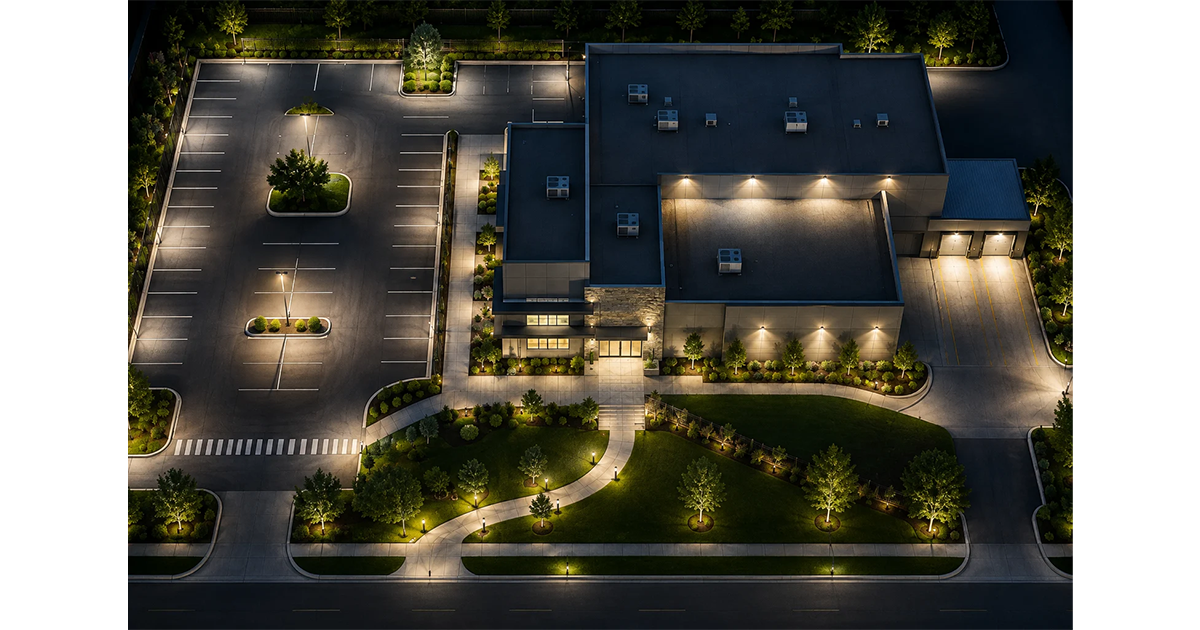
The right outdoor light starts with the space you need to illuminate and how that space is used. For commercial projects, parking lots and large exterior areas point toward area lights; entrances and building perimeters toward wall-mounted or security lighting; signs, facades and targeted areas toward flood lights; pathways toward bollards; and canopies or parking garages toward under-canopy and garage luminaires.
Starting with the application makes it easier to narrow the fixture category before comparing mounting, light distribution, controls or environmental ratings. The goal is to identify what the space needs first, then find the luminaire designed to do that job. Explore Stanpro’s current Outdoor Lighting range.
Start With the Space You Need to Light
Before comparing wattage or fixture appearance, identify where the luminaire will be installed and what it needs to illuminate. A parking lot, exterior entrance, building facade and covered garage each lead to different fixture categories.
Once the application is clear, compare the information that matters to the project, such as mounting method, light distribution, outdoor ratings and available controls. Stanpro product pages and spec sheets provide these details by luminaire, helping narrow the options without turning the first step into a full lighting-design exercise.
What Lighting Is Best for Parking Lots and Large Outdoor Areas?
For parking lots and broad exterior spaces, start with area lighting. Stanpro specifically positions its area-light solutions for applications such as parking areas and other large outdoor spaces.
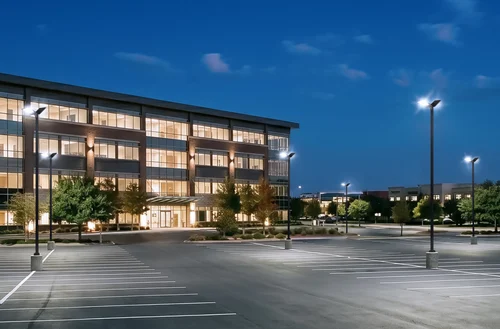
For example, AIRA is listed for parking lots, walkways, car dealerships, and large outdoor spaces. It provides several mounting options, including pole, straight-arm, slipfitter, and wall mounting. These are useful details to review when matching an area light to the project’s location and coverage needs.
For a larger site, identify the appropriate fixture family first, then confirm the configuration needed for the actual layout rather than choosing on wattage alone.
What Should I Use for Entrances and Building Perimeters?
For entrances and exterior building walls, start with wall-mounted lighting. The specific type depends on whether the application calls for general wall-mounted illumination, controlled security lighting or a more decorative accent effect.
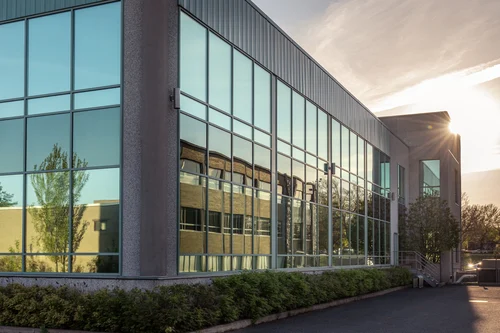
Stanpro’s WPS Gen. 5 wall pack is specifically suited for entrances, underpasses and locations where controlled security lighting is required. It is wall-mounted and uses a forward-throw distribution.
Not every wall-mounted fixture serves the same purpose. WCY, for example, is a decorative wall cylinder designed for security and accent lighting and can provide uplight, downlight or combined uplight/downlight illumination.
For applications where motion-based security lighting is the priority, DSL-L Gen. 2 includes an integrated motion sensor and dusk-to-dawn photocell and is listed for areas such as walkways, yards, driveways, parking lots and loading docks.
When Should I Use a Flood Light?
Use a flood light when the application calls for directed illumination of a specific area or surface, such as landscaping, a sign or a building facade.
Stanpro’s BFL bullet flood light is specifically listed for commercial landscaping and flood lighting of signs and facades. Its selectable beam-angle configurations provide different light patterns for the target application.
For larger-scale applications, FLL is positioned for both general lighting of grounds, storage yards, car dealerships and parking areas and for flood lighting of signs and building facades.
That overlap is worth remembering. The space and required light distribution should guide the choice, not the fixture-category name by itself.
What Lighting Works for Pathways and Landscaped Areas?
For pathway lighting, bollards are a clear category to consider. Stanpro’s BOLRD dome-top and BOLRA full-cutoff bollards are both explicitly identified for pathway lighting in commercial and residential applications.
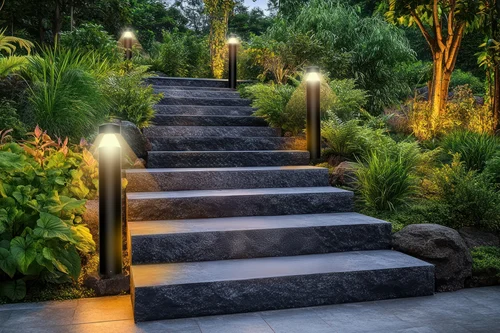
The BOLRA full-cutoff bollard eliminates uplight and is described by Stanpro as Dark Sky friendly. BOLRD offers a dome-top format.
For commercial landscaping rather than a pathway, a flood-light solution may also be relevant. BFL is specifically listed for commercial landscaping, so the installation location and what needs to be illuminated should help determine which category to explore first.
What Type of Light Is Used for Canopies and Parking Garages?
For covered exterior areas, overhangs and parking garages, start with an under-canopy and garage luminaire.
Stanpro’s IFG is specifically positioned for surface-mount applications in walkways, overhangs and parking garages. Its current product information includes selectable power and color temperature, an integrated photocell and a pre-installed sensor receptacle for compatible smart and non-smart sensors. Stanpro also describes its frosted lens as providing uniform distribution.
This makes the under-canopy and garage category a more direct starting point for covered parking areas than treating the space like an open parking lot.
How Do I Choose the Right Outdoor Light?
Match the space to a luminaire category first, then compare the individual product configurations available for the project.
| If you’re lighting… | Start by looking at… |
|---|---|
| Parking lot or large exterior area | Area lights |
| Building entrance or perimeter | Wall packs, wall-mounted or security lighting |
| Sign, facade or targeted area | Flood lights |
| Pathway | Bollards |
| Commercial landscape feature | Flood lights or another solution specifically listed for landscaping |
| Canopy, overhang or parking garage | Under-canopy and garage luminaires |
The final product choice can depend on mounting, distribution, controls and project conditions. For applications that require a more precise fixture layout, Stanpro also offers lighting layout services.