Guide to the CE Code, Part I – A Roadmap (Installment 1 in a Series)
Bill Burr
Often, users encounter situations where they find themselves at odds with the rules contained in the Canadian Electrical Code, Part I (the Code).These situations can occur for designers, consultants, installers, inspectors, manufacturers, students, instructors and standards developers alike, and usually result from a misreading, misunderstanding, misapplication or inability to locate the requirement that is needed or relevant to their tasks.
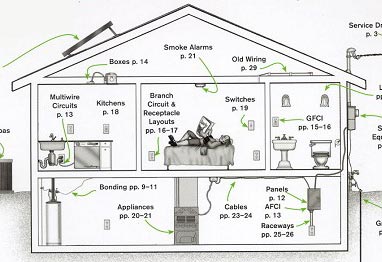
The Code is a comprehensive document. Sometimes, trying to find information quickly can seem quite daunting.Over the next series of articles, I will provide a guide to help users find their way through this critical document. This is not intended to replace the notes in Appendix B or the explanations of individual requirements contained in the CEC Handbook2, but will hopefully provide some help in navigating the Code.
Introductory pages and preface
The first few pages contain the Table of Contents, the names of the main technical committee and sub-committee members, and the all-important information in the preface. Why is the preface so important? Well, the preface, in addition to a list of reference publications, explains how the Code is organized. This arrangement of the outline provides a road map to finding your way. With this tool you can direct yourself to the exact rule or sub-rule that is the subject of your quest.
The first guidepost, indicated in the preface, is that
• Sections 0 to 16 and Section 26 are general sections that apply to all installations
• all other sections, which apply to specific situations, amend or supplement these general sections.
The usefuleness of this key distinction will become clearer later in our exploration. The preface doesn’t mention this, but Appendix A and C are normative (mandatory), and all the other appendices are informatory (non-mandatory) parts of the Code. The Tables and Drawings pages are also normative.
Section 0
Moving on to Section 0, we discover the object and scope of the Code, and the definitions of terms contained in the code.
Object
The object states that this Code establishes safety standards for the installation and maintenance of electrical equipment, where consideration has been given to the prevention of fire and shock hazards, as well as proper maintenance and operation.It also notes that the Code addresses the fundamental principles of protection for safety contained in Section 13 of IEC 60364-1, which is the International Electrotechnical Commission (IEC) standard for low voltage installations (1000 volts or less). You can examine these principles in Appendix K.
We are made aware, by the Object statement, that compliance with the requirements of the Code and proper maintenance will ensure an essentially safe installation, as protection against electric shock, thermal effects, over-current, fault currents, and over-voltage will be met.Also noted is that alternatives to the Code that comply with the fundamental principles of IEC 60364-1 may also be used to achieve safe installations, but only if used in conjunction with acceptable means to assess compliance, by the authorities enforcing the Code.This provision is intended for and usually applies to an industrial installation, under a specific safety management program developed with the authority having jurisdiction. Since the Code is adopted into law by each jurisdiction, any amendments or alternatives must also be adopted into law in that jurisdiction.
Scope
As we move to the Scope statement, we discover that basically all electrical work and equipment is covered by the Code with the exception of
• installations employed by a utility in its function as a power or communication utility
• electric railways
• aircraft
• ships that are not connected to a shore supply for more than five months
If you are looking for rules that apply to a mine or quarry, there are additional requirements in CSA M421.
Definitions
Next up are the definitions. The definitions contained in Section 0 are for specific words or terms used in the Code to aid in understanding and interpretation. An ordinary dictionary meaning applies for any word or term that is not specifically defined in Section 0.These definitions apply generally throughout the CE Code. However, some sections also contain definitions that apply to terms used only in that particular section.It is very important that you check these definitions when reading any specific rules.Although you may have a general idea of the meaning of a term, the Code definition can sometimes affect the application of the rule.
As an example let’s look at the definition of the word Approved(as applied to electrical equipment).It is generally acknowledged that electrical equipment needs to be certified by a certification organization to be approved.But wait! There’s more! According to the definition, that certification organization needs to be accredited by the Standards Council of Canada (SCC), and in addition, the product needs to be certified that it meets the requirements of
• CSA safety standards for electrical products (Part II standards), or
• other standards developed by an SCC accredited standards development organization (SDO) or other recognized documents where CSA Standards do not exist for that product.
In the case of non-CSA standards or other recognized documents, they must be correlated with the Code and also must not duplicate standards listed in Appendix A. The definition also conveys alternatively that equipment meeting the requirements of the regulatory authority is also considered approved. This normally refers to field evaluation by an accredited special inspection body that is recognized by the authority having jurisdiction and facilitates the approval of new or limited manufacture products. So you see, a lot of information is contained in this definition of Approved. The Appendix B note on this definition would also be very beneficial to the Code users.
Read the rest of the instalments in the series:
Part 1: Guide to the CE Code, Part I – A Roadmap (Installment 1 in a Series)
Part 2: A Road Map to the CE Code, Part I – Installment 2
Part 3: Guide to the Canadian Electrical Code, Part I – Installment 3
Part 4: A Road Map to the CE Code, Part 1 – Installment 4
Part 5: Guide to the Canadian Electrical Code, Part I — Installment 5
Part 6: Guide to the Canadian Electrical Code, Part I — Installment 6
Part 7: Guide to the Canadian Electrical Code, Part I — Installment 7
Part 8: Guide to the Canadian Electrical Code, Part I — Installment 8
Part 9: Guide to the Canadian Electrical Code, Part I — Installment 9
Part 10: Guide to the Canadian Electrical Code, Part 1 – Installment 10
Part 11: Guide to the Canadian Electrical Code, Part 1 – Installment 11
William (Bill) Burr is the former Chair of the Canadian Advisory Council on Electrical Safety (CACES), former Director of Electrical and Elevator Safety for the Province of BC, and former Director of Electrical and Gas Standards Development and former Director of Conformity Assessment at CSA Group. Bill can be reached at Burr and Associates Consulting billburr@gmail.com.

![Guide to the Canadian Electrical Code, Part 1[i], 26th Edition– A Road Map: Section 74 — Airport installations](https://electricalindustry.ca/wp-content/uploads/2026/05/EIN-Stock-Guide-Code-Canada-Map-1200-768x403.png)




![Guide to the Canadian Electrical Code, Part 1[i], 26th Edition– A Road Map: Section 74 — Airport installations](https://electricalindustry.ca/wp-content/uploads/2026/05/EIN-Stock-Guide-Code-Canada-Map-1200.png)