Registered Apprenticeship Training Programs, 2013
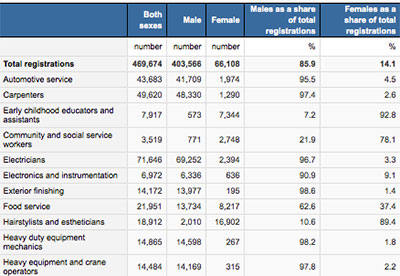
The provinces and territories reported 469,680 registrations in apprenticeship programs in Canada in 2013. Of these, more than three-quarters were apprentices continuing their programs from the previous year (already registered), about one-fifth were new registrations in 2013, and the remainder were people reinstated in a specific trade over that year.
Men accounted for more than 85% of registrations, while just over 14% were female. In some trades, males made up almost all registrations in the group. For example, in the refrigeration and air conditioning trade, 99.1% of all training participants were males. In turn, females accounted for 89.4% of registered apprentices in the hairstylists and estheticians trade group.
In 2013, four trade groups (electricians, carpenters, plumbers, pipefitters and steamfitters, and automotive service technicians) were the most common choices for male registered apprentices. Together, these four trade groups accounted for just over half of all male apprentices.
In 2013, 7 in 10 (70.9%) female registered apprentices were in four of the major trade groups: hairstylists and estheticians, user support technicians, food service, and early childhood educators and assistants. The first two groups accounted for almost half of the female registrations (47.4%).
Of the 71,646 registrants in electrician apprenticeship programs across Canada, males represented 96.7% (69,252); females, 3.3% (2,394).

Just over 65,000 certificates were awarded to apprentices and trade qualifiers in 2013. More than 7 in 10 of these certificates were issued to apprentices. This compares with 27.8% issued to trade qualifiers.
The majority of registrations (77.3%) were in apprenticeship programs where the associated trade had a Red Seal designation at the national level. Already registered apprentices in trades with the Red Seal designation accounted for 6 in 10 registrations. About 15% were new registrations in Red Seal designated trades, and 1.5% were reinstatements (apprentices who had left an apprenticeship program in a previous year and had returned to the same program during the current reporting period).
By comparison, 22.7% of all registrations were in trades without Red Seal designation. Of these, 17.2% were apprentices who were already registered in the apprenticeship program the previous year, while 5.4% were new registrations in 2013.
The 10 Red Seal trades with the highest number of registrations accounted for half of all registrations in 2013. Among these Top 10 Red Seal trades, construction electricians and carpenters accounted for more than 20% of overall registrations.
Almost 23,000 of the certificates issued in 2013 had the Red Seal endorsement.
Source: Statistics Canada, http://www.statcan.gc.ca/daily-quotidien/151026/dq151026a-eng.htm?cmp=mstatcan.




![Guide to the Canadian Electrical Code, Part 1[i] – A Road Map: Section 52 — Diagnostic imaging installations](https://electricalindustry.ca/wp-content/uploads/2022/11/Guide-CE-Code-2-768x432.png)