Heating with Electrical Resistance, Part 1
Electric resistance heat (ERH) is a safe and simple solution for many heating needs, and frequently offers meaningful advantages over other sources of heating. When used in residential, commercial or industrial applications, ERH provides a comfortable, efficient, and affordable heating option that is often the preferred method.
One of the most attractive characteristics of ERH is its relative simplicity of use, which involves only two basic steps:
• Supply electricity to an electric heater
• Add a thermostat (either built-in or wall-mounted) for temperature control
Electric heat provides warmth directly to individual rooms, making them ideal for zone or complementary heating, which means only the rooms that are actually used receive heat. Low-traffic or unused rooms can be kept at a lower temperature when not used, while the comfort of primary areas is maintained.
While the basic physics have remained the same since its invention more than one hundred years ago, ERH technology continues to evolve. Today, new innovation provides opportunities for ERH to march boldly into the future.
One of the primary purposes of this NEMA white paper is to provide an overview of recent developments in the world of ERH. We’ll begin with a high-level exploration of the different types of electric heating options. Then, we’ll review the common attributes of ERH, including its comfort, efficiency, and flexibility of use. To wrap things up, we’ll share a case study of electric heat used in “green” homes.
What is electric resistance heat?
In simple terms, electric resistance heat warms working and living spaces using convection heaters such as baseboards or fan-forced heaters.i While there are a variety of technical approaches available to consumers in the market, they all rely on the same basic physical property: passing an electrical current through a resistor converts electrical energy into heat.ii All ERH products rely on this same fundamental physical concept.
A lesson on heat transfer
From a physics perspective, heat may be transferred by three different methods: conduction, convection, and radiation. Let’s review each.
• Thermal conduction.Heat is transferred via conduction when a cooler object comes into physical contact with a warmer object. A typical example of heat transfer by way of conduction is a pot of cold water growing warmer as it sits on a hot electric stove.
• Thermal convection. Natural convection occurs when an object is heated to a temperature warmer than the air surrounding it. As the air near the object warms, it rises. Cooler air takes its place to continue the heating process. Electric baseboard heaters use this natural convection to transfer heat from warm resistive elements into room air. Fan-forced heaters use forced convection to accelerate the process by artificially circulating warm air, but the technology is still based on the naturally occurring principle.
• Thermal radiation.Radiation is a process by which energy, in the form of electromagnetic waves (e.g., visible light, infrared), travels from a heated surface directly and rapidly to objects in the path of those waves. Unlike conductive and convective heating systems, radiant heating systems do not heat air, but rather objects. It is similar to how we feel the sun’s heat. Ceramic and quartz radiant panels are examples of this method. Although floor cables and ceiling panels are often described as “radiant,” they actually combine conduction (through direct contact with feet), convection (by heating the air), and radiation.
Popular residential and commercial heating products
Electric baseboard
Electric Baseboards are the most common electric heaters, and use the convection method to quietly circulate warm air in a room. As the heating elements get warm, air naturally rises, pulling cooler air behind it across the warm elements. Baseboard heaters are often installed below a window, as in the picture below, to counteract the effect of cold air coming into the room.
Figure 1. Electric baseboard unit under window
Typically, homes or offices using electric baseboard heaters are controlled by unique thermostats, sometimes with one in each room or space. This provides people with a great degree of flexibility and operational efficiency, allowing them to heat only those rooms they occupy, and thereby saving both energy and money.
Fan-forced/ducted
Figure 2. Electric resistance wall heater
Fan heaters include an electric fan to quickly transfer energy from the electric heating element to the room. Fan heaters in a bathroom or bedroom allow for quick warm-up of a room when the overall home temperature may be kept at lower levels. This guarantees comfort where and when consumers need it, while maintaining efficiency. Many wall heaters, such as the one shown above, have a built-in thermostat for greater ease-of-use and temperature stability.
In addition to fan heaters, ERH can be packaged into a blower cabinet and installed with ductwork to provide heat to larger areas, such as an entire house. Sometimes this application is paired with an electric heat pump or air conditioner to supply both heating and cooling. An even greater level of efficiency can be achieved if a fan-forced electric heater or thermal storage heater is interfaced with an electric heat pump. A heat pump typically draws energy from outside air and uses it to heat or cool the room. When paired with an electric heater, a heat pump can be utilized during much lower outdoor temperatures, thereby increasing efficiency and reducing the total energy required for heating.
Radiant heat
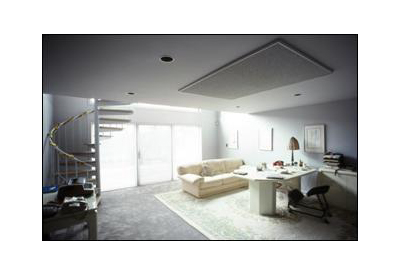
Radiant electric resistance heat comes in several varieties including quartz and ceramic element heaters, which are typically used in three-season rooms and outdoors. Other varieties include floor cables and ceiling panels, which can be used throughout the home. Quartz and ceramic heaters directly heat objects, so even when the ambient air temperature is low, those within range still feel comfortable. Radiant floor cables combine conductive energy (through direct contact with occupants’ feet) with radiant heating and convective airflow. Ceiling panels provide a similar combination of radiant and convective heating, but without the conductive heat from direct contact (e.g., radiant flooring). Energy efficiency is achieved because overall ambient air temperatures can be kept lower and occupant comfort still maintained.
Figure 3. Radiant ceiling panel in home office
Electric thermal storage
Some utilities offer discounts when the demand for electricity is relatively low and, conversely, charge more when the demand for electricity is relatively high. Electric thermal storage systems (ETS) take advantage of these rate structures by heating a storage medium, often water or bricks, during low-cost times, and releasing the stored heat on-demand when the rates peak. This avoids the consumption of electricity when it is more expensive.
More recently, a new variety of ETS application has appeared called grid-interactive electric thermal storage or GETS. This product performs like traditional ETS products except that it is capable of two-way communication with the local utility. Earlier generation ETS products were only capable of one-way communication from the utility to the appliance. Two-way communication affords a whole new level of control for the utility, and opens the door for additional services and efficiencies (e.g., electric grid load balancing, storage of excess renewable energy). Energy storage is increasingly important to allow the integration of more renewable generation. ETS space and water heaters have proven to have a long, maintenance-free life—typically 25 years—and are relatively inexpensive.
Markets and applications
Electric heat is commonly used in residential, commercial, and industrial applications.iii In any situation, ERH may be the primary heating system or may be used to supplement another system. ERH is often used in commercial applications to offset the size of forced-air furnaces. This allows for a smaller capacity unit to be used, with electric heating providing supplemental heat on only the coldest days of the year or in the coolest areas of the building. Additionally, multi-family housing builders are increasingly turning to electric heat to efficiently allow their tenants to control their comfort level.

Figure 4. Example of ERH wall heater supplementing main heating system
Part 2 of “Market Benefits of Electric Resistance Heat” explores common attributes of electric resistance heat, including its comfort, efficiency, and flexibility of use. It also includes a case study of electric heat used in “green” homes.
Notes
i ERH is also used in a number of applications other than space heating, including activities like ovens for drying painted products (car parts for instance) and the environmental remediation of hazardous waste sites. This paper, however, will focus only on the residential and commercial space heating aspects of ERH.
ii http://en.wikipedia.org/wiki/Electric_heating – Environmental_and_efficiency_aspects
iii ERH is also used extensively in industrial applications but, as noted above, this NEMA White Paper is focused on residential and commercial space heating applications.
Appendix
This white paper was developed by the NEMA Electric Resistance Heating Section of the National Electrical Manufacturers Association. Section approval of the white paper does not necessarily imply that all section members voted for its approval or participated in its development. At the time it was approved, the Electric Resistance Heating Section was composed of the following members:
• Cadet Manufacturing Company Vancouver, WA
• Dimplex North America Ltd. Cambridge, ON
• Emerson Rosemont, IL
• Marley Engineered Products Bennettsville, SC
• Steffes Corporation Dickinson, ND
• Stelpro Design Inc. St. Bruno-de-Montarville, QC
• TPI Corporation Johnson City, TN
(This version of the document was approved on the NEMA website February 27, 2015.)

![Guide to the Canadian Electrical Code, Part 1[i], 26th Edition– A Road Map: Section 74 — Airport installations](https://electricalindustry.ca/wp-content/uploads/2026/05/EIN-Stock-Guide-Code-Canada-Map-1200-768x403.png)




![Guide to the Canadian Electrical Code, Part 1[i], 26th Edition– A Road Map: Section 74 — Airport installations](https://electricalindustry.ca/wp-content/uploads/2026/05/EIN-Stock-Guide-Code-Canada-Map-1200.png)