The Sun Is Rising on Solar in Canada
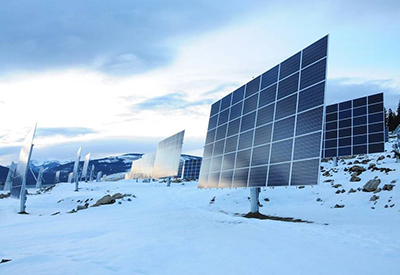
In BC, the site of what once was Canada’s largest lead and zinc mine is now being used to mine sunshine.In June, SunMine, near Kimberley, began feeding energy into BC Hydro’s grid, making it one of BC’s first grid-connected solar photovoltaic (PV) installations and one of Western Canada’s largest solar projects. Using just eight hectares of land, more than 4,000 solar PV modules generate roughly 1 megawatt (MW) of electricity, enough to power about 200 homes, according to Scott Sommerville, Chief Administrative Officer for the City of Kimberley, which now owns the site.
“It’s pretty awe-inspiring when you’re up there, looking at it. It kind of feels like you’re seeing the future,” he says.
The SunMine is built on land used by the former Sullivan Mine, shuttered in 2001, and it is a hotbed of solar potential. The site has one of the highest solar energy intensities in Canada (2,200 hours of annual sunshine, averaging six hours per day), guaranteeing reliable energy production.
Making the site even more attractive for the project is its infrastructure, including roads, high-voltage transmission lines and sub-stations, which were re-fashioned for use by SunMine. Teck, the former mine owner, provided the land as well as $2-million of the $5.3-million cost.
“We like to say we’ve gone from a brownfield to a brightfield. We took land that was dormant and created something,” says Sommerville, who adds that there’s enough land at the SunMine to install up to 200MW worth of modules — enough to power 40,000 homes.
While SunMine is still in the early stages of development, it is a significant project. Not only is it the largest project of its kind in western Canada, it is also one of the largest outside of Ontario, where the lion’s share of Canada’s solar capacity has been installed under the province’s feed-in tariff program.
Established in 2009, the program pays premium rates to businesses and property owners to feed wind- and solar-generated electricity into the grid. Today, the province is up to 19,200 grid-connected PV systems, which generated 1.2 gigawatts (GW) of electricity in 2013.
Noteworthy but much smaller projects also exist further north in the territories, where PV systems work better due to the cool climate.
“There’s way better payback,” says Gordon Howell, a professional engineer and managing principal of Howell Mayhew Engineering in Edmonton.”Electronics like cold and don’t like heat.”
Howell, who has worked in the solar industry for 32 years, has been working on the installation of off-grid PV systems at eight remote telecommunications sites in Yukon and the Northwest Territories, replacing diesel as a fuel source for generating electricity.
When a working solar cell reaches 70 degrees Celsius, the 250-watt PV module will operate at 205 watts, an 18% drop. At a cell temperature of 0 degrees, the 250-watt PV module will operate at 273 watts, 9% better.
Today’s solar PV systems are also long-lasting and adaptable, remaining 80% effective after 25 years. They can be installed on mountaintops, and in windy, humid or salty conditions. They even undergo hail tests, with 25 millimetre steel balls travelling at 80 kilometres per hour used to simulate storms.
“I’m stunningly optimistic about the future,” says Howell.
Internationally, Germany remains the biggest star on the solar stage. According to an annual 2014 International Energy Agency (IEA) report, Germany possessed 38GW of PV capacity. The U.S. has about 16GW of installed capacity. China has made gigantic strides, going from 0.8GW of PV capacity in 2010 to 32GW by March 2015. By the end of 2014, cumulative PV capacity worldwide reached roughly 177GW, enough to supply one percent of the world’s electricity requirements, according to the IEA.




![Guide to the Canadian Electrical Code, Part 1[i] – A Road Map: Section 52 — Diagnostic imaging installations](https://electricalindustry.ca/wp-content/uploads/2022/11/Guide-CE-Code-2-768x432.png)