Guide to the Canadian Electrical Code, Part I — Instalment 6
William (Bill) Burr
The CE Code is a comprehensive document. Sometimes it can seem quite daunting to quickly find the information you need. This series of articles provides a guide to help users find their way through this critical document. In this article: Section 10 — Grounding and bonding.
Section 10 — Grounding and bonding
Section 10 is a general section of the Code and applies to all installations unless amended by other Sections of the Code. It’s Scope outlines requirements for:
• grounding of electrical systems and service equipment
• bonding of non-current-carrying metal parts of equipment and conductor enclosures, together and to ground
• the use of ungrounded systems and neutral grounding devices
Special terminology used in this section and found throughout the code include bonding, bonding conductor, ground, ground fault, ground fault detection, ground fault protection, grounded, grounding, grounding conductor, grounding electrode, and grounding system.
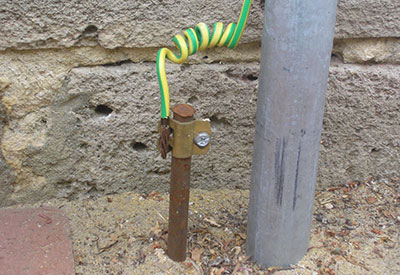
These are all thoroughly defined in Section 0. In general terms, bonding refers to a low impedance permanent connection of all non-current-carrying metal parts together, and grounding refers to a permanent low impedance connection to the earth.
The stated object of Section 10 is to provide rules for
• bonding metal parts and systems together and to the grounded system conductor to reduce the danger of electric shock and property damage, providing a low impedance path for fault current back to the source, and establishing an equipotential plane to minimize potential difference between non-current carrying metal parts
• grounding the electrical system and bonding of non-current carrying metal parts to earth to minimize any potential difference to earth
• using an ungrounded system or a neutral grounding device in the system to provide alternates to a solidly grounded system, and minimizing any damage from a single fault by limiting the magnitude of the fault current.
System and circuit grounding rules 10-102 to 10-116 provide guidance on when and where, as well as exceptions to, grounding specific two-wire dc systems, three-wire DC systems, AC systems, electric arc furnaces, electric crane circuits, isolated circuits, circuits of less than 50V, and instrument transformer circuits.
Once you have determined your specific grounding needs, Grounding connections for systems and circuits rules 10-200 to 10-212 provide specific detailed guidance on how to ground various systems. Appendix B also contains some helpful diagrams.
Conductor enclosure bonding rules 10-300 to 10-304 are guidelines for when and where to bond metal enclosures for service conductors, underground service conductors, as well as enclosures for other than service conductors.
Equipment bonding rules 10-400 to 10-414 provide the varying requirements for when and where to bond all metal non-current carrying parts of fixed equipment general, fixed equipment, specific, non-electrical equipment, portable equipment, instrument transformer cases, cases of instruments, meters, and relays-operating voltage 750v or less, cases of instruments, meters, and relays-operating voltage over 750V, as well as non-metallic wiring systems.
The Bonding methods rules 10-600 to 10-626 will guide you through the steps needed to ensure an effective continuous, low-impedance bonding connection when Bonding service equipment, Metal armour or tape of service cable, Bonding at other than service equipment, Loosely jointed metal raceways, bonding jumpers, short sections of raceway, fixed equipment, portable equipment, pendant equipment, bonding equipment to the grounded system conductor (bonding to ground), and electrolytic-type water heaters. Helpful suggestions are also contained in the Appendix B notes.
Rule 10-700 Grounding electrodes sets out the requirements for establishing a grounding connection through the use of electrodes. There are specific rules for various grounding electrodes including manufactured grounding electrodes (both rod electrodes and plate electrodes), field-assembled ground electrodes, and in-situ grounding electrodes forming part of the existing infrastructure. Rule 10-702 sets out spacing and interconnection requirements for grounding electrodes where more than one grounding electrode exists at the building including those electrodes used for signal circuits, radio, lightning protection, communication, community antenna distribution systems, and any other purpose. Rules 10-704 and 10-706 deal with railway track electrodes and the use of lightning rod system conductors and grounding electrodes.
Rules 10-800 to 10-820 are rules governing continuity, material selection, sizing, and installation of grounding and bonding conductors. The size of a grounding conductor is determined by the type of system, either AC or DC. The size of a bonding conductor as determined by Table 16A or 16B depends on the size of the associated circuit conductor (Table 16A) or on the size of the associated bus-bar (Table 16B).
Once you have installed the correct type and size of bonding and grounding conductor, pay close attention to the connection of these conductors as specified in rules 10-900 to 10-906 Grounding and bonding conductor connections. The continuity and safety of a low-impedance path to reduce the danger of electric shock and property damage, and providing a low impedance path for fault current back to the source, depends on adequate and sound connections.
The final two subjects of Section 10 deal with grounding and bonding of lightning arresters and the installation of neutral grounding devices.
In the next installment we will be discussing Section 12 — Wiring methods.
Read the rest of the instalments in the series:
Part 1: Guide to the CE Code, Part I – A Roadmap (Installment 1 in a Series)
Part 2: A Road Map to the CE Code, Part I – Installment 2
Part 3: Guide to the Canadian Electrical Code, Part I – Installment 3
Part 4: A Road Map to the CE Code, Part 1 – Installment 4
Part 5: Guide to the Canadian Electrical Code, Part I — Installment 5
Part 6: Guide to the Canadian Electrical Code, Part I — Installment 6
Part 7: Guide to the Canadian Electrical Code, Part I — Installment 7
Part 8: Guide to the Canadian Electrical Code, Part I — Installment 8
Part 9: Guide to the Canadian Electrical Code, Part I — Installment 9
Part 10: Guide to the Canadian Electrical Code, Part 1 – Installment 10
Part 11: Guide to the Canadian Electrical Code, Part 1 – Installment 11
William (Bill) Burr is the former Chair of the Canadian Advisory Council on Electrical Safety (CACES), former Director of Electrical and Elevator Safety for the Province of BC, and former Director of Electrical and Gas Standards Development and former Director of Conformity Assessment at CSA Group. Bill can be reached at Burr and Associates Consulting billburr@gmail.com.

![Guide to the Canadian Electrical Code, Part 1[i], 26th Edition– A Road Map: Section 74 — Airport installations](https://electricalindustry.ca/wp-content/uploads/2026/05/EIN-Stock-Guide-Code-Canada-Map-1200-768x403.png)



![Guide to the Canadian Electrical Code, Part 1[i], 26th Edition– A Road Map: Section 74 — Airport installations](https://electricalindustry.ca/wp-content/uploads/2026/05/EIN-Stock-Guide-Code-Canada-Map-1200.png)