November 2015 Investment in Residential Housing Construction Up 2.2% YOY
Jan 28 2016
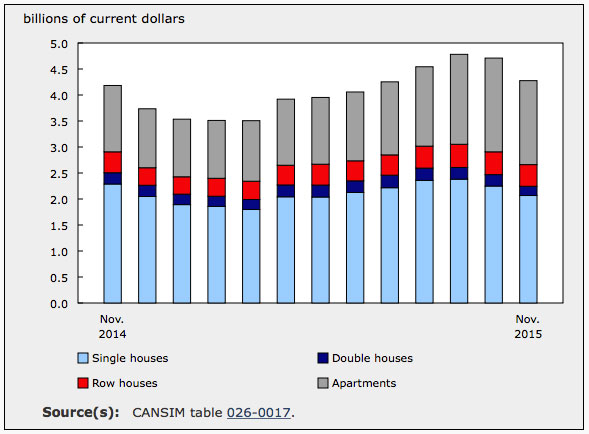
Investment in residential construction rose 2.2% to $4.3 billion in November compared with the same month in 2014. Higher construction spending on apartment and apartment-condominium buildings largely explained the advance. Gains in three provinces, led by Ontario, more than offset the declines in the other seven provinces. Nearly two of every five dollars spent on residential investment was dedicated to apartment and apartment-condominium building construction.
Chart 1: Investment in new housing construction, by type of dwelling
New housing investment led by apartment and apartment-condominium buildings
Nearly two of every five dollars spent on residential investment was dedicated to apartment and apartment-condominium building construction. Investment spending on apartment and apartment-condo buildings increased 26.6% year over year to $1.6 billion.
The investment for row-house dwelling construction was $416 million in November, up 3.4% compared with the same month in 2014.
Construction spending on single-family dwellings declined 9.6% to $2.1 billion, while construction spending on semi-detached dwellings was down 17.9% to $178 million from November 2014 levels.
Ontario posts largest advance in new housing investment
In November, the value of new housing construction increased in three provinces, led by Ontario and British Columbia. Ontario recorded the largest increase by far, with substantial gains in construction spending. Alberta posted the largest decrease.
Investment in new residential construction in Ontario rose 23.1% year over year to $1.7 billion. Higher investment in apartment and apartment-condo buildings and in single-family dwellings largely explained the advance.
In British Columbia, construction spending rose 13.9% to $784 million in November compared with the same month in 2014. The gain was largely the result of higher construction spending on apartment and apartment-condo buildings and, to a lesser extent, single-family dwellings and row houses.
In Alberta, investment in residential construction amounted to $818 million in November, down 15.7% year over year.
Table 1: Investment in new housing construction, by province and territory 
Source: http://www.statcan.gc.ca/daily-quotidien/160121/dq160121d-eng.htm?cmp=mstatcan.



![Guide to the Canadian Electrical Code, Part 1[i] – A Road Map: Section 52 — Diagnostic imaging installations](https://electricalindustry.ca/wp-content/uploads/2022/11/Guide-CE-Code-2-768x432.png)