Canada’s First Utility-Scale Storage System “Islands” Remote BC Town
January 25, 2017
An innovative community microgrid solution from S&C Electric Canada Ltd. now brings reliable power to the remote town of Field, British Columbia. Since going live, the system has saved Field from power outages due to tree falls, car accidents, avalanches and fires for a combined 126 hours. The longest single duration was 22 hours. This system has the potential to be replicated and adapted to other remote communities that could benefit from this technology. Read on to find our more about the challenges and the solution.
Nestled in the Canadian Rockies, the remote town of Field relies on one 25-kV distribution feeder, provided by BC Hydro, to supply its 300 residents with power. But providing reliable power to Field is challenging. Not only is the town located 55 km from the substation, the feeder runs along a railway line, making access and repair work difficult, time consuming, and costly.
Due to the geography and climate, faults frequently affect the power line, causing extended outages. Crews must coordinate with the rail system to avoid trains and travel along the rail route to locate the fault and repair the line, often in formidable weather. These factors result in longer than average response times for power restoration, impacting every resident in the town.
BC Hydro needed an innovative energy storage technology solution that could swiftly respond to faults by supplying reliable power to Field for extended periods, giving crews time to repair the line and minimizing service disruptions. Not only did BC Hydro seek improved power reliability for Field through “islanding,” they wanted to reduce peak load, use clean power to cut greenhouse gas emissions, extend the lives of transformers, and eliminate the need for diesel backup generators — all within a set budget.
S&C Solution
BC Hydro chose S&C for the project because of the company’s extensive experience with large-scale, battery-based energy storage systems. S&C proposed a complete energy storage solution, including all engineering, procurement, and construction services.
The solution enabled BC Hydro to achieve all of their goals, from islanding to using clean power. S&C’s proposal also helped BC Hydro to obtain 50% of the project’s funding from Natural Resources Canada (NRC).
S&C’s solution includes
- a 1-MW NGK sodium-sulfur (NaS) battery
- an S&C PureWave Storage Management System (SMS), which controls battery charging and discharging
- S&C’s IntelliRupter PulseCloser for fault detection
- S&C’s System VI Switchgear
- S&C’s IntelliTeam SG Automatic Restoration System for peak shaving and transitions between the battery and grid
- S&C SpeedNet radios, which provide fast, two-way communication to help speed restoration
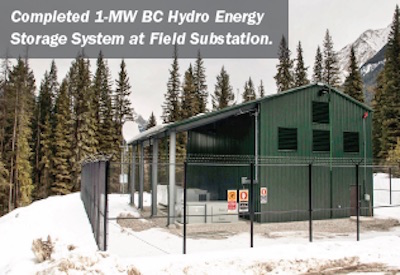
 The first of its kind in Canada, BC Hydro’s battery storage facility is 5 km south of Field and supplies uninterruptible power to the entire town for approximately seven hours during feeder related outages. Due to extremely cold temperatures, the battery is housed in a prefabricated building. When the demand in Field is low, the battery charges from the grid. This ensures the system is available to supply power during outages or use for peak shaving. When a fault occurs, S&C’s IntelliRupter detects and isolates the upstream fault while signalling the PureWave SMS to start discharging battery power, a seamless process that takes seconds.
In addition to providing islanding, the battery is scheduled through the PureWave SMS to supply power during peak demand periods. This added capacity lessens the load on system components, extends the life of transformers at the main substation, and reduces greenhouse gas emissions by eliminating the need for diesel-powered backup generators.
Valued outcome
S&C’s energy storage solution met all of BC Hydro’s expectations, and the project was completed on time and within budget. Field residents now have reliable, clean power available for islanding, greatly reducing outage durations while also reducing the peak demand of the town.
In the first six months of system operation, six major events occurred, ranging from trees falling on the lines to broken poles. Each time, S&C’s system operated flawlessly to avoid an outage, supplying Field with battery power for a total of 40 hours over just six months. In fact, during the facility’s ribbon-cutting ceremony, a line fault occurred when a feeder pole was broken. S&C’s solution quickly demonstrated its value by islanding the town for eight hours until grid power was restored.
This pivotal project promises to accelerate the adoption and integration of innovative energy storage technologies into Canada’s grid.

![Guide to the Canadian Electrical Code, Part 1[i], 26th Edition– A Road Map: Section 74 — Airport installations](https://electricalindustry.ca/wp-content/uploads/2026/05/EIN-Stock-Guide-Code-Canada-Map-1200-768x403.png)




![Guide to the Canadian Electrical Code, Part 1[i], 26th Edition– A Road Map: Section 74 — Airport installations](https://electricalindustry.ca/wp-content/uploads/2026/05/EIN-Stock-Guide-Code-Canada-Map-1200.png)