Always Online, Even On the High Seas…
Feb 26, 2018
By Joscha Duhme and Patricia Späth
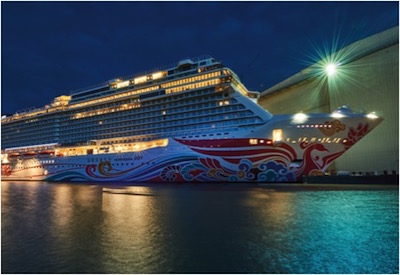
IT requirements on board cruise ships are increasing. The Meyer Werft shipyard uses Rittal data centres to ensure fast, standardized and fail-safe operations on the Norwegian Joy, so that Canadians can now cruise with extra peace of mind.
Almost 4,000 passengers can be accommodated on the Norwegian Joy. They all have access to digital entertainment, use cashless payment systems, and play in the vast casinos on board. This places demands on the IT systems in the background:
• 1,821 crew members on board access areas such as passenger management, use satellites for navigation, order food online and monitor the engines.
• 21 technology rooms on the cruise ship are each equipped with three IT racks and two air/water heat exchangers.
For the confident fortune hunters, today could well be their lucky day. The one-armed bandits rattle along, with cherries and dollar bills on rotating rollers racing through the viewing windows of the games machines. Animated voices reverberate around the room, and all the tables are full. The jackpot seems within reach.
Viva Las Vegas, or so you might think. Yet this Eldorado for casino fans isn’t located in Nevada but on the high seas, on board the “Norwegian Joy.”
The world’s fourth largest cruise ship comes from the Meyer Werft shipyard in Germany. The Papenburg-based shipbuilder, which has also been producing tankers and freighters for over 25 years and is a world leader, knows these requirements exactly. “As well as larger cabins for whole families, customers also expect larger casinos,” explains Frank Langen, Technical Design Department at Meyer Werft. And it’s not just a matter of accommodating them on the ship. Such entertainment offerings also place demanding requirements on IT systems to enable smooth operations, monitoring, play and settling up.
The IT needs are like those of a small town
IT is now a key factor for these floating small towns, which are increasing in number and have larger capacity. Passengers’ demands for digital leisure activities are also increasing. For many people, the ship, which is like a floating theme park, is the actual holiday destination, less so the ports and places it docks at. The Norwegian Joy even has its own go-kart track on board. A floating ecosystem of this kind thus needs to offer maximum comfort. Video on demand in the cabin, mobile Internet access and cashless payments are almost a given for many passengers. The crew also uses satellite navigation on the bridge, central payment systems in the on-board restaurants and continuous monitoring of performance data in the engine room. These types of services are inconceivable without high-performance on-board data centres.

Although installing a data centre is just one of numerous design challenges for the shipyard, large amounts of expertise are every bit as necessary for the IT systems as they are for fitting out the 1,925 cabins on the 333-metre-long ship.
Ships are becoming bigger and bigger with every year that passes. Yet the space on board a passenger ship for technology rooms and data centres to support profitable cabins and restaurants is very limited. Repairs to the IT infrastructure hundreds of nautical miles from the nearest port are also only possible to a limited extent. “During a voyage, parts must therefore be easy to replace. The IT system supplier should also offer technical service in the ship’s destination countries,” says Langen.
Racks withstand vibrations
“The large diesel engines create continuous vibrations, with the result that special rubber bearings are needed to protect the IT racks. The ship’s movements on the open sea also need to be compensated for accordingly. Temperature and humidity too may fluctuate widely depending on the location,” says Wilfried Braun, Key Account Manager at Rittal, referring to additional difficulties that IT suppliers need to overcome on ships. Rittal designed the data centers for the Norwegian Joy. “We’ve been working successfully with Rittal for years. During this time, we’ve repeatedly collaborated to develop clever solutions for failsafe and space-saving installation of sensitive IT components on ships,” says Frank Langen, Technical Design Department, at the Meyer Werft shipyard.
Compact installation is thus one of the key requirements, as is autonomous operation of data centres and the ability to handle systems by on-board engineers. The long service life of the ship, which is intended to remain at sea for up to 25 years, requires high-quality components for IT equipment. Other factors include excellent flexibility, scalability and exchangeability of IT modules, as ships are often retrofitted depending on the destination area, as with the development of the Norwegian Joy for global markets.
Series enclosures for series-produced ships
Up to six ships in its class are planned at the Meyer Werft shipyard, with outer shells that are around 95% identical and use modular assembly. “In designing the IT infrastructure, a high level of standardization is thus also necessary to install the server racks, cooling and power supply quickly and easily,” explains Braun.
Failure of the IT systems could lead to acute safety risks and chaos at sea. That’s why the Norwegian Joy has two redundant and separate data centres in different fire zones. The ship has over 25 technology rooms that each house three IT racks and two air/water heat exchangers for IT cooling.
“These cooling units are actually designed for industrial environments, but have proven to be an ideal solution for cooling distribution rooms thanks to their minimal space requirements and air routing,” explains Braun.
Conventional cooling concepts are used in the data centres. The IT rooms have up to 10 TS IT racks from Rittal. The racks are sealed and are climate-controlled using liquid-based cooling systems in the LCP series (LCP = liquid cooling package) with output up to 30 kW. The cooling units are mounted directly on the side panels of the racks. The warm air of the servers can thus be cooled directly and the entire system works extremely efficiently. The warm waste air is cooled using cold water provided by the ship’s redundantly designed water circuits. The ship’s own chillers supply sufficiently cool water for this purpose. The same applies to the power supply, as Langen explains: “Five large diesel engines with five generators ensure uninterrupted power for the entire ship.”
Twofold IT systems
The IT output needed on the ship covers very different services, ranging from administrative software to telephone networks.
Typically, communications are handled in the data centre, such as the DECT telephone systems for the crew and the telephone and WLAN networks. The entertainment and casino systems, software for enterprise resource planning, hotel operations, catering and payment systems are also operated there. “All nautical shipping equipment on the bridge and safety-related ship systems are completely separate from these IT systems,” says Langen.
New IT technologies are continually coming onto the market that also need to be installed on ships. “Almost every year, the multimedia applications on board change, WLAN use increases and cashless payments are requested. That’s why we need a high level of flexibility in the data centre to support future trends, too. Rittal has supplied us with a future-proof infrastructure for the data centre to meet these requirements,” says Langen.
“Anyone looking to succeed as a supplier in the shipbuilding industry also has to offer special services for maintenance and repair,” says Braun. Rittal provides a worldwide warranty for the ship data centre components. This is enhanced by global support for servicing so as to enable supplies of spare parts throughout the world, for example. Across the globe, 58 subsidiaries ensure rapid availability in every region on Earth.
Comfort is not just demanded for passengers. The engineers who deal with IT also need concepts that support rapid installation and efficient maintenance of data centres. This applies both on the high seas and to data centres on land.
Canadians love the Norwegian Joy
Canadians love cruising on the Norwegian Cruise Line, an innovator in cruise travel with a 50-year history of breaking the boundaries of traditional cruising, most notably with the introduction of Freestyle Cruising that revolutionized the industry by giving guests freedom and flexibility to design their ideal cruise vacation. Why? Cruising on Norwegians means no fixed dining times, relaxed attire, several distinct dining options, relaxed disembarkation, and more lounges, bars, theatres and other entertainment and activity options.
Norwegian offers itineraries in all areas of the world, including the Caribbean, Bahamas, Bermuda, Mexican Riviera, Europe, South America, Canada and New England, Panama Canal, Alaska, Asia, Australia and New Zealand. Recently, the line was named “Europe’s Leading Cruise Line” for the ninth consecutive year, as well as “Caribbean’s Leading Cruise Line” for the fourth time and “World’s Leading Large Ship Cruise Line” for the fifth year by the World Travel Awards.
Joscha Duhme is an editor; https://www.xing.com/profile/Joscha_Duhme/cv. Patricia Späth is a marketing consultant for Rittal; https://www.xing.com/profile/Patricia_Spaeth/cv

![Guide to the Canadian Electrical Code, Part 1[i], 26th Edition– A Road Map: Section 74 — Airport installations](https://electricalindustry.ca/wp-content/uploads/2026/05/EIN-Stock-Guide-Code-Canada-Map-1200-768x403.png)





![Guide to the Canadian Electrical Code, Part 1[i], 26th Edition– A Road Map: Section 74 — Airport installations](https://electricalindustry.ca/wp-content/uploads/2026/05/EIN-Stock-Guide-Code-Canada-Map-1200.png)