Registered Apprenticeships Declined from 2015 to 2016
June 18, 2018
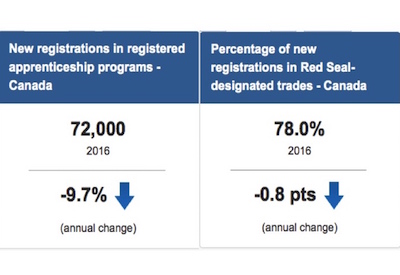
In 2016, 417,300 individuals were registered in apprenticeship programs in Canada, down from 455,900 in 2015. Of the 2016 total, new registrants accounted for approximately 72,000 registrations, while 337,450 were already registered in an apprenticeship program prior to 2016. Another 7,850 were reinstatements — individuals returned to the apprenticeship program that they had left in a previous year.
Apprenticeship training programs play a key role in preparing Canadians for a career in trades. Through this training, tradespeople acquire the skills to support industries that drive Canada’s economy. Apprenticeship training and trade qualifications in Canada are governed by provincial and territorial jurisdictions.
New registrations down in every province and territory
Among the three categories of registration, individuals newly registered to an apprenticeship program category had the biggest drop over the previous two years, falling from 93,400 in 2014 to 72,000 in 2016 (-23%). While the numbers of new registrants declined in every province and territory, Alberta (-45%) had the largest drop, down 11,000 from 2014 to 2016. This was the largest decrease in both absolute and relative terms among the provinces and territories, representing half of the national decline.
Over the same period, Alberta’s economy continued to adjust to a significant drop in crude oil prices, which fell by nearly 40% from June 2014 to December 2016. Alberta’s annual unemployment rate also nearly doubled, from 4.7% in 2014 to 8.1% in 2016, something which likely affected the availability of apprenticeship positions needed for apprentices to complete their program. Since the ability to undertake an apprentice program is linked to the availability of such positions, this might have affected the number of new registrations in Alberta over this period.
The resource-rich provinces of Saskatchewan (-37%) and Newfoundland and Labrador (-36%) reported the second and third largest decreases in new registrations from 2014 to 2016.
Red Seal-designated trades account for most new registrations in 2016
The Interprovincial Red Seal Program is the Canadian standard for skilled trades and allows tradespeople to have their skills recognized across the country. In 2016, almost 8 in 10 new registrations were in apprenticeship programs where the associated trade had a Red Seal designation. Provincially, new registration for the Red Seal Program ranged from 53% in Quebec to 98% in Newfoundland and Labrador. Trades with this designation accounted for over 90% of new registrations in 2016 for the Atlantic provinces (on average 95%), Saskatchewan (92%), Alberta (95%) and the territories (95%).
Among the Red Seal trades, the top three trades were construction electricians (15%), carpenters (13%) and automotive service technicians (7%), accounting for 35% of new registrations in 2016 at the national level.
Ontario recorded the highest number of new registrations (15,600) in Red Seal trades, followed by Alberta (12,900), Quebec (10,400) and British Columbia (10,000). These four provinces accounted for 87% of all new registrations in Red Seal trades in Canada.
Almost half of the certificates granted in 2016 had the Red Seal designation
The number of certificates awarded to individuals who completed the necessary steps to become qualified in a trade fell by 7%, from 59,400 in 2014 to 55,200 in 2016. Of certificates granted in 2016, 71% were issued to apprentices, while 29% were issued to trade qualifiers. Just under half (45%) of the certificates granted in 2016 had the Red Seal designation, figures comparable with both 2014 and 2015.
Despite modest gains, women are still underrepresented in apprenticeship programs
Women continued to be underrepresented among apprentices in 2016, accounting for 12% of all registrations. Just over half of female apprentices (52%) were registered in three major trade groups: hairstylist and estheticians (27%), food services (16%) and early childhood educators and assistants (10%). Of the certificates awarded to apprentices in 2016, 13% were granted to women.
Women accounted for 14% of new apprenticeship registrations in 2016 and represented a majority in 4 of 24 major trade groups: early childhood educators and assistants (94%), community and social service workers (90%), hairstylists and estheticians (89%) and user support technicians (53%).
Over the last decade, there has been an increase in the number and percentage of women pursuing apprenticeship programs other than the hairstylist and esthetician trade. From 2006 to 2016, the percentage of new registrations for female apprentices fell among hairstylists and estheticians (from 41% to 30%), while it increased in trades such as food services (from 11% to 21%) and, to a lesser extent, electricians (4% to 5%).
Ontario had the highest proportion of female new registrants, accounting for 30% of all new registrations among women. The major trade group early childhood educators and assistants, which is only offered in Ontario, accounted for 8% of all new female registrations in Canada, and was the third-most popular major trade group among women in 2016.
Source: Statistics Canada, www150.statcan.gc.ca/n1/daily-quotidien/180528/dq180528c-eng.htm

![Guide to the Canadian Electrical Code, Part 1[i], 26th Edition– A Road Map: Section 74 — Airport installations](https://electricalindustry.ca/wp-content/uploads/2026/05/EIN-Stock-Guide-Code-Canada-Map-1200-768x403.png)





![Guide to the Canadian Electrical Code, Part 1[i], 26th Edition– A Road Map: Section 74 — Airport installations](https://electricalindustry.ca/wp-content/uploads/2026/05/EIN-Stock-Guide-Code-Canada-Map-1200.png)