Evolving Electric Vehicle Technology and the Response by EVEMS
EV Tech

May 5, 2019

EV TechBy David Corbeil

The definition of electric vehicle energy management systems — or EVEMS — is a recent addition to the Canadian Electrical Code. This addition allows for broader applications and answers to evolving electrical needs in the market with the uptake in electric vehicles. These devices are also commonly referred to as demand charge controllers, or DCCs.

The 2018 CE Code further recognized and addressed the evolving electric vehicle technology and issues associated with future loading on electrical infrastructure. Section 8 was expanded to include two new definitions:

    • Control of electric vehicle supply equipment loads — the process of connecting, disconnecting, increasing, or reducing power to [electric vehicle] supply equipment.

    • Electric Vehicle Energy Management System — a means of controlling [electric vehicle] supply equipment loads comprised of any of the following: a monitor(s), communications equipment, a controller(s), a timer(s), and other applicable device(s).

In many instances, the addition of electric vehicle supply equipment (EVSE) can result in the total load exceeding the existing service capacity. This is the main use case for the addition of EVEMS. A secondary option is to increase the service size but in practice, the cost is often prohibitive.

EVEMS technology is intended to limit and regulate the electrical loads when EVSE is installed to a load calculation at 100% of the rating. These devices dynamically and instantaneously control the EVSE loads in such a way that the overall load does not exceed the limits of the existing service, feeders, and branch circuits, with a tripping point generally set to 80% of available power.

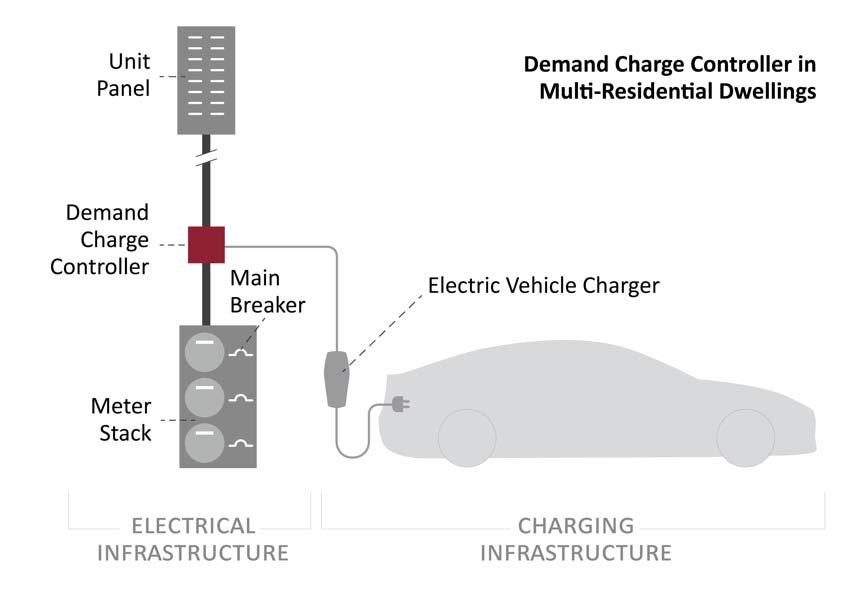
Multi-unit buildings pose additional constraints than those seen in single-dwellings and an EVSE in the form of a demand charge controller — a DCC — is implemented in these scenarios. These devices are connected to the main panel intercepting the connection in proximity to the electrical meter, often in an electrical room. By intercepting the connection at ground level, the overall footprint of the installation is kept to the minimum required.

An EVSE installed and controlled by a demand charge controller (DCC) is capable of summing static and variable loads and controlling the variable load so that the total power consumption does not exceed the circuit rating.

The application of a DCC is identical when an EVSE is added to an existing single-dwelling home with a load calculation at 100%.

 EV Tech


EVSE demand is unpredictably growing and the installation of DCCs is used in new constructions to mitigate the future impact on the residential service.

These types of devices are implemented in global retrofits for multi-unit dwellings, creating buildings ready to accommodate electric vehicles, or in new development plans to evade future upgrades and installations.

The cost benefits of this technology, in both retrofitting existing builds and in new construction, are significant for the building industry and the utility alike because maximum impact information on EVEMS technology is required at the design stage for any installation.

David Corbeil is the co-inventor of the DCC, Demand Charge Controller, and is the CEO at RVE, a company focused on residential electric vehicle charging solutions. He has considerable experience in the electric vehicle charging industry, beginning his career as an electrician, sits on the boards of the Association des Véhicules Électriques du Québec and Electric Mobility Canada. To get in touch: david@dcc.technology | www.dcc.technology

Related Articles


Latest Articles

  • Industrial Construction Intentions Drive Increase in Non-Residential Sector in January

    Industrial Construction Intentions Drive Increase in Non-Residential Sector in January

    March 13, 2026 In January, the total value of building permits issued in Canada increased $607.0 million (+4.8%) to $13.3 billion. The increase was led by the non-residential sector (+$464.0 million) and supported by the residential sector (+$143.0 million). On a constant dollar basis (2023=100), the total value of building permits issued in January rose 4.3% from the previous month Read More…

  • Multi-Unit Construction Drives Growth in December Residential Construction Investment, 2025 Review

    Multi-Unit Construction Drives Growth in December Residential Construction Investment, 2025 Review

    March 13, 2026 The total value of investment in building construction increased $442.9 million (+1.9%) to $23.7 billion in December. The residential sector grew 2.4%, while the non-residential sector edged up 0.6%. Year over year, investment in building construction grew 12.2% in December. On a constant dollar basis (2023=100), the total value of investment in building construction in December rose 1.7% Read More…

  • 5 Strategic Reasons to Attend the Lumen Exhibition

    5 Strategic Reasons to Attend the Lumen Exhibition

    March 13, 2026 In a market where deadlines are tight and projects are increasingly complex, staying competitive is no longer just about technical skills. It also depends on having the right tools, the right information, and the right partners by your side. The Lumen Exhibition is more than just an event—it’s a strategic lever designed to Read More…

  • BCCA Official Statement on Construction Projects Procurement Act

    BCCA Official Statement on Construction Projects Procurement Act

    March 13, 2026 On March 5, 2026, Kiel Giddens, MLA for Prince George – Mackenzie and Critic for Labour, introduced the Construction Projects Procurement Act, a Private Member’s Bill aimed at restoring fair and open procurement on public construction projects in British Columbia. BCCA has a long history of advocating for fair and open public procurement. Read More…


Changing Scene

  • Nova Scotia Strengthens Housing Legislation to Accelerate Supply

    Nova Scotia Strengthens Housing Legislation to Accelerate Supply

    March 13, 2026 Amendments to existing legislation will mean more housing, improved efficiency in the sector and better alignment of related agencies. The changes extend the Executive Panel on Housing in the Halifax Regional Municipality and give the Minister of Housing new authority to ensure housing projects aren’t delayed. “We are strengthening how we plan, Read More…

  • Sonepar Company Opens a New Automated Distribution Center in Las Vegas

    Sonepar Company Opens a New Automated Distribution Center in Las Vegas

    March 13, 2026 Codale Electric Supply, a Sonepar company, is transforming electrical distribution with the launch of its central distribution center located just off the Las Vegas Strip, in October 2025. The site features a highly automated setup designed to improve speed, accuracy, and customer convenience. At the heart of the facility is an advanced Read More…

  • BC Introduces Public Sector Construction Projects Procurement Act

    BC Introduces Public Sector Construction Projects Procurement Act

    March 13, 2026 Kiel Giddens, MLA for Prince George-Mackenzie and Critic for Labour, has introduced the Public Sector Construction Projects Procurement Act, legislation aimed at ensuring publicly funded construction contracts are awarded through labour-neutral, merit-based procurement. “Here’s the simple question: if labour shortages are driving cost overruns, why would government limit who can work on public projects?” Read More…

  • KPMG Establishes Major Products Delivery Office

    KPMG Establishes Major Products Delivery Office

    March 13, 2026 KMPG: Complex projects require well-structured teams, appropriate delivery models tailored to the project’s needs, robust governance frameworks, and stable execution environments: KPMG Canada Canada is entering a defining era of major project development that has significant implications for the nation’s economic future, as the country works to establish new trade partnerships, develop its resources, reinforce Read More…