Pratap Revuru, Director of Microgrid Solutions and Strategic Partnerships, Schneider Electric
June 27, 2021
By Blake Marchand
Earlier this year, Schneider Electric released its Microgrid Solution focused on small and medium sized buildings to the Canadian market. The solution integrates distributed energy resources for commercial, industrial, healthcare, and educational facilities. The solution can also be applied to small, remote communities where energy resiliency is an issue.
When it comes to lowering carbon emissions and hitting climate change targets, “Ultimately, we need to think of how we can do it,” said Revuru, “that’s where we want to help our customers.” The aim for Schneider Electric is to make a complex process like turning a facility into a microgrid, into something that is simple and turn-key.
“The building codes are changing, buildings are being taxed to go net-zero or even net-positives,” said Revuru. He added that a main focus for Schneider Electric was to deliver the solution in a simple, complete package to make it a more realistic investment. “Microgrid in a box.”
“We want to design and integrate a Microgrid solution in one box and that box can be drop shipped wherever we want to bring the sustainability and resiliency.”
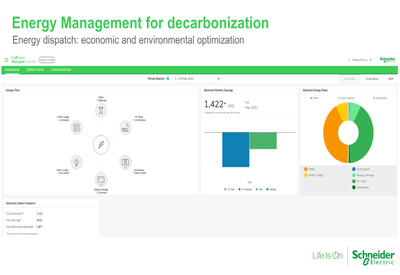
Schneider Electric uses data analytics to optimize energy usage, managing connection to the grid and DERs to reduce power consumption during peak periods, as well as when to produce, store, and sell back to the utility.
Even at the residential level, Revuru explained, builders are looking at how they can implement these types of technologies.
“Most of the systems that need to be integrated, we build into this box. If you think of a sustainable solution for a community or a building, you need think of how you can bring the renewable energy to the building, you also have energy storage, and any other distributed energy source we need to bring into the picture.”
Essentially, the various energy resources – the grid, solar, generators etc., can be brought into one picture and actively managed and optimized through data and analytics.
“Something needs to orchestrate what energy needs to be consumed, what energy needs to be stored, which energy needs to be sold – if the utility is ready to take the energy, we can actually sell energy back to the grid.”
There is a demand response program that allows buildings to supply energy back to the grid when there is demand, “you actually flag it, saying I can give you 500 KW from my building,” he said for example.
It also manages time of use pricing to draw less power from the grid during peak periods to help lower costs while also reducing strain on the grid.
“It does the economic dispatch, meaning it understands which energy needs to be used so that I’m cutting my energy bill.”
“It can also do energy optimization, you need to understand, on the load side, what type of load we need to use. Which are essential loads, which are non-essential loads.”
“We also talk about thermal energy, we don’t want to heat the building for the sake of heating the building,” which is another way to manage energy costs.
DERs also allow facilities to continue operating their critical loads when there is a grid outage. The platform monitors weather patterns so the system is prepared to go into ‘island mode’ when an outage occurs.
Revuru explained that the building of the future is about sustainability and resiliency, the goal being to reach net-zero/positive while also making the energy we consume more reliable than it already is.
Ultimately, Revuru said, “Reduced carbon means reduced cost. Energy efficiency comes into the picture and you know what (energy) you’re using.”
With that visibility its possible to reduce consumption by managing heat and lighting loads, for example, or identifying aging equipment that is drawing more energy than it needs.
 On top of that, carbon emissions are becoming more expensive beyond the cost of electricity itself. Canada has had carbon pricing in place since 2019, referred to commonly as a ‘carbon-tax’, and officially as Output-Based Pricing System. The system sets a standard for emissions per unit of output relative to a given industry’s average emissions, facilities that exceed the set limit pay for that excess. If you are below the industry standard you earn credits that can be sold to other ‘emitters’. In 2019, the price was set at $20/tonne to be raised $10 a year to $50/tonne in 2022.
The investment in DERs can be made ‘as-a-service’, meaning facilities can essentially ‘subscribe’ to a renewable energy service that installs and manages the equipment. Schneider Electric provides this through partnerships with Carlyle Group (AlphaStruxure) and Huck Capital (GreenStruxure ).
“If its less than 5 megawatts we can talk to GreenStruxure and if its more than 5 megawatts we can talk to AlphaStruxure,” he noted. “That is roughly the numbers but depending on the situation we can see who the right fit will be.”
When it comes to system integration, Schneider Electric leans on a number of partners, “depending on the situation, what type of services are required from us, we can bring a number of partners into the picture for engineering procurement construction (EPC).”
Healthcare, universities, food and beverage, Commercial & Industrial Customers and automotive are the main industries Schneider Electric is working with right now, when it comes their small/medium building microgrid solution. Primarily because there is increased focus on resiliency for these industries; hospitals have a lot of critical infrastructure to maintain when it comes to patient care, while food and beverage and automotive industries have strict safety regulations to maintain when it comes to production. Universities also house a lot of critical infrastructure. So, there is motivation beyond reducing emissions for those sectors.
Another interesting area Revuru highlighted was that across Canada public bus transportation services are beginning to move toward electric vehicles (EVs), so they’ll look to microgrid solutions to manage the increased energy demand.
Being a public service, busses need to be charged on strict schedule, “you need electrical infrastructure so that its being charged at the right time, because there needs to be a systematic way of charging and getting back to the road.”
“The other one is EV load,” said Revuru, as electrical vehicles come more and more into the picture, the energy required to charge EVs needs to be accounted for without impacting a building’s critical loads.
Revuru provided the City of Markham as an example, they installed 16 EV chargers at the Markham Civic Centre, “When you think of installing 16 EV chargers in the parking lot, you need to think about how to manage the building load and the EV load. You suddenly have a huge amount of EV load coming into the building – you need to think about HVAC not having a disturbance because people are working in the building, so you need to maintain the thermal energy of the building and at the same time manage the EV whenever the public is charging.”
As we move further into this digital transformation and electrification of buildings, communities, and vehicles, we are going to need the infrastructure that is reliable as much as it is sustainable.
If you don’t have resiliency and sustainability with that energy, Revuru said, “You aren’t going to go anywhere with the digital transformation.”
![Guide to the Canadian Electrical Code, Part 1[i], 26th Edition– A Road Map: Section 74 — Airport installations](https://electricalindustry.ca/wp-content/uploads/2026/05/EIN-Stock-Guide-Code-Canada-Map-1200-768x403.png)




![Guide to the Canadian Electrical Code, Part 1[i], 26th Edition– A Road Map: Section 74 — Airport installations](https://electricalindustry.ca/wp-content/uploads/2026/05/EIN-Stock-Guide-Code-Canada-Map-1200.png)