Building Construction Price Indexes, Second Quarter 2026

July 30, 2026
Residential building construction costs increased 0.5% in the second quarter, following a 0.7% increase in the previous quarter. Non-residential building construction costs rose 1.4% in the second quarter, following a 0.9% increase in the previous quarter.
Year over year, construction costs for residential buildings in the 15-census metropolitan area (CMA) composite rose 2.3% in the second quarter, while non-residential building construction costs saw an increase of 3.5%.
The construction industry faced several challenges in the second quarter, as geopolitical tensions drove higher oil prices; retaliatory tariffs between Canada and the United States disrupted supply chains; regulatory uncertainty delayed purchases; and seasonal construction projects further intensified demand for an already constrained skilled trades workforce. Builders across the country reported that higher fuel prices contributed to increased operating costs, increasing costs related to construction equipment and machinery, as well as the transportation of building materials.
Regional factors also contributed to cost pressures and uncertainty. Builders in Ontario noted that uncertainty surrounding the implementation of the federal GST/HST rebate continued to delay purchasing decisions, particularly for new homes, as developers and buyers awaited the legislation required to make rebate claims, which came into effect on June 22, 2026. In Quebec, builders reported that annual construction union wage increases contributed to upward pressure on construction costs in the province. Taken together, these factors contributed to a challenging operating environment for builders across the country during the second quarter.
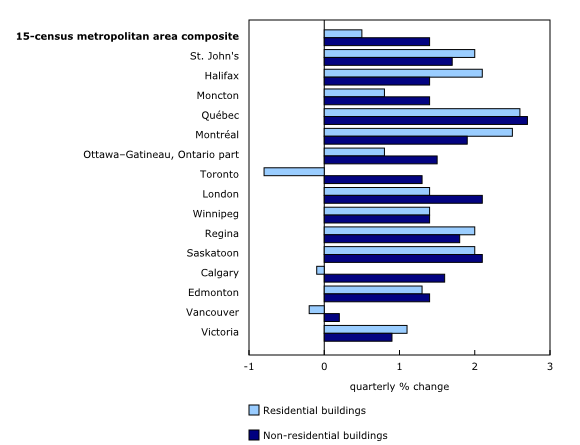
Metal fabrications division leads residential construction cost growth
In the second quarter, residential building construction costs rose across nearly all CMAs, with Québec (+2.6%) reporting the largest quarterly increase, followed by Montréal (+2.5%). Increases were also notable in Halifax (+2.1%), Saskatoon (+2.0%), and Regina (+2.0%). Calgary (-0.1%), Vancouver (-0.2%), and Toronto (-0.8%) were the only CMAs to experience declines in the second quarter.
At the division level for residential building construction, the metal fabrications (+2.1%) division saw the largest quarterly increase in the second quarter, followed by the structural steel framing (+1.8%) and earthwork (+1.5%) divisions. In contrast, the conveying equipment (-0.2%) and wood, plastics and composites (-0.3%) divisions recorded price declines in the second quarter. Metal and steel products continued to lead cost increases due to the upward price pressure associated with implemented retaliatory tariffs and the related supply chain disruptions.
Québec leads non-residential construction cost growth
The cost of constructing non-residential buildings increased the most in Québec (+2.7%) in the second quarter, followed by Saskatoon (+2.1%) and London (+2.1%). Montréal (+1.9%) and Regina (+1.8%) also reported similar growth. In contrast, Victoria (+0.9%) and Vancouver (+0.2%) showed the smallest growth in the second quarter.
At the composite level, non-residential building construction costs increased across all divisions measured in the second quarter, with the conveying equipment (+2.9%), earthwork (+2.2%), structural steel framing (+2.2%) and metal fabrications (+2.0%) divisions recording the largest increases. Increases in these divisions reflected rising oil and fuel related prices, as these segments are heavily reliant on the use of machinery and equipment, and the transportation of materials. Price pressure across most other segments was moderate through the second quarter, while the finishes (+0.5%) and wood, plastics, and composites (+0.5%) divisions experienced the smallest price growth in the quarter.
![Guide to the Canadian Electrical Code, Part 1[i], 26th Edition– A Road Map: Section 74 — Airport installations](https://electricalindustry.ca/wp-content/uploads/2026/05/EIN-Stock-Guide-Code-Canada-Map-1200-768x403.png)




![Guide to the Canadian Electrical Code, Part 1[i], 26th Edition– A Road Map: Section 74 — Airport installations](https://electricalindustry.ca/wp-content/uploads/2026/05/EIN-Stock-Guide-Code-Canada-Map-1200.png)