Emerson Software Automates Purdue University’s Groundbreaking DC-Powered Nanogrid House
December 17, 2022
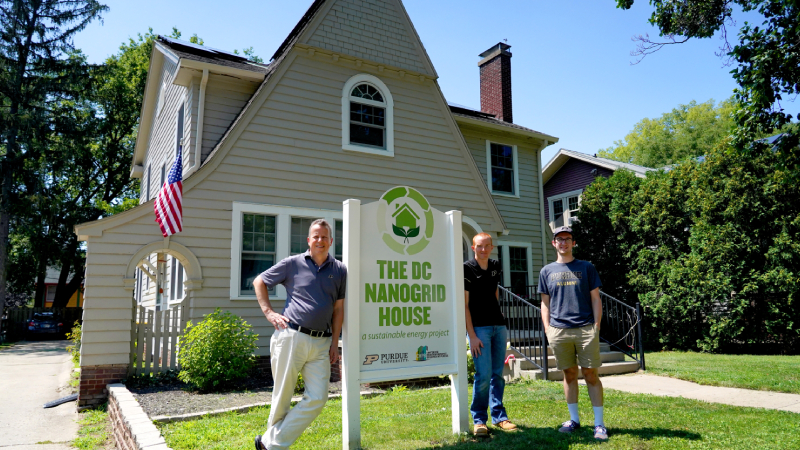
Purdue University is using global software and engineering leader Emerson’s advanced digital technologies to automate its Nanogrid House, a living lab for energy-efficient home research. Compared to today’s homes and businesses that are powered predominantly by alternating current (AC) power, the Nanogrid House can shift between AC and direct current (DC) power, which increases the ability to use renewable energy and lowers homeowners’ energy costs.
High-voltage AC power from the grid must be converted to DC power to run household devices, wasting time and money. And while new renewable energy sources such as solar and wind deliver DC power directly, this power is not compatible with existing home electrical infrastructure. The Nanogrid House enables researchers to develop technologies to address these challenges in anticipation of a future nationwide shift to DC power.
“As we continue to face extreme weather, a DC-powered home is uniquely suited to the future of energy generation, empowering homeowners to turn their houses into nanogrids of efficient, self-sufficient production and consumption,” said Bob Yeager, president of Emerson’s power and water business.
Using Emerson’s renewable power expertise and Ovation™ software and technologies, Purdue University researchers have retrofitted an entire house to run on its own DC-powered nanogrid. The nanogrid integrates both AC power from local electric utilities and DC power from solar panels, wind turbines or battery storage.
These sustainable energy sources help reduce the house’s carbon footprint by an estimated 55% and lower annual energy costs by up to 44%. The Nanogrid House can also sustain itself for short periods of time by generating its own renewable energy and detaching from the grid through the help of on-site stored energy.
“As consumers add sustainable, DC-based electrical solutions to their homes, the need for a low-voltage, more energy efficient infrastructure will continue to increase,” said Eckhard A. Groll, William E. and Florence E. Perry head of mechanical engineering and Reilly professor of mechanical engineering, Purdue University. “Emerson’s expertise in automation software for power generation and sustainability helped us design a DC nanogrid solution that may someday become the national standard.”
Emerson’s Ovation™ software and technologies provide the project with a digital automation foundation integrating data provided by the home’s energy generation, heat and cooling production and battery storage assets. Ovation software operates as the “brain” of the home by managing voltage control, power distribution and load and intelligently optimizing operation of the nanogrid equipment.

![Guide to the Canadian Electrical Code, Part 1[i], 26th Edition– A Road Map: Section 74 — Airport installations](https://electricalindustry.ca/wp-content/uploads/2026/05/EIN-Stock-Guide-Code-Canada-Map-1200-768x403.png)





![Guide to the Canadian Electrical Code, Part 1[i], 26th Edition– A Road Map: Section 74 — Airport installations](https://electricalindustry.ca/wp-content/uploads/2026/05/EIN-Stock-Guide-Code-Canada-Map-1200.png)