Discussing the EV Landscape with LEDVANCE’s EVSE Product Manager, Erich Bockley

By Blake Marchand
In discussion with Erich Bockley, the LEDVANCE EVSE Product Manager, the conversation emphasized the importance of flexibility in their approach to the current EV industry landscape.
Earlier this year, LEDVANCE introduced its PHASE EV™ Gen 2 Level 2 Commercial Charger. Bockley explained that flexibility was a key priority in the development, due to the evolving technological and regulatory landscape, as well as the unique demands of specific projects and jurisdictions.
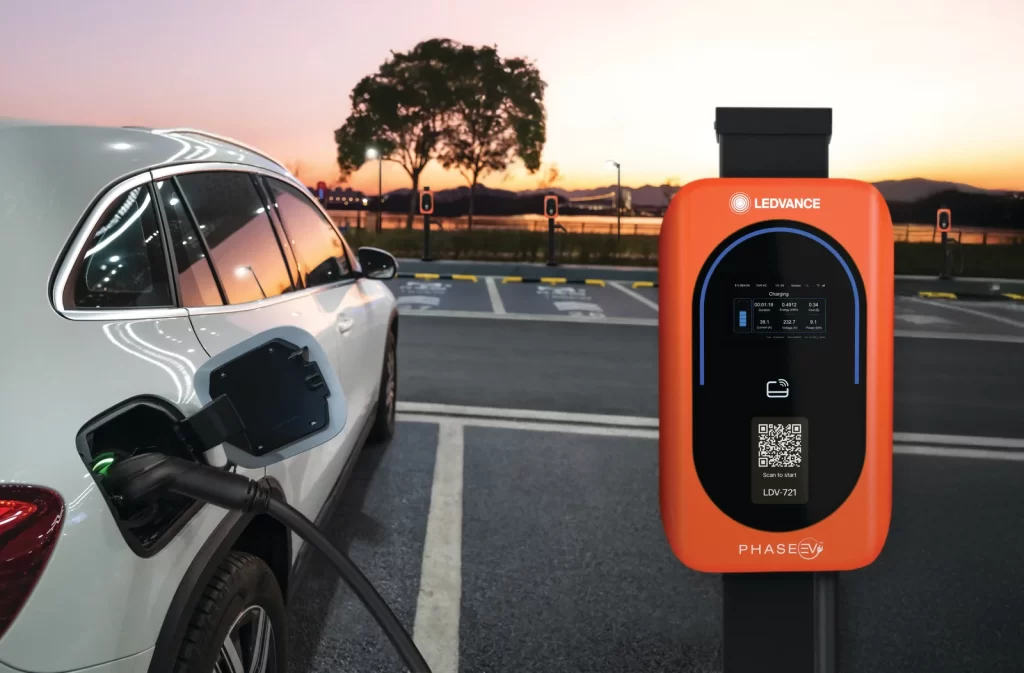
“What we try to do is build a flexible product to meet the various demands of the current EV commercial charging station market. The platform that we use was designed to be modular in the sense of the hardware required for a specific jurisdiction or location — we can add any specialized functionality to our chargers before we ship them to the end user,” he explained.
“That does a couple of things for us… It enables us to always have the right charger in stock at the time it’s required. We inventory specialized hardware that we can install on demand to meet the client’s needs; in this way, we don’t have to stock multiple configurations of our chargers, but we can still ship customized units with very short lead times,” Bockley added.
At the same time, with the modular approach, Bockley said, “we want to be able to add the functionality to meet the current and future demands in the EVSE market.”
The “motherboard” for the LEDVANCE charger is designed so that new technologies and protocols can be added over time.
Industry regulations and government incentives are a significant focus for companies like LEDVANCE because of their impact on adoption. For EV adoption to grow, Bockley explained, infrastructure networks need to be well-established so drivers have the confidence to buy an EV. Investments in infrastructure, coupled with regulations that incentivize adoption, create positive signals for manufacturers, utilities, and supply chain stakeholders to forecast market demand.
A key concern for potential EV drivers remains range and public charging convenience. For most drivers, home charging is sufficient for daily local travel. However, range anxiety exists for longer trips.
“When you come to a rest stop or another public charger, drivers want to have confidence that the charging station is reliable. They want the experience to be similar to what they are used to with gas-powered vehicles,” Bockley noted. “EV charging technology is on its way there, with the potential to be even more seamless and convenient than the gas pump.”
However, harmonized standards, improved technology, and network reliability are critical to achieving that level of convenience.
There are many stakeholders that play a role in the EV transition, creating both challenges and opportunities. Bockley spoke to the impact of new charging standards, improving battery technology, and the importance of harmonized standards.
“On the technology side, some of the things we’re looking into very closely are battery technology,” he said.
EV battery technology directly impacts EV range and charging speed, Bockley explained. “During a charging session, the EV itself controls how much electricity is supplied to the batteries, when it’s supplied, and the rate at which it’s supplied.”
The EV communicates with the charger to determine the optimal current level, protecting battery health and ensuring an effective charge.
“It’s basically two computers talking to each other — and the charger is simply accepting the information from the EV to control that charge.”
The new ISO 15118 protocol (Road Vehicles – Vehicle-to-Grid Communication Interface) defines the communication standards between the charging station and electric vehicle. The protocol also applies to bidirectional or vehicle-to-grid (V2G) charging.
The EV charger must connect to the charge point operator (CPO), which holds the driver’s payment information. This allows EVs to plug into any charger and immediately begin charging — the system already recognizes the car and driver through the ISO 15118 protocol.
“The car identifies itself to the charger, the charger identifies itself to the vehicle, and then the CPO knows who you are — and it just goes. You don’t have to scan, swipe a credit card, or download an app. Once the EV is plugged into the charger, the communication protocol all takes place in the background.”
Bockley noted that both the charger and EV require hardware to enable ISO 15118 communication. Not all vehicles and chargers currently include this capability, creating a delay in widespread adoption. However, the standard can significantly improve convenience for consumers while helping manage energy demand through vehicle-to-grid functionality.
Several pilot projects across Canada are exploring vehicle-to-grid applications. For example, BC Hydro recently announced a project using bidirectional charging with electric school buses to create a “mobile power source.” An electric bus battery can provide about 200 kilowatt-hours of electricity — roughly enough to power the average Canadian home for six to seven days. Nova Scotia Power also launched a pilot with 200 participants to “demonstrate utility-controlled smart charging and assess the potential of vehicle-to-grid bidirectional charging to mitigate peak demand impacts.” Bockley noted that LEDVANCE remains aware of emerging standards so they can be implemented smoothly once in effect. “Being agile is an asset in an evolving technological landscape,” he said — one that’s becoming more complex amid tariffs, supply chain shifts, and global competition.

![Guide to the Canadian Electrical Code, Part 1[i], 26th Edition– A Road Map: Section 74 — Airport installations](https://electricalindustry.ca/wp-content/uploads/2026/05/EIN-Stock-Guide-Code-Canada-Map-1200-768x403.png)



![Guide to the Canadian Electrical Code, Part 1[i], 26th Edition– A Road Map: Section 74 — Airport installations](https://electricalindustry.ca/wp-content/uploads/2026/05/EIN-Stock-Guide-Code-Canada-Map-1200.png)