How Local Competition Could Benefit Energy Consumers

February 14, 2025
By Jake Brooks
Energy competition does not need to be limited to the wholesale level. The potential benefits of wider and more open competition were recently evidenced when Ontario’s electric grid operator and a local utility decided to set up and test Canada’s first local electricity market through the IESO York Region Non-Wires Alternatives Demonstration Project. The Ontario government took an important step in the same direction when it announced in late 2024 that it will “work with the IESO to launch a competitive program for local generation resources by early 2026,” and asked the IESO to provide advice on it by April 30, 2025.
Based on their analysis of the two-year demonstration project in York Region north of Toronto, independent experts found that there can be real financial benefits when relatively small-scale facilities, known as Distributed Energy Resources, reduce the need for more costly conventional grid infrastructure. The ground-breaking initiative was a collaboration between the Independent Electricity System Operator (IESO) and Alectra Utilities, with funding from Natural Resources Canada and the IESO’s Grid Innovation Fund.
The potential savings from broader competition could be particularly timely considering the scale of new investments in energy infrastructure that are currently anticipated in many parts of Canada, according to both federal and provincial governments.
The eleven successful bidders in the demonstration project used technologies such as peak load management, behind-the-meter Combined Heat and Power, and smart thermostats to either supply energy or reduce demand, thereby alleviating pressure on the grid. When implemented at scale and under the right conditions, these kinds of initiatives can potentially reduce the need for new wires in some situations. The project, which set out to test “Non Wires Alternatives (NWAs),” has opened the door to a new type of long-term change in the energy sector – based on activating local flexibility markets for competitive acquisition of local resources. Relatively small-scale energy resources can be efficient, responsive to local needs, and supplied competitively.
Brian Bentz, the President and CEO of Alectra Utilities, said that the York Region NWA Demonstration Project “has proven the potential for using local solutions as a cost-effective alternative to traditional electricity infrastructure.”
After many years of energy development focused on large-scale infrastructure, rising levels of smaller, more locally oriented projects may be coming.
A thorough, independent study of the project recently released by the IESO found that a prudent portfolio of Distributed Energy Resources (DERs) could be less expensive than installing the wires and transformers that would otherwise be needed under reasonably likely conditions in parts of York Region, depending on the levels of future DER growth and other circumstances. The authors caution that the findings in this report might not be directly applicable to other time frames, places, or types of distributed energy resources, but taken in context, they are nonetheless remarkable as an indicator of potential change in progress.
The energy system and the industry behind it could take on a diverse and exciting new look if DER growth continues. After many years of energy development focused on large-scale infrastructure, rising levels of smaller, more locally oriented projects may be coming. For example, according to energy consultant Wood Mackenzie, the market for Distributed Energy Resources in the US, “will nearly double from 2022 to 2027, reaching US$68 billion per year.”
Community leaders see value in this kind of activity. Steven Del Duca, the mayor of Vaughan, home to several of the project participants, said, “I commend the Vaughan-based businesses, like Longo Brothers, Tycho Poly Inc. and Sobeys, for pioneering new ground-breaking technologies that will alleviate pressure on our electricity grid while benefitting residents and businesses in Vaughan and beyond for years to come.”
Geri Yin, Vice President of Alectra’s GRE&T Centre, said, “This project energized the local community to take on an active role as part of grid solutions – a win-win-win for customer, community and the grid.”
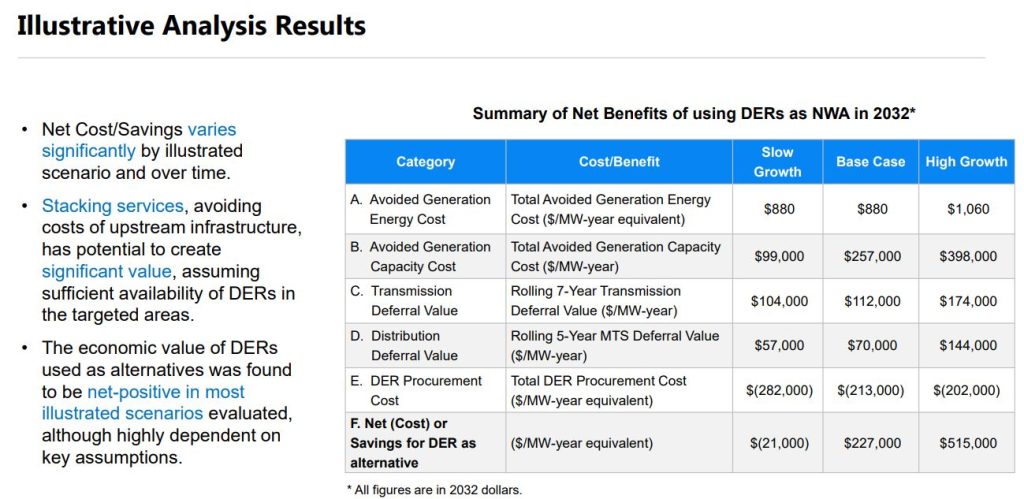
In its final report, the energy consultant ICF said, “The illustrative cost-benefit analysis … demonstrates that DERs can offer substantial cost savings as an alternative or deferment to traditional infrastructure given the right conditions.” Factors such as market conditions, evolving DER growth and regulatory policies will play a significant role in determining the overall cost-benefit analysis in the future. The report’s cost-benefit analysis is described as “illustrative” because, like any forward-looking research, it was based on current conditions and a number of assumptions. Nonetheless, the study was the most comprehensive and authoritative of its kind ever conducted in Canada.
The NWA Demonstration Project was considered highly innovative when first announced in 2019 as it effectively created the first local electricity market in North America. The two-year local capacity auctions successfully procured 10 megawatts (MW) of capacity for the year 2021 and 15 MW of capacity for the year 2022, from a diverse range of DER participants, including manufacturers, supermarket operators, and residential homeowners participating through aggregators.
Some see the increasing reliance on local resources as a kind of democratization of the energy sector.
Highlighting some of the benefits, ICF said, “DERs have shorter development timelines and can be deployed modularly, allowing for closer alignment of capacity need and DER installation” compared to transmission and distribution infrastructure which is usually oversized compared to initial capacity need.
Opening up local grids to large numbers of new suppliers certainly raises questions about cybersecurity and the potential for new kinds of technical problems. The Ontario Energy Board, like many other regulators around the world, has assessed the issues and collected professional advice. It released an update to the provincial Distribution System Code that became effective October 1, partly to recognize the potential for new challenges. Ontario utilities are now required to comply with a new Ontario Cyber Security Standard.
A number of energy analysts including Jennifer Delony think that the grid may be evolving from a centralized, primarily top-down distribution system towards a more open network that includes a wide range of participants, some large and some small, exchanging energy in real time on a transactional basis. Some see the increasing reliance on local resources as a kind of democratization of the energy sector.
From humble beginnings in the York Region, this project may have planted some of the seeds for far-reaching innovation in the future.
There is little doubt that the NWA Demonstration Project and the learning derived from it represent an important landmark in the history of energy in Canada. They may also herald the beginning of a significant new kind of long-term change in the energy sector.
Jake Brooks is an energy consultant who served as Executive Director of the Association of Power Producers of Ontario for many years.
******
Jake Brooks
Electricity Market Insight, Strategy and Action
https://www.linkedin.com/in/jakebrooks-ca
Disclaimer: This article is for general and public information only. It is not necessarily applicable to the reader’s specific circumstances and should not be relied on as the basis for financial, regulatory or other decisions, unless it’s under the advice of an appropriate certified professional.
© 2025 Jake Brooks

![Guide to the Canadian Electrical Code, Part 1[i], 26th Edition– A Road Map: Section 74 — Airport installations](https://electricalindustry.ca/wp-content/uploads/2026/05/EIN-Stock-Guide-Code-Canada-Map-1200-768x403.png)





![Guide to the Canadian Electrical Code, Part 1[i], 26th Edition– A Road Map: Section 74 — Airport installations](https://electricalindustry.ca/wp-content/uploads/2026/05/EIN-Stock-Guide-Code-Canada-Map-1200.png)