Behind the Glow: How Neonview Helped Shape Vancouver’s Newest Landmark Roof
July 27, 2026
Some projects are exciting because they’re new. Others are exciting because you can feel how many people had to be exceptionally good at their craft to make them look effortless.
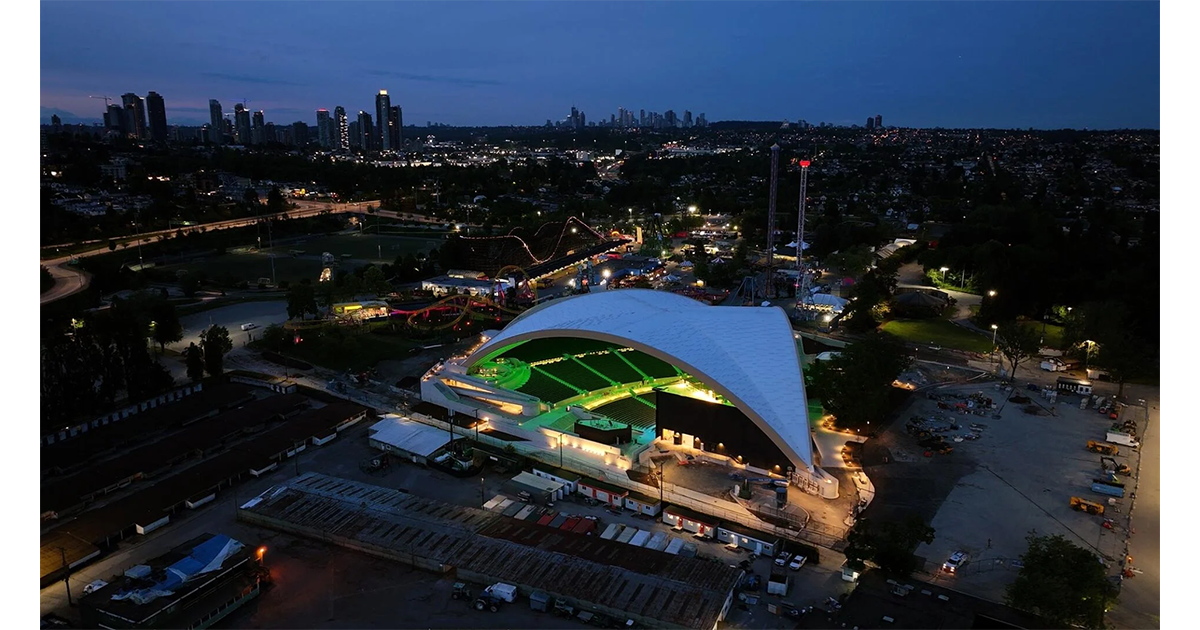
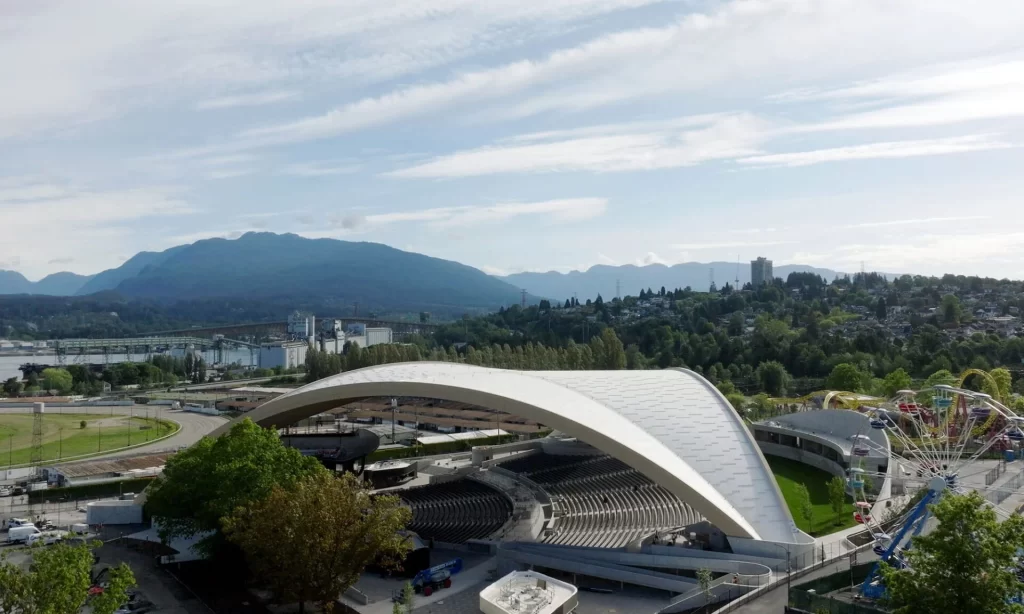
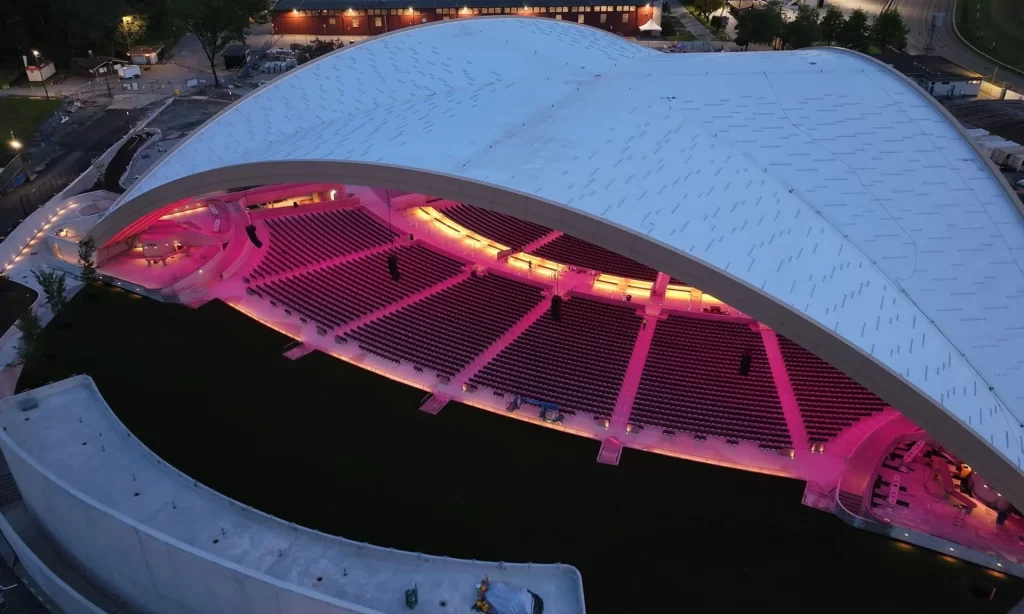
The PNE Amphitheatre (Freedom Mobile Arch) is the latter. The notable largest free-span wood roof in North American is the headline, but the lighting is the supporting act that makes that architecture readable after dark—continuous lines that trace the geometry, shift with the energy of an event, and still respect the timber structure they live on.
This is a behind-the-scenes look at the architectural lighting approach that helped bring the roof to life, with a theme that comes up again and again in every conversation: collaboration. Revery, EllisDon, AES, Houle, BL Lighting, and Mac’s II Agencies were all pulling on the same thread: design intent, constructability, controls, and long-term operation.
Project Snapshot:
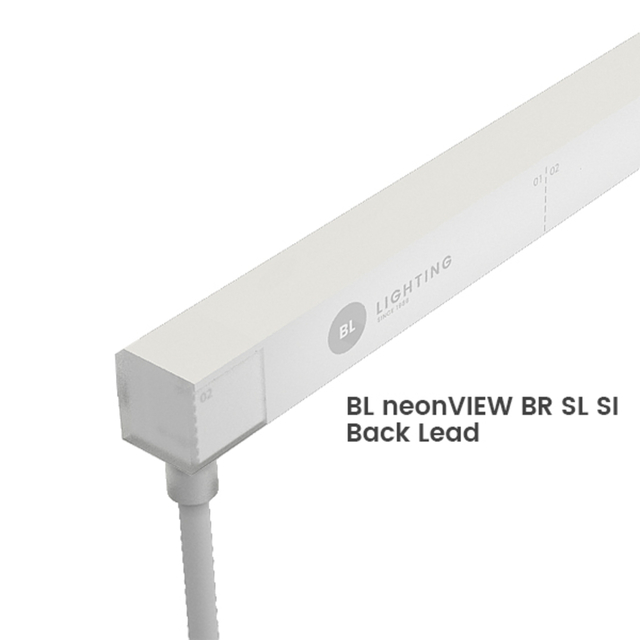
- Product: Neonview Bright Side H RGBW (referred to as Neonview below)
- Project: PNE Amphitheatre (Freedom Mobile Arch) in Vancouver’s Hastings Park
- Seating capacity: up to 10,000
- Roof lighting: ~10,000 ft total (roof itself estimated at ~8,000 ft)
A West Coast Collaboration
This project was never a one-team win, it was a Vancouver (and BC) collaboration that had to hold together from early design through installation.
BL Lighting, a female-founded, Vancouver-based architectural lighting manufacturer with over 40 years of experience, helped bring the roof lighting concept to life with a product and system that met the architecture’s demands: continuous lines of light that read as a single, uninterrupted gesture across the timber geometry: clean, consistent, and designed to feel “built in,” not bolted on.
From the Mac’s II side, the contribution was less about being the loudest voice and more about being the steady one: supporting the right solution locally, staying close to the project team as pricing and value engineering conversations unfolded, and helping keep the specified approach moving forward when it would’ve been easy to compromise.
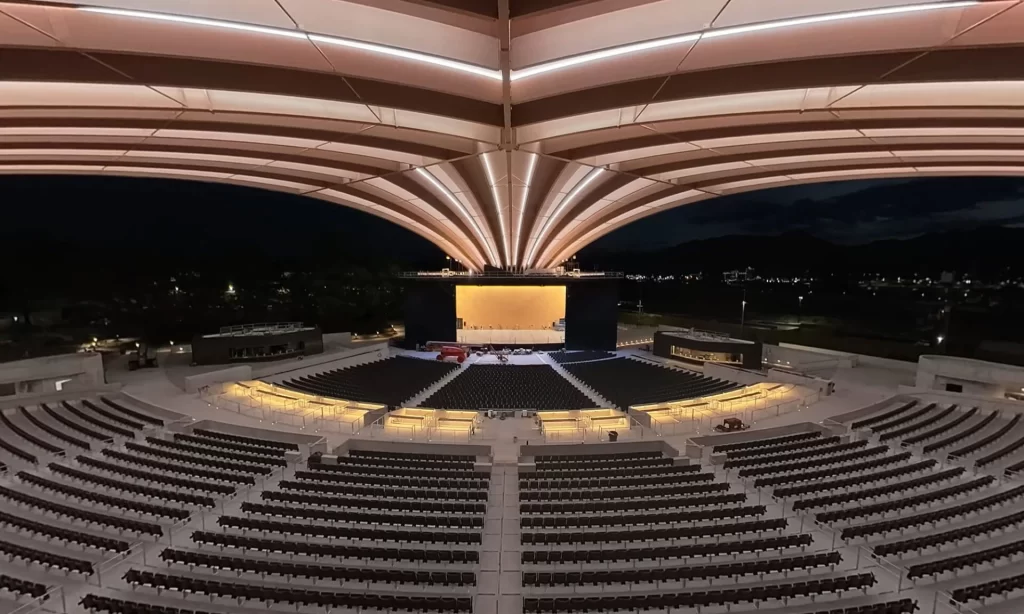
Why BL Neonview?
Early on, a more pixel-forward concept was considered. For a performance venue, that instinct makes sense: concerts, touring productions, and shows naturally push teams toward a pixel dynamic, high-resolution control.
But as the project evolved, the team landed on a solution that delivered the creative range and the real-world practicality required for a landmark roof: Neonview, specifically an RGBW, horizontal-bend format suited to run along the roof’s curves.
What made Neonview the right fit wasn’t just the illumination, it was the combination of performance, durability, and project-readiness:
- Continuity: a “line of light” effect that reads cleanly across long runs and complex geometry.
- Dynamic Capability: control granularity that still supports patterns and scene changes.
- Outdoor Resilience: engineered for the realities of a Vancouver exterior environment.
- Sustainability Alignment: Declare certification supports the project’s broader sustainability goals (including LEED ambitions).
- Built for the Elements: IP68 environmental protection helps ensure reliable performance in outdoor conditions.
- Impact Resistance: an IK10 rating (noted as higher than typical neon ratings).
- Confidence in High-Vibration Environments: a 3G vibration rating for applications where movement and vibration are real-world factors.
- Made to Last: material and finishing choices designed for long-term outdoor performance, including UV-related stability considerations.
- Proudly Vancouver: BL Lighting is a Canadian, Vancouver-based manufacturer, which meant fast, on-the-ground support was available throughout the project.
Controls at Scale: 10,000 Feet, 20-Foot Precision
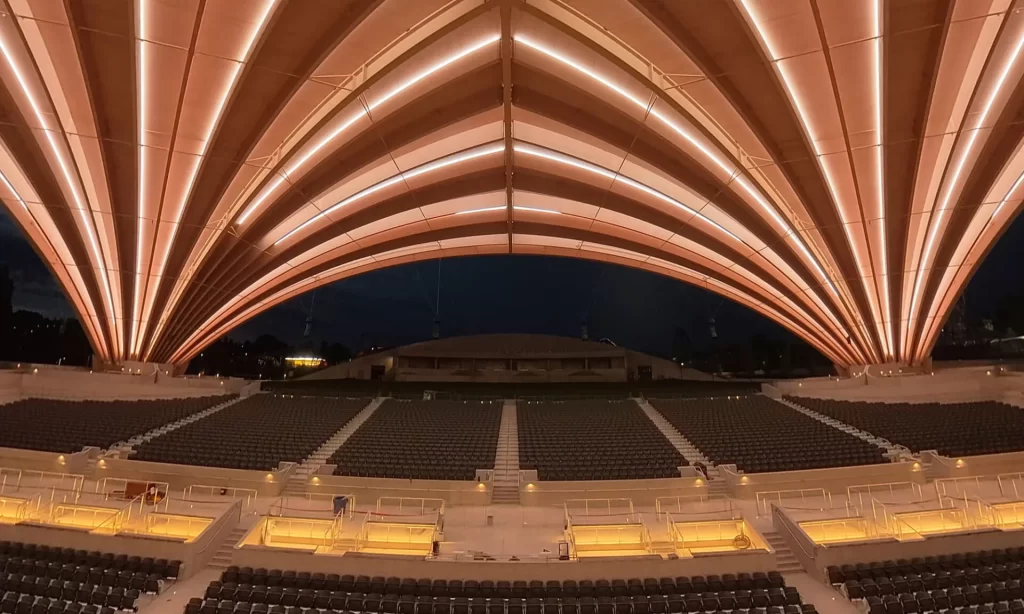
The Freedom Mobile Arch uses ~10,000 feet of BL Neonview overall, with the roof itself estimated around ~8,000 feet. At that scale, the controls approach can’t be an add-on, it has to be designed into the layout from day one.
The roof was organized so every 20 feet is individually controllable. That decision sits in a sweet spot: enough granularity for movement and variety across the structure, without the complexity (or channel load) of treating the entire ceiling like a giant pixel screen.
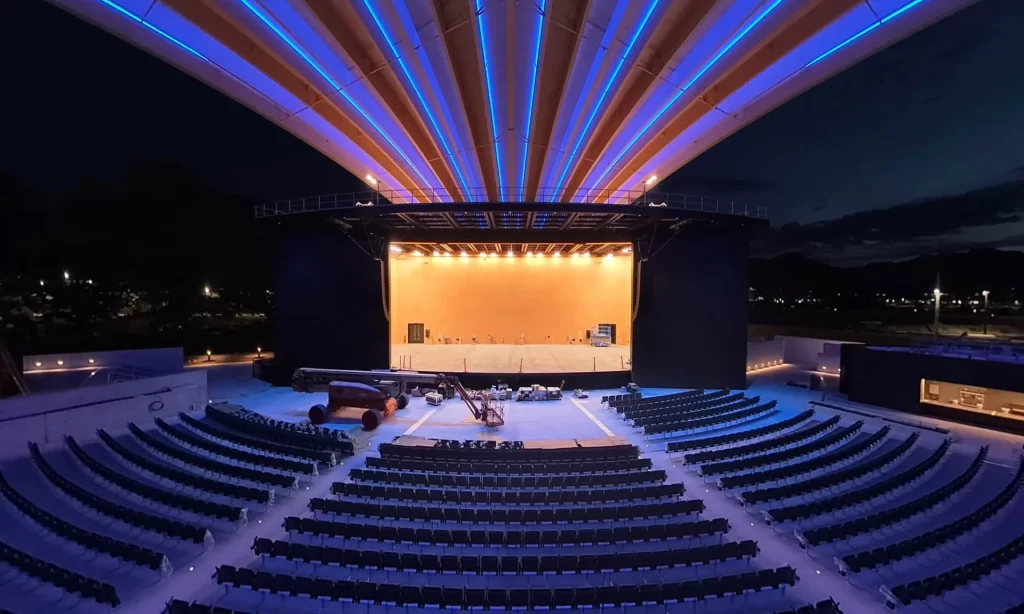
In practice, that means the ceiling can run as one calm ambient look, or break into controllable zones for chases, animations, and show looks when touring productions roll in.
How do the 20 ft linear lighting segments tie into the controls backbone? The system is built on a show-friendly controls stack:
- DMX control, distributed over the network via Art-Net
- RDM capability through the control/distributor boxes (supports remote addressing and reconfiguration)
- Multiple Art-Net nodes
This allows for adjustments to be made from the ground so the lighting remains easily accessible.
Unique Installation Challenge: Building the Light Into the Roof
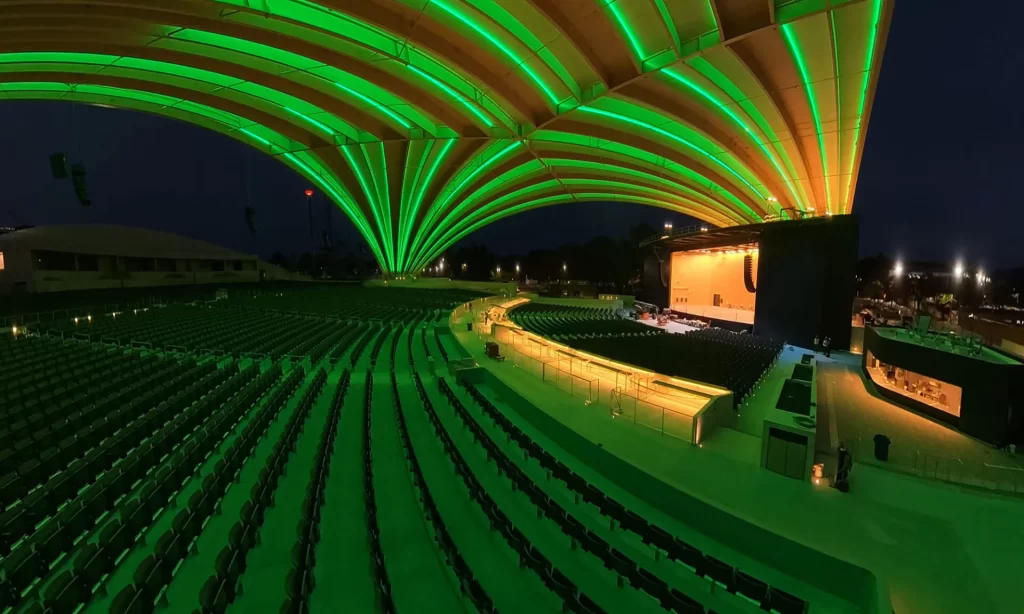
The roof lighting wasn’t treated as a typical “install it after everything’s up” scope. It was engineered into the roof build itself, so when beams were lifted into place, the team wasn’t just raising timber, they were raising timber with the lighting integration already installed.
That sequencing changes everything. It turns installation into an exercise in repeatability, where the question isn’t “can we install it?”—it’s “can we lift it into place and still keep it perfect?”
Because with linear tape light, there are tight tolerances that don’t politely average out over distance. The channels have to line up cleanly, beam after beam. Breaks have to stay consistent. Setbacks have to repeat. Maintaining that precision as the beams lift into place becomes a genuine engineering challenge.
This is where flexible surface-mount channel played a critical role. On a roof defined by curves, intersecting planes, and long sightlines, flexibility is how you protect the design intent across thousands of feet, allowing fine adjustments that keep the line reading clean from the ground.
On the technical side, that meant channel runs had to remain perfectly aligned, channel-to-channel breaks had to hold a consistent 10 mm gap, and setbacks from edges had to repeat cleanly from beam to beam (validated through mock-ups).
This is exactly where the project’s core theme, collaboration, shows up in the most practical way. With BL Lighting’s technical team working closely with engineers and installers, the project moved through a steady back-and-forth that kept errors minimal and alignment consistent.
Finally, the infrastructure had to disappear. Driver and control hardware has to live somewhere, but on a roof like this, it can’t compete visually with the architecture. That’s why the BL Lighting team developed custom driver / control boxes, going through iterations and real-world testing to reduce occlusions on the beams—then planned to paint them to match the roof, camouflaging the tech so the geometry (and the light) stays the hero.
“This was an exciting project to work on and it all started with the roof lighting, all other lighting feel into place afterwards. It was also a great collaboration between all parties involved to design and work on this iconic and legacy project.”
Victor Quezada, Principal and Architectural Lighting Team Lead at AES Engineering
The Coordination Detail that Made the Difference
On a project with this many moving parts and sheer size and scale, the “invisible” work becomes the deciding factor: how cleanly the system is organized, how quickly it can be serviced, and how confidently it can be handed over.
That’s why the level of detailed labeling and mapping mattered so much here: box numbers mapped to drivers, drivers mapped to runs, runs mapped to orientation, plus DMX addresses and channels documented end-to-end.
It’s the kind of documentation that keeps installers aligned during the build and keeps the venue protected long after the last lift comes down. If something needs to be re-addressed, reconfigured, or repaired, teams can move quickly and precisely, without guesswork.
There’s a technical satisfaction in making a system work, but on this project, BL Lighting’s contribution goes beyond the spec. The team’s product knowledge, responsiveness, and willingness to iterate on the details helped keep the design intent intact at an ambitious scale. And there’s a different kind of pride in standing under a roof like this during a live event, knowing you helped shape the experience.
“We’re honoured that Revery Architecture and AES Engineering specified BL Neonview for the Freedom Mobile Arch. The project’s scale and geometry demanded exceptional performance, durability, and precise control. As a Canadian manufacturer, we’re proud that our product and technical expertise helped bring the lighting design vision to life.“
Sean Pacey, President of BL Lighting
The Takeaway for Lighting + Architecture Enthusiasts
If there’s one reason this project is worth paying attention to (beyond the sheer design excellence), it’s that it demonstrates what happens when architectural intent, product choice, controls strategy, and installation sequencing brilliantly line up.
Neonview didn’t just “light the roof.” It helped the roof read as one coherent, continuous, programmable element, built to handle Vancouver weather, event cadence, and the long-term realities of operating a world-class venue.
Photographs by: Take Off Photography
![Guide to the Canadian Electrical Code, Part 1[i], 26th Edition– A Road Map: Section 74 — Airport installations](https://electricalindustry.ca/wp-content/uploads/2026/05/EIN-Stock-Guide-Code-Canada-Map-1200-768x403.png)

![Guide to the Canadian Electrical Code, Part 1[i], 26th Edition– A Road Map: Section 74 — Airport installations](https://electricalindustry.ca/wp-content/uploads/2026/05/EIN-Stock-Guide-Code-Canada-Map-1200.png)