New Research on Smart Home Trends & Technology Adoption

September 17, 2025
Sustainability and occupant well-being have become top priorities for smart home consumers, while AI-driven technologies continue to reshape expectations around comfort and convenience.
These are among the findings from the latest research by the Association for Smarter Homes & Buildings (ASHB), conducted in collaboration with Harbor Research. The 2025 Smart Home Trends & Technology Adoption project explores how homeowners and renters in the U.S. and Canada are engaging with emerging technologies, revealing evolving motivations, barriers, and opportunities across the smart home ecosystem.
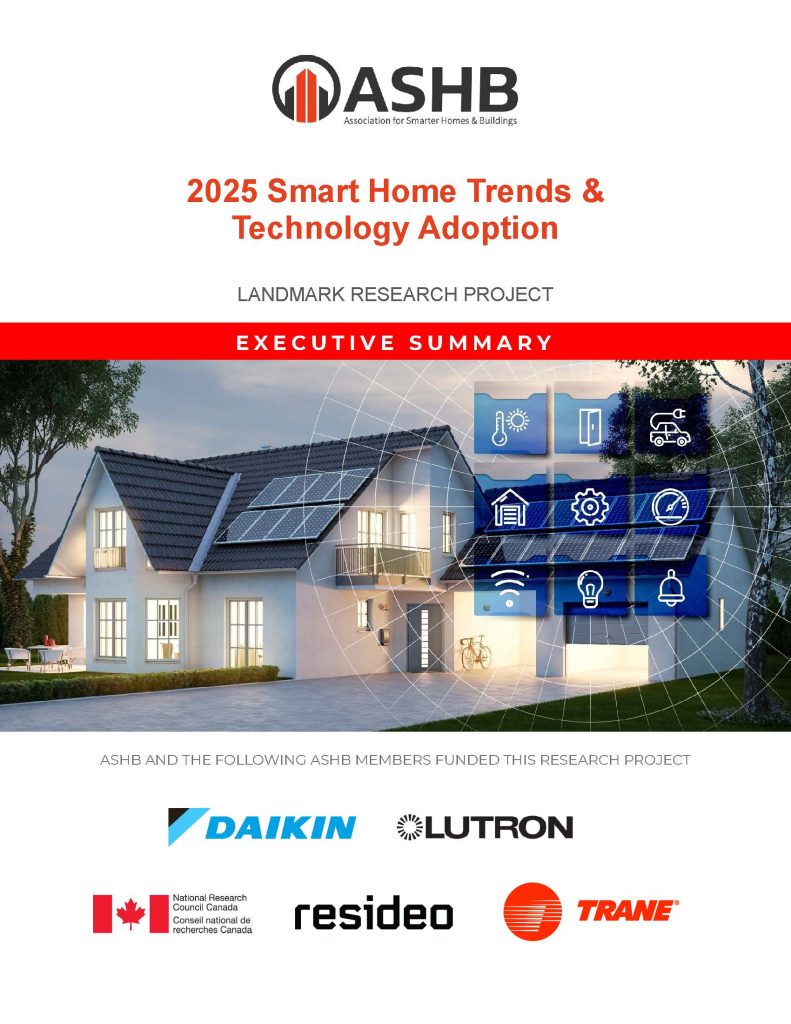
Based on a consumer survey of 644 homeowners and renters, the research identifies four major trend areas shaping the future of connected living:
- Smart Home Roadmap for Sustainability Technologies
- Redefining AI-Native in the Smart Homes & Occupants
- Occupant-Centric Environmental Comfort & Wellness
- Technology-Assisted Living & Aging in Place
“This year’s study reinforces how quickly consumer expectations are evolving,” said Greg Walker, CEO of ASHB. “People want technologies that are intuitive, sustainable, and enhance daily life—not just add convenience. The findings point to significant opportunities for solution providers that align innovation with real-world needs.”
Funded by ASHB member organizations, the collaborative $50,000 research initiative identifies the strategies, technologies, and business models most likely to drive revenue growth in the coming years.
An executive summary is now available for public download. The full research findings, including infographics, survey results, and detailed trend analyses, are currently available only to participating funders but will be open for public purchase in the ASHB Shop beginning February 2026.

![Guide to the Canadian Electrical Code, Part 1[i], 26th Edition– A Road Map: Section 74 — Airport installations](https://electricalindustry.ca/wp-content/uploads/2026/05/EIN-Stock-Guide-Code-Canada-Map-1200-768x403.png)





![Guide to the Canadian Electrical Code, Part 1[i], 26th Edition– A Road Map: Section 74 — Airport installations](https://electricalindustry.ca/wp-content/uploads/2026/05/EIN-Stock-Guide-Code-Canada-Map-1200.png)