How Welcoming Is Your Workplace for Those with Disabilities?
Feb 12, 2016
Did you know that both provincial and federal governments have enacted legislation that requires organization to remove barriers for persons with disabilities (PWD) to participate fully in Canadian society, be that in employment or access to services?
While this has been a stimulus for some organizations to develop employment equity strategies, employers should, as a best practice, attempt to foster a culture of equal respect, adaptation and understanding to recognize the strengths that all cohorts bring to the workplace.
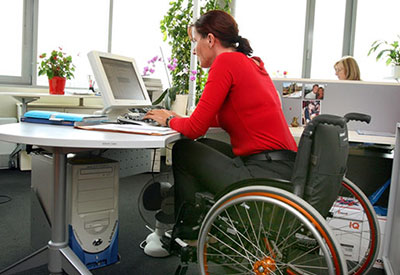
Photo courtesy: http://gogovernment.org
In addition to those who enter the workplace with a disability (visible or hidden), there are also those who have a disability as a result of illness or injury while in employment. We know that the barriers for people with disabilities take a number of different forms, from lack of awareness, inaccurate assumptions, inappropriate behaviour and attitudes on the job as well as the need to exceed expectations to prove oneself on a continual basis. Breaking down the assumptions that exist in many workplaces, be they conscious or unconsciously biased, will take a coordinated effort by employers and employees, including those with disabilities.
Many electricity employers are not aware of research that shows, for example, that in the areas of punctuality, attendance, work quality, task consistency, and overall proficiency, the performance of people with disabilities has been rated as the same as or even better than their co-workers.
Many accommodation options available to you as an employer can be low cost or no cost. While you may have to make some changes to workstations or provide an assistive device or assistive technology, many changes are simple. The employee being accommodated will be an important source of information about accommodation needs and sources of information, and potentially, sources of funding for making the accommodations.
In Ontario, the Accessibility for Ontarians with Disabilities Act (AODA) 2005 is a law that sets out a process for developing accessibility standards. In addition to the AODA requirements already in place, the act’s Employment Standard came into effective January 1st 2016 for large organisations with 50+ employees. The Employment Standard makes accessibility in organizations a regular part of finding, hiring, supporting and communicating with employees who have disabilities. Smaller organizations (>50 employees) have until January 1, 2017 to comply. Different jurisdictions may have different interpretations about the duty to accommodate, so it is worth reviewing the requirements that are relevant to your place of business.
EHRC research and consultations to date indicate that there is a recognition, interest and willingness among employers to be more inclusive of talent from under-represented and minority groups. Hiring people with disabilities is not only socially responsible but good for business, increasing employer morale, productivity, innovation, profitability and the ability to retain talent.
Michelle Branigan is CEO, Electricity Human Resources Canada.
More from Michelle Branigan:
– Michelle Branigan: Profile
– It’s Not Just the Technical Stuff That’s Important
– Call for Mentors to Support Recruitment and Retention of Women in the Electricity Industry
– Retention: You’ve Hired. Now What Are You Doing to Keep Your Staff?
– What are the Benefits of Effective Coaching?
– Multigenerational Workforces
– Mentoring