August Electricity Consumption Dips 2.9% YOY
Electric Power Stats

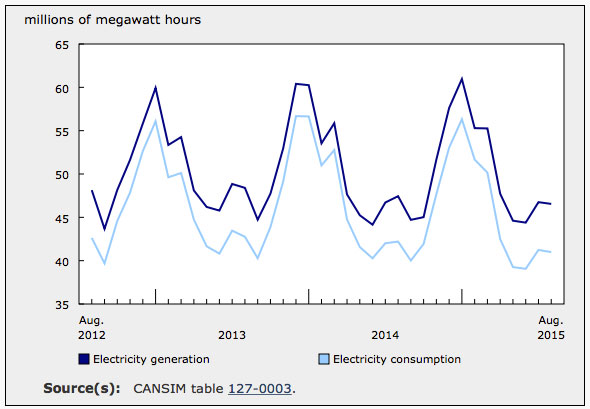
 Chart 1: Electricity generation and consumption, August 2012-2015


Canada’s available electricity totalled 41.0 million megawatt hours (MWh) in August, down 2.9% from the same month in 2014. Generation levels were also lower for the month, down 1.9% to 46.5 million MWh, reflecting lower output fin some provinces rom hydro and nuclear generators.

Canada’s electricity exports to the United States increased 1.8% to 6.2 million MWh on higher deliveries from British Columbia. Imports fell by nearly a quarter on a year-over-year (YOY) basis to 0.6 million MWh. Lower receipts from the United States were widespread with British Columbia posting the largest decline.

In Ontario, electric power generation levels totalled 11.8 million MWh in August, a 5.8% decrease compared with the same month in 2014. Lower water inflows to generating stations pushed hydro generation down 24.3% to 2.2 million MWh, more than offsetting small gains in steam conventional, nuclear, solar and wind generation. Lower generation, combined with higher net outflows, pushed total available electricity in August down 7.2% to 10.5 million MWh.

On the east coast, maintenance shutdowns at a nuclear power plant in New Brunswick resulted in a 27.3% decrease in total generation levels, which fell to 0.8 million MWh. Mitigating the decline, output from hydro, combustion turbine and steam conventional generators rose by more than 9% (in each case) on a year-over-year basis. To meet demand, the province increased receipts from other provinces, principally Quebec.

Generation gains of 7.7% in British Columbia and 18.9% in Newfoundland and Labrador eased the national decline in generation levels. Both provinces used their higher generation levels to increase deliveries; exports from British Columbia to the United States rose 57.6%, while deliveries from Newfoundland and Labrador to other provinces were up 27.6%.

Source: Statistics Canada, http://www.statcan.gc.ca/daily-quotidien/151027/dq151027b-eng.htm?cmp=mstatcan.


Related Articles


Latest Articles


Changing Scene

  • CAF-FCA Welcomes Federal Apprenticeship Investments, Urges Focus on Implementation

    CAF-FCA Welcomes Federal Apprenticeship Investments, Urges Focus on Implementation

    May 1, 2026 CAF-FCA welcomes the federal government’s strong focus on skilled trades in the 2026 Spring Economic Update, including new investments in apprenticeship pathways, financial supports, and employer incentives. These measures reflect long standing priorities advanced by employers and partners across the country. The Canadian Apprenticeship Forum (CAF-FCA) welcomes the Government of Canada’s renewed Read More…

  • ECABC Announces 2026 Hall of Fame Inductees

    ECABC Announces 2026 Hall of Fame Inductees

    April 30, 2026 ECABC is proud to announce that Bill Strain and Rob Tate will be inducted into the ECABC Electrical Hall of Fame this June. Bill and Rob have devoted their careers to the electrical contracting industry in British Columbia. Induction into the Electrical Hall of Fame is the highest honour the Association can Read More…

  • Nexans Initiates Copper Mark Recertification for Montreal Site

    Nexans Initiates Copper Mark Recertification for Montreal Site

    April 27, 2026 Nexans Canada Inc. has initiated the Copper Mark recertification process for its site located at 460 Durocher Avenue in Montreal. As part of this process, an independent external assessment of the site is scheduled for April 22–24, 2026. Copper Mark is an independent assurance framework designed to assess the responsible practices of industrial sites against recognized Read More…

  • Fort Frances Memorial Sports Centre Adding Solar as Part of GICB Program

    Fort Frances Memorial Sports Centre Adding Solar as Part of GICB Program

    April 27, 2026 The Fort Frances Memorial Sports Centre will generate solar energy following an investment of $589,762 from the federal government through the Green and Inclusive Community Buildings (GICB) program. This funding will reduce greenhouse gas emissions and annual electricity costs for the facility. A rooftop solar generation system will convert solar energy into Read More…