Arc Flash Alphabet Soup: Understanding the Hazard Behind the Acronyms and Technical Terms (Part 3)
In Arc Flash Part 1, Jim Pollard reviews technical terminology and acronyms.
In Arc Flash Part 2, what causes an arc flash and how to prevent it.
The latest edition of CSA Z462, published in January, requires an arc flash risk assessment. This process is used to determine if an arc flash hazard exists (hazard identification), estimating the potential severity of injury or damage to health and estimating the likelihood of the occurrence. Risk is defined as being a combination of the severity and likelihood. The requirement to perform an arc flash risk assessment is a fundamental part of any comprehensive electrical safety program. Different types of risk assessment processes can be used, including the arc flash PPE category method within the CSA Z462-15 standard.
The arc flash PPE category method requires the use of tables from within the CSA Z462-15 standard. The following steps are completed when using this method:
• Determine if arc flash PPE is required through arc flash hazard identification (work task and equipment condition)
• Determine arc flash PPE categories for AC and DC systems (equipment types, voltage levels and specific electrical parameters)
• Outline arc flash PPE and other personal protective equipment requirements for each of the arc flash PPE categories (1-4)
The incident energy analysis method requires the use of engineering based calculations using the IEEE 1584 standard to estimate the incident energy exposure level. Arc flash PPE is then selected based on the incident energy so the arc rating matches or exceeds the incident energy calculated.
PPE is one of the most readily available solutions to protect workers; however, it should be used as a last line of defense.
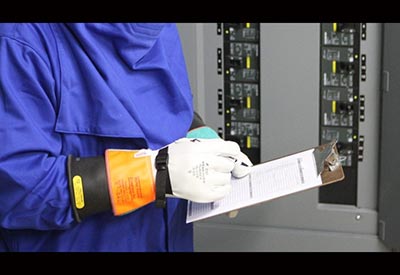
Arc flash PPE consists of specially designed and appropriately tested products suitable for use by workers that need protection from the heat of an arc flash hazard. Employers are required to ensure workers within the arc flash boundary wear appropriate full body protection when it is determined that arc flash PPE is necessary based on an arc flash risk assessment.
There are hundreds, if not thousands, of different arc flash PPE products available on the market. Arc-rated PPE product segments include clothing, face shields, arc flash suits, outerwear and specialized equipment. All arc-rated PPE is available with the associated laboratory testing documentation — employers just need to ask for it. Unlikeshock protective PPE, arc flash PPE doesn’t require recertification. At the very least, all arc-rated PPE shall indicate compliance with ASTM F1506, which outlines performance specification for flame resistant and arc flash textiles specifically for electrical workers.
The product label is the best indication of its compliance, but only destructive testing can verify a manufacturer’s claims.
Training is also an important component and there are several formats available, including on-the-job, e-learning, instructor-led and blended learning (e-learning and instructor-led training). Both e-learning and instructor-led training formats can be considered classroom training, either in the traditional sense or virtual. Any worker exposed to electrical hazards in the workplace requires adequate training suitable for their role and appropriate for the risk of their exposure. This includes both electrical and non-electrical workers.
In Arc Flash Part 1, Jim Pollard reviews technical terminology and acronyms.
In Arc Flash Part 2, what causes an arc flash and how to prevent it.
Jim Pollard is a member of several technical committees, including CSA Z462. He is the owner of Unlimited PPE in Stoney Creek, Ont., and he can be reached at jim@unlimitedppe.com or (905) 573-0300.
Reprinted by permission of Canadian Occupational Safety © Thomson Reuters Canada Ltd., April/May 2015, Toronto, Ontario, 1-800-387-5164. Web: www.cos-mag.com.
![Guide to the Canadian Electrical Code, Part 1[i], 26th Edition– A Road Map: Section 74 — Airport installations](https://electricalindustry.ca/wp-content/uploads/2026/05/EIN-Stock-Guide-Code-Canada-Map-1200-768x403.png)




![Guide to the Canadian Electrical Code, Part 1[i], 26th Edition– A Road Map: Section 74 — Airport installations](https://electricalindustry.ca/wp-content/uploads/2026/05/EIN-Stock-Guide-Code-Canada-Map-1200.png)