First Battery Electric Coach Rolls in Canada
March 25, 2020
Motor Coach Industries (MCI), a U.S. subsidiary of NFI Group, is making history in Canada.
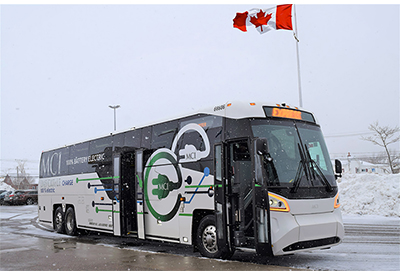
Coach Atlantic Maritime Bus is the first to bring environmental sustainability to long-distance travel in Canada with the test of MCI’s first all-electric coach, the MCI D45 CRTe LE CHARGE, designed for long-range express routes and setting a new standard in accessibility.
MCI and Coach Atlantic Maritime Bus paired for a March 9-11 demonstration tour on Maritime Bus regular routes, inviting passengers to ride along and comment on the performance and comfort of MCI’s first-ever battery-electric Commuter Coach. Government officials, transportation stakeholders and sustainability experts will also take part in the tour.
Mike Cassidy, Principal of the Cassidy Group, said, “Bus travel is already the most-sustainable form of long-distance travel. Now, with MCI’s commitment to battery-electric, we can transform our communities and improve our carbon footprint even further.”
Cassidy Group’s T3 Transit was the first to test a battery-electric, low floor transit bus made by MCI sister company New Flyer on municipal transit routes serving greater Charlottetown on Prince Edward Island in 2018. Coach Atlantic Maritime Bus has committed to green strategies throughout its offices, maintenance hubs and service routes, and anticipates introducing battery electric to its operation by 2022.
“MCI’s electric era has arrived,” said Ian Smart, MCI President. “Backed by extensive testing and technical expertise, robust NFI Parts support, and electric training available to operators’ technicians, our CHARGE model lineup is ready to serve innovators like Coach Atlantic Maritime Bus with long-term reliability. MCI is honored to team with Coach Atlantic Maritime Bus in this milestone moment in Canada, where our Winnipeg production facilities, Montreal-based MCI Service Center and heritage are rooted.”
MCI’s battery-electric coach models have already performed as reliably as the company’s best-selling clean diesel, hybrid-electric, and compressed natural gas (CNG) models during U.S. demonstration tests. MCI’s all-electric move is supported by New Flyer’s 50 years of electric experience and New Flyer Infrastructure Solutions, a full-suite of services that help deliver charging specifications to meet each customer’s needs. New Flyer actively supports over 41,000 heavy-duty transit buses currently in service, of which 7,300 are powered by electric motors and battery propulsion and 1,600 are zero-emission. Its battery-electric bus programs are deployed across North America.
“Our MCI D45 CRTe LE is built for the range and distances required on Coach Atlantic Maritime Bus routes,” said Michael McDonald, MCI’s Sustainable Transportation Specialist. “Projected range is an average of 210 km at 389 kWh.” McDonald holds a Ph.D. in chemistry with post-doctoral work at MIT in battery chemistry.
MCI offers two battery-electric models. The J4500e (bringing all-electric capability to the industry’s best-seller in the tour, charter and employee shuttle markets) will deliver later this year and due to the high floor configuration the coach can be configured for more than 370 km at the top end by adding more batteries to achieve a capacity of 544 kWh. The D45 CRTe LE, which features a revolutionary patented LE (Low Entry) vestibule with a seating area and ramp that significantly improves dwell times and the boarding and ride experience for passengers with disabilities and mobility will be available in 2021.
Both models share the same electric platform. McDonald and the engineering team at MCI have spent the past two years testing MCI’s first battery-electric vehicles in varied road and weather conditions including extreme cold and snow in Michigan’s Northern Peninsula during 2019’s polar vortex.
Coach Atlantic Maritime Bus will also test MCI’s latest safety and fleet management technology on the new 54-seat MCI D45 CRTe LE model, including the benefits of MCI Connect Telematics. MCI’s new diagnostic system, standard on 2021 coaches, will measure key performance metrics including distance and time on route, auxiliary systems and battery efficiency related to grade and ambient temperature in real time. According to MCI’s McDonald, the data collected will be used to help Coach Atlantic Maritime Bus plan its future fleet needs.
Coach Atlantic Maritime Bus said its consideration of battery-electric also includes savings and maintenance costs compared to diesel coaches. With battery-electric buses, engine oil and filter changes, emissions and transmission systems are eliminated, and there is less brake wear due to the electric motor’s regenerative braking capability.
Each day, Coach Atlantic Maritime Bus provides affordable service to the three Maritime Provinces with connecting service to central Canada. Says McDonald, “Electric coaches can absolutely transform distant travel, and the D45 CRTe LE brings the benefit of appealing to more riders,” noting that MCI is the only motor coach manufacturer to involve people with disabilities and their advocacy groups in the design of an actual motor coach. “We’re proud to demonstrate both the accessibility and zero-emission technology breakthroughs offered by MCI throughout the Maritimes. We thank Coach Atlantic Maritime Bus for this opportunity.”