WAGO Canada Unifies Data Centre Control to Reduce Time to Market and Eliminate Rework

April 30, 2026
WAGO Canada’s vendor-independent architecture enables faster integration and consistent operation across power distribution and HVAC systems.
Data centres are under pressure to scale rapidly, with operators building and expanding capacity as quickly as possible to meet accelerating compute demand. This pace is already creating supply constraints across critical power, cooling, and infrastructure components, while increasing the complexity of integrating diverse systems into a consistent operational environment.
WAGO Canada addresses these challenges with an automation architecture designed to help operators scale quickly without being locked into a single vendor ecosystem. By establishing a consistent control layer across power distribution, HVAC, and supporting infrastructure, new systems can be integrated rapidly as capacity grows, even when equipment availability varies. Built on industrial PCs or WAGO controllers and using CODESYS (an open IEC 61131-3-based control programming environment), the architecture allows control logic to run across different hardware platforms with minimal modification, enabling systems to be deployed and expanded without redesigning or rewriting applications, saving time, reducing engineering effort, and lowering cost.
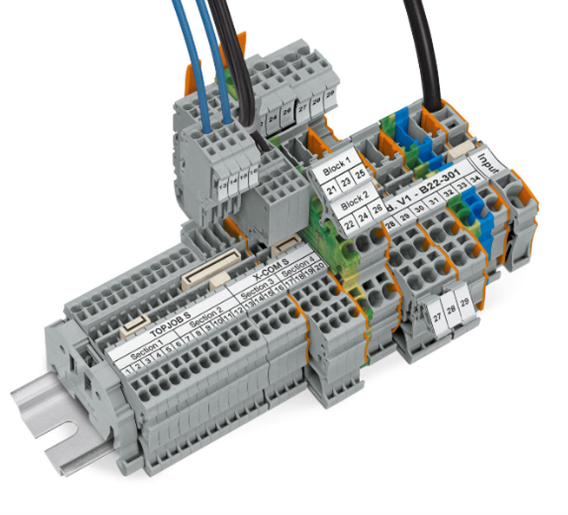
TOPJOB® S Rail-Mount Terminal Blocks:
In various industrial applications and modern building installations, WAGO’s TOPJOB® S Rail-Mount Terminal Blocks offer more than just reliable electrical connections.
The architecture for hyperscale, enterprise, and co-location data centres separates control logic from physical I/O, allowing power distribution, cooling, and supporting systems to be integrated quickly regardless of vendor. This flexibility helps mitigate supply chain risks by allowing operators to incorporate available equipment without being constrained by proprietary control systems. It also provides a scalable control foundation across both electrical and thermal systems, reducing the need for multiple specialized platforms and simplifying operations by enabling teams to work within a single control environment. This reduces integration effort, accelerates commissioning, and ensures predictable system performance as new capacity is added.
Power distribution: maintaining stable, coordinated power under changing load
As computing demand increases, data centres deploy additional switchgear, uninterruptible power supply (UPS) systems, busways, and power distribution units. These systems must be integrated in a way that maintains stable voltage, load balance, and system protection. A scalable control approach enables these assets to be incorporated quickly within a consistent framework, allowing operators to adapt to equipment availability while maintaining coordinated system performance.
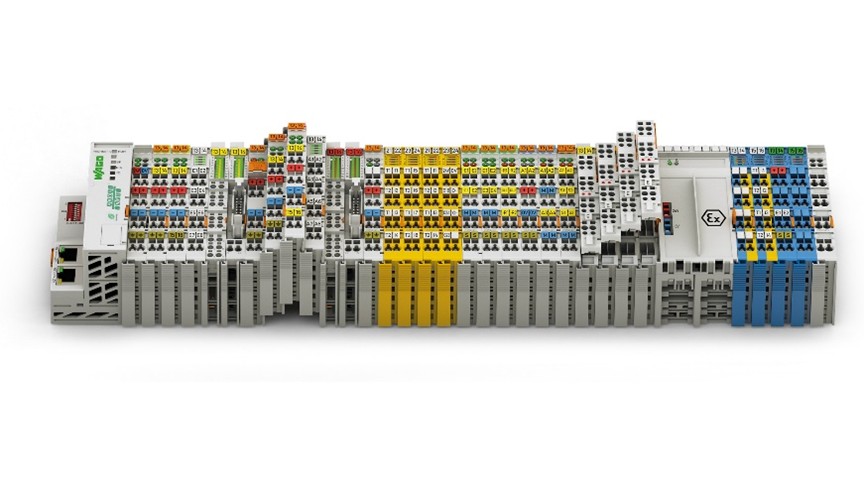
WAGO I/O System 750 series Decentralized peripherals for every application:
Boasting more than 500 I/O modules, programmable controllers and fieldbus couplers, WAGO’s remote I/O system offers all the functions required for your automation needs – and for every fieldbus.
WAGO addresses this at the connection layer with its TOPJOB® S rail-mount terminal blocks, where CAGE CLAMP® spring pressure technology eliminates the need for re-torquing connections over time, supporting high availability in uptime-critical environments. At the system level, the 750 Series I/O System brings power monitoring and protection signals into a consistent control environment. This allows new electrical infrastructure to be incorporated without rewriting control logic or rebuilding the control system.
The result is stable, coordinated power delivery that protects computing operations as capacity increases.
HVAC and thermal management: coordinating cooling systems as loads change
Cooling infrastructure including liquid and air cooling systems comprises chillers, computer room air handling (CRAH) units, rooftop systems, pumps, and air handling equipment, typically supplied by multiple vendors. As demand increases, these systems must be deployed and coordinated quickly while maintaining temperature stability.
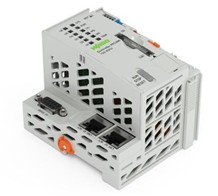
WAGO Controller PFC 300Powerful and flexible for medium to large applications:
The WAGO PFC 300 Controller boasts fast data processing, 2 GB of RAM and a 64-bit dual-core processor – ideal for demanding tasks
WAGO addresses this with its PFC300, which manages control logic across distributed systems, and BACnet and Modbus interface modules within the 750 I/O System, which connect directly to cooling equipment. These components bring new cooling assets into the existing control structure, allowing them to operate within the same control logic as systems are added. This enables additional cooling capacity to be commissioned quickly while maintaining stable thermal conditions across the facility.
The same control framework applies across power distribution and supporting infrastructure, enabling operators to scale both electrical and thermal capacity without being constrained by vendor-specific control systems.
“Data centre growth today is defined by speed. Every delay in bringing new capacity online has a direct impact on revenue,” said Tyrone Visser, Head of Smart Industry – Automation (Americas), WAGO. “Our focus is helping operators standardize their control foundation so they can deploy power and cooling systems quickly, using whatever equipment is available, without being slowed down by vendor-specific constraints.”
Contact WAGO Canada to discuss data centre applications at 1-888-WAGO-221 (9246-221) and visit www.WAGO.com/ca to explore its full range of data centre automation solutions or write customerservice.ca@WAGO.com.