Building Construction Price Indexes, Second Quarter 2026

July 30, 2026

Residential building construction costs increased 0.5% in the second quarter, following a 0.7% increase in the previous quarter. Non-residential building construction costs rose 1.4% in the second quarter, following a 0.9% increase in the previous quarter.

Year over year, construction costs for residential buildings in the 15-census metropolitan area (CMA) composite rose 2.3% in the second quarter, while non-residential building construction costs saw an increase of 3.5%.

The construction industry faced several challenges in the second quarter, as geopolitical tensions drove higher oil prices; retaliatory tariffs between Canada and the United States disrupted supply chains; regulatory uncertainty delayed purchases; and seasonal construction projects further intensified demand for an already constrained skilled trades workforce. Builders across the country reported that higher fuel prices contributed to increased operating costs, increasing costs related to construction equipment and machinery, as well as the transportation of building materials.

Regional factors also contributed to cost pressures and uncertainty. Builders in Ontario noted that uncertainty surrounding the implementation of the federal GST/HST rebate continued to delay purchasing decisions, particularly for new homes, as developers and buyers awaited the legislation required to make rebate claims, which came into effect on June 22, 2026. In Quebec, builders reported that annual construction union wage increases contributed to upward pressure on construction costs in the province. Taken together, these factors contributed to a challenging operating environment for builders across the country during the second quarter.
Metal fabrications division leads residential construction cost growth

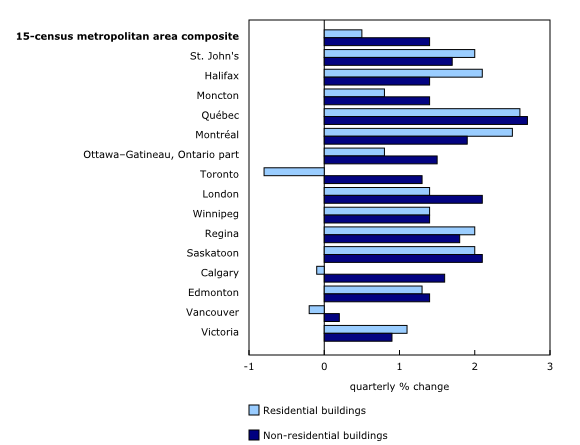
In the second quarter, residential building construction costs rose across nearly all CMAs, with Québec (+2.6%) reporting the largest quarterly increase, followed by Montréal (+2.5%). Increases were also notable in Halifax (+2.1%), Saskatoon (+2.0%), and Regina (+2.0%). Calgary (-0.1%), Vancouver (-0.2%), and Toronto (-0.8%) were the only CMAs to experience declines in the second quarter.

At the division level for residential building construction, the metal fabrications (+2.1%) division saw the largest quarterly increase in the second quarter, followed by the structural steel framing (+1.8%) and earthwork (+1.5%) divisions. In contrast, the conveying equipment (-0.2%) and wood, plastics and composites (-0.3%) divisions recorded price declines in the second quarter. Metal and steel products continued to lead cost increases due to the upward price pressure associated with implemented retaliatory tariffs and the related supply chain disruptions.

Québec leads non-residential construction cost growth

The cost of constructing non-residential buildings increased the most in Québec (+2.7%) in the second quarter, followed by Saskatoon (+2.1%) and London (+2.1%). Montréal (+1.9%) and Regina (+1.8%) also reported similar growth. In contrast, Victoria (+0.9%) and Vancouver (+0.2%) showed the smallest growth in the second quarter.

At the composite level, non-residential building construction costs increased across all divisions measured in the second quarter, with the conveying equipment (+2.9%), earthwork (+2.2%), structural steel framing (+2.2%) and metal fabrications (+2.0%) divisions recording the largest increases. Increases in these divisions reflected rising oil and fuel related prices, as these segments are heavily reliant on the use of machinery and equipment, and the transportation of materials. Price pressure across most other segments was moderate through the second quarter, while the finishes (+0.5%) and wood, plastics, and composites (+0.5%) divisions experienced the smallest price growth in the quarter.

Related Articles


Latest Articles

  • Resilient but Not Ready: Affordability, Trade and Workforce Barriers Limit Alberta’s Retrofit Supply Chain

    Resilient but Not Ready: Affordability, Trade and Workforce Barriers Limit Alberta’s Retrofit Supply Chain

    July 30, 2026 Alberta’s building retrofit sector is ready to scale and could generate $5.8 billion in GDP and support 24,000 jobs with $2.5 billion in annual investment — but only if governments, utilities, and industry align on a clear, coordinated strategy. Resilient but Not Ready shows that while Alberta’s retrofit supply chain is adaptable and… Read More…

  • Lighting 101: How to Choose the Right LED Replacement

    Lighting 101: How to Choose the Right LED Replacement

    July 30, 2026 By EB Horsman & Son Not all LED replacements are created equal. Whether you’re replacing a single light fixture in your home or upgrading lighting throughout your building, choosing an equivalent LED replacement isn’t always as simple as matching the wattage or colour temperature. Many homeowners, contractors, facility managers, and property managers… Read More…

  • Lighting an Industrial Facility: Designing for Safety, Productivity & Performance

    Lighting an Industrial Facility: Designing for Safety, Productivity & Performance

    July 30, 2026 By CSC LED When planning an industrial facility, lighting is often discussed by fixture type—high bays, wall packs, flood lights, emergency lighting, and so on. In reality, successful lighting design starts by understanding how each space is used. Every area of an industrial property has different visual requirements. A parking lot prioritizes… Read More…

  • Gescan Milwaukee Tent Events

    Gescan Milwaukee Tent Events

    July 30, 2026 Take advantage of exclusive event‑day pricing, live hands‑on demos with Milwaukee Specialists, and explore new and featured solutions across power tools, lighting, safety, batteries, and accessories. Enjoy food, giveaways, and prize draws happening at the branch for ONE DAY ONLY! BONUS ITEMS: Visit one of Gescan’s participating locations starting at 7:00 am, don’t… Read More…


Changing Scene

  • Copper Thefts on Bell’s Network Surge 78% at the Mid-Year Mark

    Copper Thefts on Bell’s Network Surge 78% at the Mid-Year Mark

    July 30, 2026 Copper theft continues to rise across Canada, with serious consequences for communities and the critical services they rely on. In the first half of 2026, Bell has seen a surge in theft and vandalism targeting telecommunications infrastructure, causing service outages that can disrupt Internet, TV and phone services — and, most importantly,… Read More…

  • Electrozad Launches Enhanced Digital Solutions with Improved eCommerce Website and New Mobile App

    Electrozad Launches Enhanced Digital Solutions with Improved eCommerce Website and New Mobile App

    July 30, 2026 Electrozad, a Sonepar company, is proud to announce the launch of its newly enhanced eCommerce website and new mobile app, marking a significant milestone in the Electrozad’s digital evolution and commitment to delivering the best customer experience. The digital platforms are now available to customers across Southwestern Ontario, making it easier and… Read More…

  • Seacliff Electric Introduce New Regional Manager for Calgary Operations

    Seacliff Electric Introduce New Regional Manager for Calgary Operations

    July 20, 2026 Seacliff Electric are pleased to announce that Joe Niosi has accepted the position of Regional Manager for their Calgary operations. “Joe has been an important member of our team and brings extensive experience in the electrical construction industry, project execution, leadership, and team development. Through his time as our Service & Special… Read More…

  • Electrical Safety Authority Welcomes Federal Action on Copper Theft, Citing Deadly Risks to Public and Workers

    Electrical Safety Authority Welcomes Federal Action on Copper Theft, Citing Deadly Risks to Public and Workers

    July 20, 2026 New sentencing provisions recognize serious public safety consequences of crimes targeting electrical infrastructure. The Electrical Safety Authority (ESA) welcomes the federal government’s implementation of provisions within the Bail and Sentencing Reform Act (Bill C-14) that strengthen consequences for crimes that damage or interfere with essential infrastructure, including copper theft. Copper theft is a growing challenge… Read More…