New ABB and BCG Report Highlights Growing Role of Direct Current Technologies in Future Power Systems
September 16, 2026
- Rapid expansion of AI computing, increasing electrification and rise of renewable energy are driving renewed interest in DC technology as part of future electrical systems
- Both AC and DC systems have strategically important roles in meeting future electricity demand
- Establishing common standards and developing DC-specific skills can help accelerate deployment
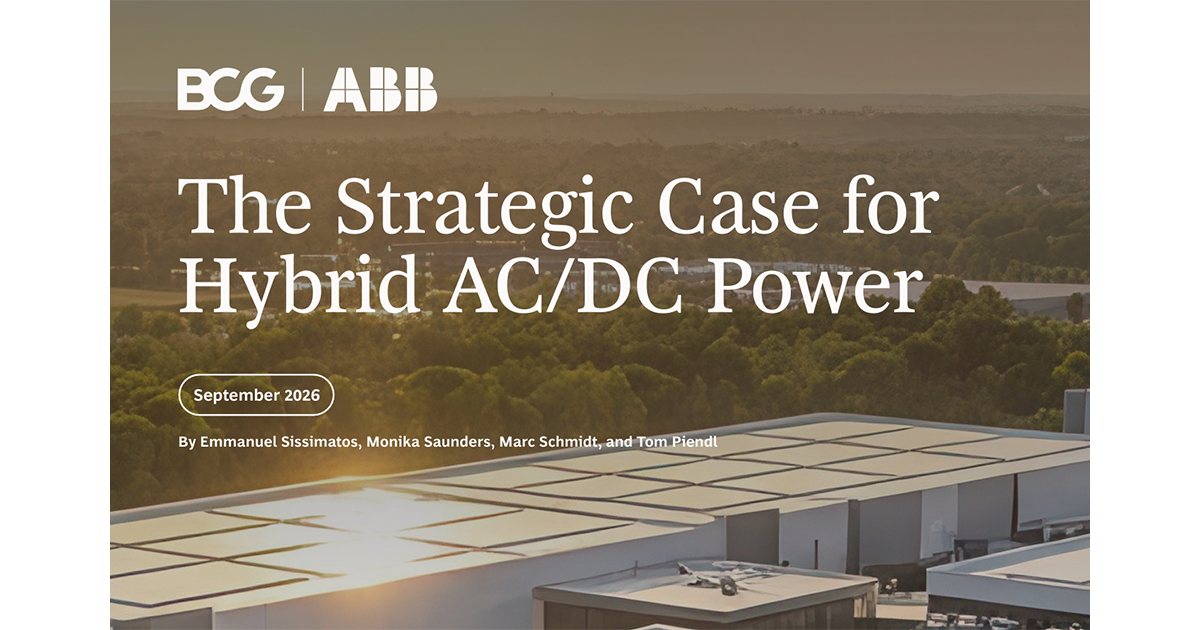
ABB published a new report on September 9, 2026, The Strategic Case for Hybrid AC/DC Power: Shaping the Transition to the Next Electrical Architecture, developed in collaboration with Boston Consulting Group (BCG). The report makes the case that direct current (DC) technology is moving from the periphery to the center of industrial, commercial, and digital infrastructure – and that the decisions made by business leaders and policymakers in the next two to three years will determine who shapes that transition and who inherits it.
The future of power distribution is not an either-or choice between alternating current (AC) and direct current, but a hybrid system that combines the strengths of both technologies. While AC will remain the backbone of most transmission and regional distribution networks, DC is expected to play an increasingly important role within facilities where many major energy sources and loads already operate natively on direct current.
The fastest-growing technologies, including solar photovoltaic systems, batteries, electric vehicles, AI data centers and many industrial automation systems, are inherently DC-based. As these technologies scale, reducing the number of power conversion steps between generation, storage and consumption can improve efficiency, increase the usable capacity of an existing grid connection and simplify integration.
The report identifies AI data centers as one of the most immediate drivers of DC adoption. As AI workloads continue to increase power density requirements, conventional electrical architectures are reaching practical limits. The report finds that 800 VDC distribution is emerging as the defining architecture for next-generation AI infrastructure, enabling operators to maximize compute capacity within constrained grid connections while improving energy efficiency.
At the same time, the shift is also relevant for a range of other key industries with the research highlighting several opportunities beyond data centers. Automation-intensive manufacturing facilities, commercial buildings and, over the longer term, buildings can also benefit from DC systems or subsystems through lower conversion losses, more effective integration of onsite renewables and storage, and enhanced operational flexibility.
“In a world that will require more power while operating within the constraints of existing infrastructure, enabling broader adoption of DC systems will require stronger collaboration among business leaders, policymakers and technology stakeholders, as well as greater attention to the role DC can play,” said Morten Wierod, Chief Executive Officer of ABB.
“For more than 25 years, ABB’s DC solutions have helped customers reduce conversion losses, improve power transfer efficiency and lower electricity demand. To enable broader adoption where the business case is strongest, we need common technologies, harmonized standards, and the workforce capabilities to support implementation at scale. AC and DC each have important roles to play, and together they can help build a more efficient, resilient and future-ready electrical system.”
As part of the report, ABB and BCG address several long-standing misconceptions that have slowed DC adoption concluding that concerns around scale, safety and economics increasingly reflect outdated assumptions rather than the capabilities of today’s technologies. Instead, fragmented standards and a shortage of DC-specific skills are seen as the primary challenges that need to be addressed urgently to accelerate deployment.
ABB was the first company to demonstrate the energy-saving potential of DC in vessels with a DC-based onboard power system that achieved fuel savings of up to 27 percent and launched the industry’s first solid state circuit breaker in 2022. With more than 700 DC-related patents, ABB is now bringing DC distribution to a much broader range of applications, including electric transport, microgrids and data centers. It is also working with industry partners to explore how DC distribution can support low-carbon aluminum production and the production of green hydrogen.




![Guide to the Canadian Electrical Code, Part 1[i], 26th Edition– A Road Map: Section 70 & Section 72](https://electricalindustry.ca/wp-content/uploads/2026/05/EIN-Stock-Guide-Code-Canada-Map-1200-768x403.png)