Schneider Electric Expands Connectivity Ecosystem for Residential and Hospitality Sectors
July 2, 2020
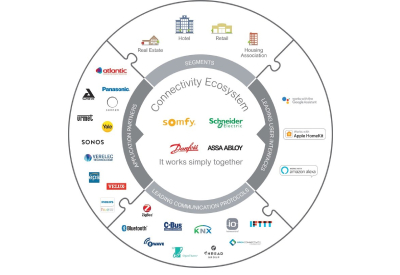
The Connectivity Ecosystem, a partnership between Schneider Electric, Somfy and Danfoss, welcome its newest member to the alliance, ASSA ABLOY, a company that provides access solutions that enable safe, secure and convenient access to physical and digital places.
With a combined vision of driving simple, safe and seamless solutions for both residential and commercial applications, the partnership will deliver a superior value proposition to customers, combining expertise in comprehensive solutions bringing connectivity to the next level in this increasingly digital age.
The interoperability of products and apps offers users and occupants secure, simple and full experiences, while balancing operational cost-optimization and energy management systems.
“We are excited to join the Connectivity Ecosystem at a time when people are more than ever looking at ways to ensure their homes are comfortable and safe,” said Christophe Sut, Head of ASSA ABLOY Global Solutions and Executive Vice President at ASSA ABLOY Group. “In many cases, our products and apps are the first point of contact for a person going into a home or commercial building, and starting to use a series of services, and the last point of contact as they leave.”
In the wake of global lockdowns due to the COVID-19 pandemic, these integrated solutions allow homeowners, real estate and hotel groups to easily adopt new hygiene measures. When smart building systems work together, the Connectivity Ecosystem offers minimized touchpoints, improved air quality and renewal, and energy saving mechanisms.
Together, the partners in the Connectivity Ecosystem are putting their expertise and data at the service of solutions to help people feel safer and more comfortable at home, addressing specific touchpoints like door handles, access code panels, door entry systems and how they could evolve:
- Antimicrobial solutions such as using bacteria killing materials on light switches
- Hands-free solutions using automation, motorized shutters, blinds and doors, gesture-controlled
- interfaces and sensors
- Low touch methods where entry and interaction are achieved with personal devices like
- smartphones rather than shared touchpoints like keypads and panels
- Smarter systems to control access of guest and visitors – entrance solutions providing counting and real-time control of temperature, or providing temporary access codes and camera-controlled access
- Smarter systems to improve air quality such as automation for windows.
Ensuring safe spaces in hotels
Hospitality solutions adopted by major hotel groups are also evolving to respond to the new safety measures created in response to the pandemic. Integrated apps and solutions help empower guests, limit touchpoints and guarantee comfort in hotel rooms and common use spaces like restaurants and lobbies.
The Connectivity Ecosystem allows guests to be in control in their hotel rooms through voice and app controls, access solutions and integration of anti-bacterial and anti-microbial touchpoints like light switches and control panels. In common areas, solutions including ventilation control and motion detectors will allow for new social distancing and room temperature checks.
The Connectivity Ecosystem offers hotel solutions that integrate increased voice or motion control minimizing touchpoints, managing tasks like opening doors, controlling light, heating and cooling and providing comfort like water sanitation and water heating.
Global hotel chains including Hyatt, Hilton and Marriott continue discussions with partners in the Connectivity Ecosystem to integrate tailored solutions across hotel portfolios.
Integrated solutions for energy efficiency
The proportion of energy supplied by renewables is expected to grow by a factor of 2.5 by 2050, becoming the number one source of energy, and increased electrification and digitization can help achieve recovery and sustainability goals.