Building Permits Decline for 2nd Month in September
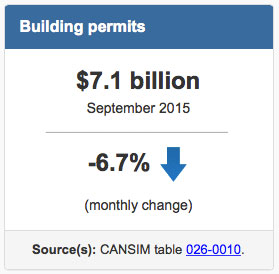
Municipalities issued $7.1 billion worth of building permits in September, down 6.7% from the previous month. This was the second consecutive monthly decline. Lower construction intentions for residential buildings and commercial structures in Ontario largely explained the decline.
Chart 1: Total value of permits

The value of residential building permits declined 11.6% from August to $4.2 billion in September. This marked the second consecutive monthly decline following two months of gains. Decreases were registered in five provinces, led by Ontario, followed by Saskatchewan and Quebec. Manitoba and Alberta registered the largest increases in residential construction intentions.
Construction intentions for non-residential buildings rose 1.6% to $2.9 billion in September, the first increase in three months. Gains were recorded in six provinces, led by Saskatchewan, followed by Alberta and Quebec. Ontario reported the largest decline, followed by British Columbia.
Residential sector: double-digit decline in multi-family dwelling construction intentions
The value of building permits for multi-family dwellings declined 20.0% to $1.8 billion in September, marking the second decrease in three months. Much of this decline came from Ontario, which had posted a large increase the previous month. Manitoba and Alberta recorded the largest gains in the component.
The value of single-family dwelling permits was down 3.7% to $2.3 billion in September. This was the second consecutive monthly decline. Decreases were posted in five provinces. Ontario accounted for most of the decline, with British Columbia and New Brunswick a distant second and third. The largest advances were in Quebec and Alberta.
Municipalities approved the construction of 16,907 new dwellings in September, down 9.4% from August. The decline came from multi-family dwellings, which fell 11.6% to 11,235 new units, and single-family dwellings, which decreased 4.8% to 5,672 new units.
Chart 2: Residential and non-residential sectors
Non-residential sector: higher construction intentions in the institutional and industrial components
In the institutional component, the value of permits rose 15.6% to $744 million in September, the first increase in three months. The advance at the national level was attributable to higher construction intentions for medical facilities. Gains in four provinces, led by Saskatchewan and Ontario, were sufficient to offset declines in the other provinces. British Columbia and Alberta recorded the largest declines in construction intentions for institutional buildings.
The value of permits issued for industrial buildings rose 16.3% to $550 million, following two consecutive monthly declines. The gains were primarily attributable to increases in the value of building permits for utilities buildings and manufacturing plants. Gains were reported in five provinces, led by Quebec, British Columbia and Ontario, while the most notable declines were in Saskatchewan, New Brunswick and Alberta.
Construction intentions for commercial buildings fell 7.8% to $1.6 billion in September, following a 10.9% increase in July and a 2.4% advance in August. Lower construction intentions for office buildings and recreational facilities largely explained the decline in the component. Decreases were posted in three provinces, led by Ontario, which had posted a notable increase in commercial building construction intentions the previous month. The largest gains were in Alberta and Saskatchewan.
Provinces: Ontario posts notable decline
The total value of permits was down in four provinces in September, with Ontario posting the largest decline, followed by British Columbia.
The large decrease in Ontario was the result of lower construction intentions for multi-family dwellings, commercial buildings and, to a lesser extent, single-family dwellings. In British Columbia, the decline stemmed from institutional buildings, commercial structures and single-family dwellings.
In contrast, the largest gain was in Saskatchewan, where notable increases in the value of permits issued for institutional structures and commercial buildings were responsible for the rise. Advances in Alberta and Manitoba were, in turn, a result of higher construction intentions for commercial buildings and multi-family dwellings.
Construction intentions down overall in census metropolitan areas
In September, the total value of building permits was down 10.7% overall in census metropolitan areas (CMAs), with Toronto registering the largest decline, followed by Vancouver and Guelph. In contrast, construction intentions for regions outside CMAs increased by 9.3% in September.
In Toronto, the decline resulted mostly from lower construction intentions for commercial buildings and multi-family dwellings. In Vancouver, the decrease came mainly from institutional buildings, although all components were down. In Guelph, residential buildings and commercial structures accounted for most of the decline.
The largest increase was in Edmonton, followed by Ottawa and Oshawa.
The large gain in Edmonton occurred mainly as a result of higher construction intentions for commercial buildings and multi-family dwellings. In Ottawa, the advance was attributable to commercial buildings, single-family dwellings and industrial buildings. In Oshawa, the gain was largely a result of higher construction intentions for single-family dwellings and industrial buildings.
Source: Statistics Canada, www.statcan.gc.ca/daily-quotidien/151106/dq151106b-eng.htm?cmp=mstatcan.