Intelligent Heating: A Key Vector for Energy Efficiency
Nov 18, 2018
By Étienne Bolze and Youri Cupidon
In winter, heating accounts for an average of 60% of the residential electricity consumption of Quebec households. How to reduce this load without compromising comfort? How to improve the energy efficiency of our residential electric heating? Read on to learn more.
How to combine energy efficiency and comfort?
What is an electric heater for? Certainly, the first reason is to ensure the thermal comfort of the user. On the other hand, knowing that 60% of the electric household use of the average Quebec household is consumed by heating, we can deduct that it also has a role to play in the energy efficiency of houses as well as have an impact on family finances. The following question therefore arises: how to increase the energy efficiency of electric heating without compromising the comfort of its user? At Convectair, we believe that the answer lies in the intelligence of the control and its information sensors.
Passive intelligence
To better understand the importance of the heater’s control and its temperature sensor for energy efficiency, it would be beneficial to understand some of the evolutions that these objects have experienced.
• The bimetal thermostat. Historically known as the conventional wall thermostat, its operating principle is based on the expansion of a bimetallic strip. When it expands sufficiently due to a change in temperature, the strip turns the heating on or off. This type of control is generally not very precise, nor is it very responsive to temperature variations in the room.
• The digital thermostat. This type of thermostat is equipped with a probe and programming capabilities that allow it to read and act on the room temperature more accurately. These probes are also more sensitive to temperature variations in the room. As a result, it is possible to get an energy saving of 5 to 10% thanks to the increased sensitivity of these thermostats and the decrease in the heating range.
• The programmable thermostat. This type of thermostat is characterized by a particular programming function. Indeed, this feature offers the possibility of creating activity schedules that can be lowered at times when it is less relevant to heat, such as at night or during our absences. They allow adapting in advance the heating to adjust it to the daily schedule of the user. A study published by Hydro-Québec mentions that a decrease of 3˚C for 8 hours each night allows an additional saving of up to 5% on heating consumption.
• The wall thermostat vs. built in. Over the years, we have also seen distinctions in the positioning of the control. While some heaters, such as baseboards, place the thermostat on the wall, other types of heaters have their built-in thermostat directly on the inside. This position would allow the probe at the bottom of the unit, where the air is the coldest, to have a more useful reading of the ambient air. This reading combined with a good device design that correctly distributes the air in the room offers the user a more homogeneous comfort.
Not experiencing temperature stratification problems, the user will be less inclined to compensate by increasing the degree of heating. The result: energy savings.
Nevertheless, whether on the wall or in the device, these different types of controls are rigid and do not adapt well to the real life of the user. Although they can offer energy savings, they remain constrained to human manipulation. We could call them “passive”. The next step in the direction of energy efficiency is devices that adapt to the lifestyle of the user. We could call them “dynamic” or “active”.
Active and mindful intelligence of its environment
To ensure that the devices can actively work towards energy efficiency and comfort, it is necessary to improve the performance of the information sensors and the intelligence of the control.
The sensors
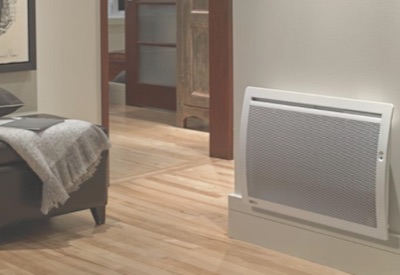
Including sensors on heaters helps to identify and act upon collected information about their environment. The first of the sensors is the temperature sensor or probe. On the other hand, it is possible to include other elements onto heating devices to increase the effectiveness of these products. It is possible, as Convectair has done for its Opera line of radiant heaters, to include an absence detector on the front of the device. This eye allows knowing if someone is present in the room or not. Thus, if the device does not detect human presence, it will lower its heating temperature by a few degrees. By automatically reducing its activity at several moments of absence, the device makes it possible to save energy in the long term. (Shown in photo: Opera 17.)
Controls
The usefulness, relevance, and impact of the data collected by the sensors are all the more meaningful when they are managed and leveraged by intelligent controls. For example, the Opera’s open window detection feature allows you to save energy by using data collected by the probe and combining them with time factors. Indeed, if the sensor detects a drastic drop in temperature in the room in a short period of time, the device assumes that a door or window has been opened. It stops heating and waits for the user to turn the unit back on. Thus, rather than running at full speed to remedy the loss, the device stops and saves energy.
In addition, new types of platform-based controls seek to use the intelligence and sensors of each device with the benefit of centralization. For example, when these platforms have energy consumption management functions, they use the information collected by each device and centralize it, allowing users to graphically display their total consumption. They can therefore take action to increase the energy efficiency of their home.
When these platforms allow it, remote control offers users significant gains because it allows overriding programmed schedules if unforeseen events occur. Also, when offered, scenario functions automate certain tasks based on user actions to achieve energy efficiencies. For example, turning off the lights at night before going to bed could automatically reduce heating by 3˚C. Together, these energy-saving features can accumulate to create substantial gains in energy and money.
Finally, as illustrated in the previous example, the more the objects of the home collaborate and communicate together, the greater the synergy effect and the impact on the home’s energy efficiency. For these different objects to reach their full potential, ecosystems integrating connected objects are essential.
Artificial intelligence
Lately, we have started seeing the inclusion of artificial intelligence capabilities within the programming of the platforms. Equipped with this new intelligence combined with the use of sensors on heating units, the heaters can learn about the user’s daily life and adapt to it. For example, thanks to an absence detector, the device could understand that no one has been in the kitchen after 8:00 PM for the last 7 days while the user’s programmed schedule mentions a presence up until 10: 00 PM. The platform could therefore, thanks to its capacity of self-adaptation and self-learning, propose to adjust the program to accommodate this new reality. Thus, it would be possible to create even more savings based on actual usage facts.
The choice of heating method: a relevant and intelligent choice
A word must be added about the choice of heating method in the perspective of saving energy. By choosing radiant wall units versus traditional electric baseboards, it is possible to reduce even more the energy consumption of the house without compromising the comfort of the user. Indeed, the combination of direct radiant, diffuse radiant, and convection heat within a single heater creates a homogenous environment in which the user will feel comfortable even if the energy consumption is lower.
In addition, for certain types of rooms such as rooms with cathedral ceilings, radiant heaters are more suitable for saving energy.
Smart heating, a key vector for your energy savings
As we have seen, heaters can have a wider role than just heating a room. Indeed, by using smart sensors and controls, we can reduce the energy consumption of heaters without compromising user comfort. At Convectair, this is what we refer to as energy efficiency.
Étienne Bolze is Marketing & Communications Manager for Convectair; etienne.bolze@convectair.ca. Youri Cupidon is Convectair’s Engineering Technical Director; Youri.cupidon@convectair.ca