The Drivers and Benefits of Edge Computing
Aug 8, 2019
By Steven Carlini, Schneider Electric
Internet use is trending towards bandwidth-intensive content and an increasing number of attached “things.” At the same time, mobile telecom networks and data networks are converging into a cloud computing architecture. To support needs today and tomorrow, computing power and storage is being inserted out on the network edge in order to lower data transport time and increase availability. Edge computing places data acquisition and control functions, storage of high bandwidth content, and applications closer to the end user. This white paper explains the drivers of edge computing and explores the various types of edge computing available.
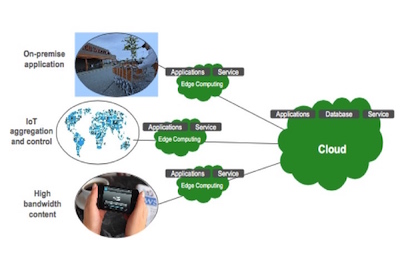
Edge computing is inserted into a logical end point of a network (Internet or private network), as part of a larger cloud computing architecture.
There are three primary applications of edge computing we will discuss in this white paper:
1. a tool to gather massive information from local “things” as an aggregation and control point
2. a local storage and delivery provider of bandwidth-intensive content as part of a con- tent distribution network
3. an on-premise application and process tool to replicate cloud services and isolate the data centre from the public cloud
But before we discuss the applications and solutions let’s define how networking and the Internet works.
“East-west” data transmission
Source data is converted into packets that are transmitted across the network via the networking protocol called IP (Internet Protocol). The Internet routing is handled by another protocol called BGP (Border Gateway Protocol). The Internet was designed to survive massive outages and route around problems. BGP does not factor in timing for data routing. It only looks at the number of hops between two networks trying to communicate. Those hops may be really congested or the route may take a physically long route with fewer hops instead of a very short route with multiple hops. While BGP works really well in terms of reliability, and is a fundamental technology on which the Internet is built, it is really sub-optimal from a latency (delays, jitter, and image freezing) performance standpoint.
“North-south” data transmission
From the inside of the typical cloud data centre network to the outside, data flow goes from a physical server interface through top of rack switches or end of row switches. From each top of rack switch, data goes through an aggregation switch and the aggregation switches route data through a core switch that is the main input and output of the data centre. Each one of these switches transfers data and is considered a network hop with its associated data slowdown and possibility of network congestion. If there is an oversubscription in any network layer (i.e., bandwidth is not sized for peak output), there is further potential of additional slowdowns during these periods of heavy usage.
Latency is the time between the moment a data packet is transmitted to the moment it reaches its destination (one way) and returns (round trip). Even though most data travels only one way, it is almost impossible to measure. That is why round-trip time from a single point is the most common latency measurement. Round trip latencies of less than 100 milliseconds (ms) are typical and less than 25 ms desired.
Bandwidth refers to the transmission speed of data on the network. Networking equipment maximum speeds are published by their manufacturers. However, the actual speed obtained in a given network is almost always lower than the peak rating. Excessive latency creates traffic jams that prevent data from filling the network to capacity. The impact of latency on network bandwidth can be temporary (lasting a few seconds) like a traffic light, or constant like a single lane bridge. The greatest probability of network congestion is from high band- width video content. VoD, 4K TV, and video streaming are the fastest growing high bandwidth applications.[1]
In order to relieve network congestion to improve streaming of high bandwidth content now and in the future, service providers are interconnecting a system of computers on the Internet that caches the content closer to the user. This enables the content to be deployed rapidly to numerous users by duplicating the content on multiple servers and directing the content to users based on proximity. These computers caching content are an example of edge computing.
The technologies that will enable “smart” everything — cities, agriculture, cars, health, etc. — in the future require the massive deployment of Internet of Things (IoT) sensors. An IoT sensor is defined as a non-computer node or object with an IP address that connects to the Internet.
As the price of sensors continues to decline, the number of connected IoT things will skyrocket. Cisco estimates the IoT will consist of 50 billion devices connected to the Internet by 2020.[2] IoT can automate operations by
• gathering information automatically about physical assets (machines, equipment, devices, facilities, vehicles) to monitor status or behaviour
• Uusing that information to provide visibility and control to optimize processes and re- sources
Machine to Machine (M2M) refers to technologies that allow both wireless and wired systems to communicate with other devices of the same type. M2M is considered an integral part of the IoT and brings several benefits to industry and business in general as it has a wide range of applications in the smart city.
The Industrial Internet of things (IIoT), which includes the harnessing of sensor data, machine-to-machine communication control and automation technologies, generates large amounts of data and network traffic. Proprietary industrial IT systems and networking technologies are migrating to mainstream commercial IT systems that are communicating over IP (Internet Protocol) networks.
Oil and gas exploration is an example of this IIoT application. Multiple flying drones called “aerial data collection bots” examining job sites during oil exploration are generating large quantities of data in the form of high definition video. These job sites are difficult to coordinate with fleets of massive trucks, cranes, and rotary diggers. Legacy methods of traffic management have used manned helicopters for surveillance video. Self-piloted drones can photograph job sites 24 hours a day providing site managers an up-to-the-minute view of how their resources are deployed. Relying on edge computing allows the drones to transmit the data in real time and receive instructions in a timely fashion.
The need to maintain or increase availability of IT and its networks is almost always a top of mind concern. Cloud computing has always been a centralized architecture. Edge computing transforms cloud computing into a more distributed computing cloud architecture. The main advantage is that any kind of disruption is limited to only one point in the network instead of the entire network. A Distributed Denial of Service (DDoS) attack or a long lasting power outage, for example, would be limited to the edge computing device and the local applications on that device as opposed to all applications running on a centralized cloud data centre.
Companies that have migrated to off-premise cloud computing can take advantage of edge computing for increased redundancy and availability. Business critical applications or applications needed to operate the core functions of the business can be duplicated on site. A way to think of this is a small town using a very large shared water supply as a main source. Should this water supply be interrupted due to a disruption caused in the main supply or distribution network, there is an emergency water tank located in the town.
In general, there are three types of edge computing:
• Local devices — devices sized to accommodate a defined and specified purpose. Deployment is “immediate” and they are suitable for home or small office applications. Running the security system for the building (Intel SOC appliance) or storing local video content on a DVR are examples. Another example is a cloud storage gateway which is a local device and is usually a network appliance or server that translates cloud storage APIs such as SOAP or REST. Cloud storage gateways enable users to integrate cloud storage into applications without moving the applications into the cloud itself.
• Localized (1-10 racks) data centres — these data centres provide significant processing and storage capabilities and are fast to deploy in existing environments. These data centres are often available as configure-to-order systems thath are pre-engineered and then assembled on site. Another form of a localized data centre is prefabricated micro data centres which are assembled in a factory and dropped on site. These single enclosure systems can be equipped in rugged enclosure types — rainproof, corrosion proof, fire proof, etc. — or normal IT enclosures for an office environment. The single rack versions can leverage existing building, cooling, and power, thereby saving on CAPEX vs. having to build a new dedicated site. Installation requires picking the location in close proximity to the building power and fibre source. The multi-rack versions are more capable and flexible due to scale, but require more planning and installation time and need their own form of dedicated cooling. These 1-10 rack systems are suitable for a broad base of applications requiring low latency, and/or high bandwidth, and/or added security or availability.
• Regional data centres — data centres that have more than 10 racks and are located closer to the user and data source than centralized cloud data centres are called regional data centres. Due to their scale, they will have more processing and storage capabilities than localized 1-10 rack data centres. Even if they are prefabricated they will take longer to construct than localized data centres due to the likely need for construction, permitting, and local compliance issues. They will also need dedicated power and cooling sources. Latency will be dependent on the physical proximity to the users and data as well as the number of hops in between.
Edge computing can solve latency challenges and enable companies to take better advantage of opportunities leveraging a cloud computing architecture. Workloads generated from bandwidth intensive streaming video are causing network congestion and latency. Edge data centres bring bandwidth intensive content closer to the end user and latency-sensitive applications closer to the data. Computing power and storage capabilities are inserted directly on the edge of the network to lower transport time and improve availability. Types of edge computing include local devices, localized data centres, and regional data centres. The one that provides the deployment speed and capacity in-line with future IoT application demands are the localized 1-10 rack versions. These can be designed and deployed quickly and easily with either configured-to-order or prefabricated variants.
Endnotes
1. ACG Research, The value of content at the edge, 2015, p.4
2. Dave Evans, The Internet of Things: How the Next Evolution of the Internet Is Changing Everything, Cisco Internet Business Solutions Group, p. 3
Schneider Electric white papers are now part of the Schneider Electric white paper library produced by Schneider Electric’s Data Center Science Center DCSC@Schneider-Electric.com