TMU Schneider Electric Smart Grid Lab Provides Collaborative Space Critical for Developing Energy Future
Nov 5, 2019
By Blake Marchand
On October 8th, Schneider Electric brought together experts from multiple disciplines to explore the role collaborative innovation will play in the future of sustainable energy and smart grid evolution in Canada. The event was put on to celebrate Schneider Electric’s newly relocated Smart Grid Lab at TMU’s Centre for Urban Energy.
The event included a tour of the lab as well as a panel discussion with Dr. Bala Venkatesh, Toronto Metropolitan University University; Frederick Morency, Schneider Electric; Martin Huang, Hydro One; and Kevin Whitehead, Elexicon. Schneider also put on a brief presentation discussing Energy as a Service.
The panel discussion centred around the collaboration between industry, institution, and government stakeholders required to transition into the future of energy sustainable consumption.
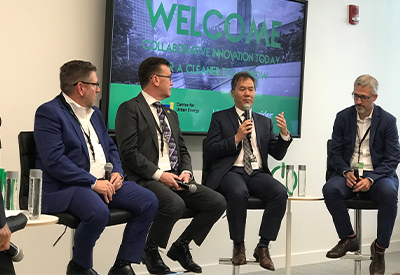
“The future is going to be electric,” explained Fredrick Morency of Schneider Electric, “matter of fact, there’s a projection energy usage from electricity will double in the next 30 years. The answer isn’t technology – certainly technology is going to be part of it – the answer to cope with that increase of demand in electricity is not building a new nuclear power plant or a hydro power plant; that’s not something that can be sustained environmentally. The way we are looking at it, the answer is from energy efficiency.”
“We believe that if you look at the building stock of commercial buildings, industrial buildings, there’s 30% to be saved in terms of energy usage there.”
Morency added that commercial and industrial buildings represent 40% of energy consumed around the world.
As electrification continues into the future, in particular mass electrification of vehicles, the electrical grid will need to be upgraded in order to support an increase in demand. Smart grids, microgrids, energy efficiency and green technology must be utilized in order to meet the demand. Commercial, industrial, and residential buildings (including houses) have to become mini-grids able to achieve net-zero consumption. Something that Morency sees as a possibility in the near future.
“I think it is foreseeable in next five years that there will be residential homes that will be totally autonomous, even being able to be net-positive from energy production.”
Smart grid technology and solutions are a part of that, providing the ability for buildings to operate as their own mini-grid.
Martin Huang of Hydro One commented that in order to continue to “keep the lights on” into the future, and do so sustainably and efficiently, “the only way for us to get to that is through innovation,” he said, “so, continuation of improvement on technology, adaptation of new technology; this is where collaboration is so important.”
Huang noted the development of distribution management technology done in collaboration with BC Hydro and Schneider, as an example. “It’s through working together, finding the scope of what that system is going to be and going from nothing to a computerized system that can monitor and control the grid.” He added that this type of collaboration has to be expanded to include research and development in institutions like TMU, as well as the government. “Policy direction is absolutely essential,” he said.
A lot of that direction, with respect to what the energy future will look like, comes from the provincial level, Huang explained, adding that the federal level needs to participate in the discussion, as well. Government policy is what drives a broader vision.
“We need to get together and let’s agree on the vision. What the system should look like, what the energy infrastructure should look like 5-years from now, 10-years from now.” So, each sector can operate under clearly defined roles tailored to its expertise.
Originally opened in 2015, TMU’s Schneider Electric Smart Grid Lab is meant to foster that type of collaboration and innovation. Providing a hub for researchers and practicing engineers. The state-of-the-art collaborative facility, designed to test and demonstrate smart grid ideas, physically and electrically representing a substation, feeders of any local distribution company, or microgrid.
![Guide to the Canadian Electrical Code, Part 1[i], 26th Edition– A Road Map: Section 74 — Airport installations](https://electricalindustry.ca/wp-content/uploads/2026/05/EIN-Stock-Guide-Code-Canada-Map-1200-768x403.png)



![Guide to the Canadian Electrical Code, Part 1[i], 26th Edition– A Road Map: Section 74 — Airport installations](https://electricalindustry.ca/wp-content/uploads/2026/05/EIN-Stock-Guide-Code-Canada-Map-1200.png)