ABB’s First Carbon Neutral Factory of the Future Delivers on Its Promise
Dec 11, 2019
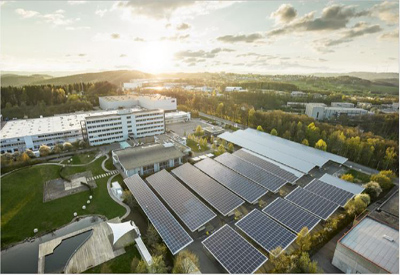
A combination of solar power, smart energy management and a highly efficient cogeneration plant have proven to deliver enough energy to power a whole factory and save huge amounts of CO2. So far, the solar-powered plant at ABB’s Busch-Jaeger subsidiary in Lüdenscheid has generated 721,980 kWH, which equates to a carbon saving of 375 tons during the first five months of operations.
The project is part of ABB’s Mission to Zero and a proof-of-concept that it is possible to build and run a zero emissions factory. On sunny days, the installed ABB technology can generate enough power to run the whole factory and even feed energy into the grid. Whenever the on-site solutions can’t cover a peak in energy demand, additional green energy is sourced from MVV Energie AG, which guarantees 100% CO2-neutral production.
“This flagship project serves as proof that even in industrial settings it is possible to reduce carbon emissions all the way to zero,” says Tarak Mehta, President of the Electrification business at ABB. “This scalable blueprint marks the beginning of an exciting revolution for electrification; one which will transform not only industry, but individual homes up to large cities into safe, smart and sustainable ecosystems.”
Powering the Lüdenscheid factory is an array of photovoltaic solar panels that cover approx. 7,300 square metres and — to save space — are installed on the roofs covering the on-site car park. The system is expected to deliver around 1,100 MWh of climate-neutral solar power a year, which is about as much as the annual demand from 340 private households.
There is also a cogeneration plant on site, which has double the energy efficiency of a traditional coal-fired power plant. Together, the Lüdenscheid factory can generate around 14% more energy on site than it actually needs. Any surplus power is fed into the public grid, contributing to the region’s power supply with sustainably produced energy.
The technological centrepiece of the entire system in Lüdenscheid is the scalable energy management system OPTIMAX from the ABB Ability Energy Management for Sites suite. The digital solution provides for the constant surveillance and optimum control of energy production, consumption and storage and operates largely autonomously. This learning system calculates the optimum energy flow on the basis of predictive data and compensates for deviations in real time.
With this project, MVV and ABB are cooperating to share solutions for the sustainable improvement of energy efficiency in industry, medium-sized companies and municipalities — all designed to create viable smart city concepts. The cooperation between the two companies is not only about the avoidance of CO2 emissions and the economic marketing of available flexibilities in the energy sector, but also about the design of future cities through innovative technologies, such as storage solutions and charging infrastructure for electric vehicles.
In Lüdenscheid, ABB installed not just a new energy management system and the photovoltaic system with inverters, but integrated other ABB technologies like a battery energy storage system (BESS) with an output of 200 kW and a capacity of 275 kWh, and ABB charging points, where staff and visitors can charge their electric vehicles free of charge, which adds to the factory’s regional eco-balance. This single-source energy management solution is rounded off by smart switchgear for energy distribution.
The flagship site is expected to save about 630 tonnes of CO2 a year in total.
The Lüdenscheid factory itself is a typical industrial site, manufacturing products for electrical installation. ABB offers products and services that make a decisive contribution toward greater sustainability in industry. Over half of ABB’s worldwide revenues are generated by technologies that combat the causes of climate change. The company’s goal is to increase this contribution from 57 percent in 2018 to 60 percent by 2020.
Source https://new.abb.com/news/detail/41199/abbs-first-carbon-neutral-factory-of-the-future-delivers-on-its-promise