4 Reasons Why DALI Is the Right Lighting Control for Your Customers
June 7, 2021
The Digital Addressable Lighting Interface (DALI) has been around for decades, dating back to the mid-1990s. The world was amid a digital revolution then, and global lighting manufacturers wanted lighting to join the transformation.
With the creation of DALI, a common set of international standards for lighting control systems, several European lighting manufacturers working together did just that.
Then, after the U.S. joined the effort late in the decade, the industry spearheaded the revolution.
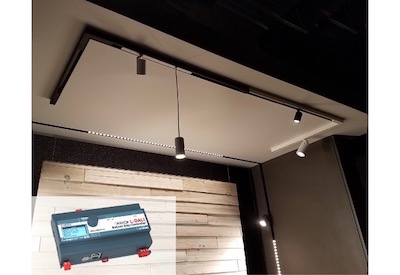
Today, DALI has become the industry open standard for tailoring the needs of present-day LED lighting technology, utilizing a two-way communication system that has brought digital capabilities to lighting. DALI allows interconnected drivers, ballasts, switches, sensors and controllers — regardless of differing manufacturers — to “talk” to the user, who then talks back using a DALI controller, a computer equipped with the appropriate software or a building automation system.
As Wayne Morrow, president of Starfield Controls, explained to Buildings.com, DALI control systems send out messages as computers do, and ballasts receive these messages via addresses. “The ballast with that address picks it up and follows the instruction,” he said.
So, when you say, “‘All lights in Room 10 turn off,’ all the lights in Room 10 know who they are. They pick up that message and say, ‘It says here I’m supposed to turn off.’ And that’s what [happens],” he says.
DALI is simple — and interference-free. “We can all co-exist on a DALI network,” Marrow says. “We worked very hard at that interoperability.”
And yet, while DALI lighting control systems are commonplace in Europe, this mature LED lighting control technology continues to be met with hesitation in the U.S.
Some of the reasons for this reluctance can be attributed to outdated information; others are linked to widespread misconceptions that a little fact-checking can rectify.
Let’s discuss four reasons why DALI is the new standard for digital communication between individual components of a lighting system — and how recent improvements have systematically crossed off your apprehensions.
Why installing DALI is as easy as plug and play
Manufacturers now design DALI to be exceedingly easy to install and commission. Its installation nearly mirrors the process for installing low-voltage controllable lighting systems.
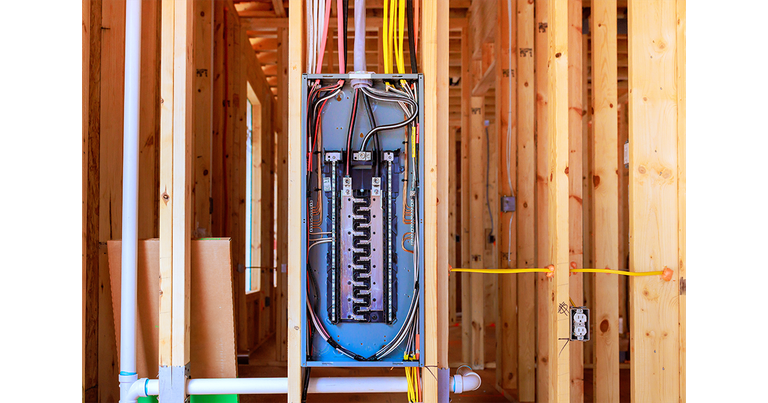
DALI wiring and power wiring can be installed into one conduit with no special wiring requirements to provide a full system solution—fixture, lamp, ballast, wiring and control.
Another reason: DALI installation schemes now include pluggable, prefabricated cable assemblies that speed up installation and reduce unexpected hiccups. Pair these capabilities with a web-based or app-based setup, and installation essentially becomes an easy plug-and-play action item.
First, identify your groupings from the elements displayed on your screen. Then, add how you want them to behave and perform. Later, if you want to add a new feature to the room, your DALI control systems will automatically find that feature and connect it for you.
“You don’t have to re-route the control wiring to the fixtures,” Mike Williams, a former product marketing manager at OSRAM SYLVANIA, told Buildings.com.* “You can just reconfigure the DALI fixture to tell it, ‘Now you take commands for this new control scene (grouping) as opposed to the one that you used to listen to.’ Changes can be done via software instead of going in and doing hard-wire changes.”
Also, he adds, paying for outside, high-skilled labour isn’t needed when installing DALI.
“You can have fairly low-skilled labour pulling in your wire because they don’t need to know about zoning, and they don’t need to keep track of control wires like you would with a relay system,” he said. “The relay system might have 30 or 40 wires in a conduit, and each one has to be labelled, pulled to a specific spot and made up to a specific location and panel. DALI only has two wires, and they go everywhere.”
An easy way to enhance your energy-saving lighting benefits
Congrats, the bulk of your project’s lighting are LEDs, and the benefits are worth the investment. The lighting is extremely energy efficient, using only a tiny fraction of other light types’ energy.
LEDs also last for a long time — an exceptionally long time, between 50,000 to 70,000 hours for most models. In some instances, longer. This lifespan is orders of magnitude longer than other outdated technologies like HPS and halogen. This lifecycle, paired with LEDs’ durability, will keep maintenance costs to almost nil.
But to help your customers get the most out of the investment, consider a DALI lighting control system, which will maximize energy and lifetime savings, provide valuable information, and make it easier to monitor as well as modify your lighting requirements.
Equally important is DALI helps create a supremely comfortable environment with more precise levels of dimming, a must-have for retail, commercial, urban residential and hospitality applications.
“For example, in a ballroom that serves many different purposes throughout the day, one button may be pre-programmed to set the lights appropriately for a morning meeting. Another button may be pre-programmed to set the scene for an evening concert,” experts told Buildings.com.
The best way to future-proof your lighting investment
There are three LED dimming controls commonly used in commercial buildings: DSI, 1-10V and DALI. The first two are prevalent in the U.S. You know them well.
You don’t know DALI as well, and for a good reason, you think it costs more.
Does it?
DALI lighting control systems can be brought and installed for the same cost as its two leading competitors in many instances. Compared to Power over Ethernet (PoE), DALI can provide nearly all the same benefits at a quarter of the price.
Also, consider how much it could save in labour costs later down the road, Marrow tells Buildings.com.
“If you take a traditional 0-10V system and a DALI system, the installed cost for both will be about the same,” he reasons. “Your ballast is going to cost more, but you’ll save in labour because of the lack of lighting circuit requirements. You have fewer home runs going back to electric panels; you have fewer electric panels.”
Another under-the-radar benefit that will significantly reduce expenses: DALI’s web-based or app-based applications will future-proof the upfront investment, automatically updating and quickly reconfiguring devices when requirements, capabilities or legislation changes.
How to gain a winner’s punch in small spaces
A small retailer, a midsize art gallery, a private offer, a grade-school classroom, and a high-rise apartment — none, you think, seem like the right application for such a flexible advanced lighting control like DALI a go-to lighting control systems for large-scale projects.
True, it is, but thanks to its simple wiring systems and easy-to-install simplicity, it’s advantageous for smaller applications.
Many DALI lighting control manufacturers have exclusively constructed their solutions to provide all DALI benefits for smaller projects. A standard method is utilizing a web- or app-based, plug-and-play solution that identities light groupings, adds how you want them to behave and automatically connects new features as they’re added.
Is this lighting control the right fit for my project?
DALI is every bit the lighting control cure-all you’re heard much about. Its installation is uncomplicated and straightforward, it offers unparalleled controllability over your lighting and its capabilities future-proof your project investment.
Still, there’s much to consider. Will your lighting needs throughout the day, between events or before and after specials? Does your building include many multifunction rooms? Is this for new construction?
These questions matter. Choosing the right lighting control manufacturer can help you answer them correctly and ensure your project investment is protected with the proper LED lighting control solution.
Want to learn more?
To learn more about how you can use advanced LED lighting controls to reduce energy and waste, read 5 LED Lighting Control Strategies That Cut Energy Costs
Source
* “Deciphering Digital Addressable Lighting Interface,” Buildings