A Look at DC Microgrids
August 30, 2021
By Craig DiLouie
Direct current (DC) is emerging as a competitive or complementary power distribution option at the grid, community, and building level. Among the advantages for building owners is potential efficiencies in operating DC-based LED lighting and controls as well as plug-and-play sensor and controls installation, including networking that can unlock Internet of Things (IoT) applications.
Due to these advantages coupled with greater resiliency in the event of a grid failure, microgrids are expected to grow to a $25 billion market by 2026 with a CAGR of 24% between 2020 and 2024, according to Global Market Insights.
The EMerge Alliance defines a building DC microgrid as an “electrical system that can efficiently distribute, consume, and potentially create and store direct current (DC) electricity to power a wide variety of electrical devices in and around buildings when connected to a utility grid or when disconnected as an island.”
Microgrids are power sources capable of operating independently of the larger electrical grid, and may be AC, DC, or a hybrid of the two.
A robust DC building microgrid features generators and/or on-site renewable energy sources such as solar panels as well as batteries to store the energy and a DC electrical system to distribute it. Some type of inverter and controller is typically required to connect the renewable energy source and batteries to the building’s electrical system and the larger community grid.

Potential advantages of DC-to-DC power delivery include reliability, energy savings documented at 10-18%, cost efficiencies, and greater sustainability through carbon reduction.
By producing and storing power onsite, the building gains resiliency in the event of a grid failure. By using renewable energy, overall carbon emissions are minimized. And by directly connecting DC power to DC end-use devices such as LED lighting and controls, electrical efficiencies and potential installation and product cost reductions are gained. Low-voltage DC (<60V, considered Class 2 by the National Electric Code) does not require conduit and allows power and control wiring to be combined in a single cable or raceway, reducing installation material and labor.
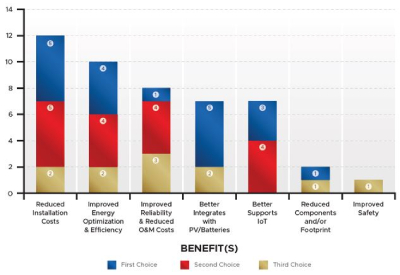
“The key benefit to microgrids is resiliency, though there are additional potential benefits including energy savings, reduced costs, and improved equipment reliability,” said Gabe Arnold, PE, LC, Senior Engineer, Pacific Northwest National Laboratory (PNNL), which recently produced a report on DC microgrids. “Ideal applications are buildings where resiliency and/or sustainability are important and where photovoltaic and/or energy storage batteries are being installed. The resiliency benefits can help avoid costly downtime for a business or critical facility, and the 10-18% energy savings can help achieve a Zero Energy Building and qualify for special LEED points available to DC power systems.”
The number of DC end-use buildings loads is large and growing, including LED lighting, controls, sensors, motors, fans, computers/IT, and other electronics.
In the case of LED lighting, on top of added electrical efficiency, the elimination of the rectifier that converts AC to DC would potentially increase product reliability while reducing materials, size, and cost.

“A recent DOE study that implemented accelerated stress testing on LED drivers found that 64% of the drivers failed within the 6,000-hour accelerated testing period, with all failures attributed to the Stage 1 driver circuitry that performs the AC-to-DC conversion,” Arnold said. “If the conversion circuitry within drivers is eliminated, drivers may cost less and last longer.” He added that there are already many LED lighting products that accept DC at their input.
Another potential advantage for DC building microgrids is gaining infrastructure for plug-and-play installation of LED lighting as well as sensors and controls that can be networked for measuring, monitoring, and IoT integration/data strategies.
“If using power over Ethernet (PoE), the networking is built-in and one of the key benefits of PoE is its integration and IoT potential,” Arnold said. “You don’t have to use POE though, and a wireless networked lighting control system can work just as well with DC LED lighting.”
Implementation is achievable using products designed according to two major open standards or various proprietary standards. The open standards include the EMerge Alliance’s standards, published by an industry consortium, and PoE, published by the Institute of Electrical and Electronics Engineers (IEEE).
The EMerge standards address DC distributed over a 380VDC bus to power larger loads and 24 or 48 VDC for smaller loads such as lighting and control devices. PNNL identified eight lighting manufacturers offering LED luminaires that accept these voltages at their input as a standard option.
PoE (IEEE 802.3bt) enables up to 90W though PoE cabling to power loads such as lighting and controls. The wiring can be configured in a centralized (all cabling run back to a central server room); distributed (cabling is run to local PoE switches residing in mechanical closets, ceiling plenums, etc.); or hybrid architecture. PNNL identified 17 lighting manufacturers offering numerous LED luminaires accepting PoE at their input.
The EMerge approach is more energy-efficient, while PoE’s advantages include high-speed data transfer over the power cable, which enables simplified integration between building systems using TCP/IP communication, which can be foundational for realizing an IoT-enabled building.
While the advantages of DC microgrids are driving interest in adoption, significant inhibitors remain, notably a lack of awareness, equipment availability, and standardization. Early adopters will include buildings desiring resiliency, sustainability, and/or IoT implementation.
“Among the biggest barriers we heard is the lack of available equipment that accepts DC at the input—even though the loads are inherently DC,” Arnold said. “Equipment manufacturers continue to include AC-to-DC converters at the equipment input. This is a chicken-and-egg scenario whereby equipment manufacturers are unwilling to divert resources to develop DC input equipment without a significant market to support it, and that market will not develop without more equipment choices and competition. The way forward is to start with the technologies and applications with the most compelling value propositions, or where there is already available equipment. LED lighting is a great example.”
As buildings move toward becoming smarter, building systems integration, deployment of sensors, and networking will be key to achieving this vision. DC microgrids provide infrastructure that can enable the IoT to become a reality, while offering other significant benefits such as resiliency, sustainability, and whole-building energy savings.
Click here to check out PNNL’s whitepaper on DC microgrids.
Click here to check out CSA Group’s analysis of the potential of DC microgrids in Canada.
Published with the written permission of Lighting Controls Association.