Safety Made Smart: ISOtechnologyTM from Siemens
October 22, 2021
By Alyssa Kerslake
Life safety today is top of mind for nearly everyone. There is a certain level of trust that fire alarm systems continue to work within a fire incident. With system survivability being a key concern to regulators, building managers, and the public, Siemens has developed systems that are designed to meet and exceed regulations that protect people, property, and assets.
One of the most significant concerns, particularly in a large multi-story building, is implementing a secure and fully functional fire alarm system. Today, it is not uncommon to have power and data for hundreds of fire alarm devices connected over a single pair of wires. The concern is, if a fault occurs somewhere between the devices, the zone and location of the device may no longer be known, or the operation of that circuit reduced or possibly impaired. These scenarios could allow an undetected catastrophic event to develop within the space due to inoperable life safety devices.
ISOtechnologyTM eliminates this concern by utilizing Fault Detection and built-in Isolation in each fire alarm device (i.e., detector, manual station, I/O modules, etc.). It identifies when a fault has occurred, reports the type of fault, and isolates as required. ISOtechnologyTM allows other devices on a common Data Communication Link (DCL) loop to operate when a fault occurs. Fault Isolation is one of the key requirements under the National Building Code and CAN/ULC-S524, and Siemens is the first major manufacturer to provide a system with built-in isolation in all major devices.
ISOtechnologyTM has proven to be reliable and secure, but the benefits go well beyond peace of mind concerning operational efficiency. ISOtechnologyTM is also extremely easy to install as it utilizes fewer devices, includes pinpoint wire-to-wire short identification, and can be added into existing Siemens various Control Units.
To learn more about ISOtechnologyTM, we spoke with Jeffry Tondang, Product Manager at Siemens Canada.
Q: What are the benefits of having built-in isolation in Fire Alarm devices?
With built-in isolation in fire alarm devices such as smoke/heat detectors, manual stations, input/output modules, the traditional isolator-only devices are no longer needed, and this comes with several benefits. For example, less engineering work, fewer devices (no isolator-only devices, backboxes, wiring, and associated labor) This would provide lower system life-cycle costs over the life of the system with savings in operational and maintenance costs.
Q: How is troubleshooting time decreased with ISOtechnologyTM?
When a fault happens, i.e., wire-to-wire short, short and ground, or short and open, the ISOtechnologyTM allows a technician to locate where the disconnect location is. The location, which is between two devices, will be made available at the control unit. Therefore, the technician can now concentrate on troubleshooting only between these two points. It removes the laborious and time-consuming process of elimination method, checking between one device to another.
Q: Can the whole system still run efficiently if one fault, i.e., wire-to-wire short applied to the circuit?
Yes. By setting all the ISOtechnologyTM devices as isolators, the system survivability is increased. Therefore, a single fault will not affect the operation of the fire alarm system at all.
 Image 1: A traditional fire alarm system with isolators.

Image 2: A fire alarm system with built-in isolation “ISOtechnologyTM”
Q: How does pin-point wire-to-wire short identification reduce service time?
When a wire-to-wire short happens within a wiring loop, the two devices adjacent to the short location on the wires will isolate themselves. These devices and location will be made known at the control unit. Then the technician will know where to begin troubleshooting efforts instead of searching for some time to find the location of the short.
Q: How would one go about expanding their already existing Siemens system?
This depends on the current system in the field, and there could be variations on how we could approach it. For example, if the system installed is an addressable legacy system, we will look for the most efficient way to migrate the head-end (or the control unit) then moving on to the devices as the field is ready. The process is much simpler for our most current fire alarm systems (i.e., earlier version without ISOtechnologyTM). The best way to find out how is by contacting our Branches or Partners in the area for solutions to your specific site design.


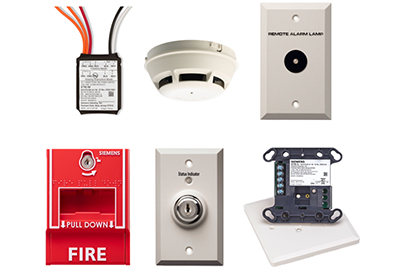
The image above depicts a traditional device in comparison to Siemens ISOtechnology devices with built-in isolation. Each of these devices are compatible with Modular, Compact, or 50 Point panels.
Q: How can end-users rest assured that they have a reliable system that has increased system survivability?
With built-in isolation, each device can be set or configured as an isolator, which is above and beyond the regulatory requirement. The code requires that each fire zone (i.e., 1 floor area) be isolated so that a fault within one floor area cannot affect normal operation of devices in another area. In other words, if a single fault happens on that floor, it is understandable if that floor is gone or no longer visible to the system, as long as devices on other floors are working normally. By setting all devices on that floor as isolator, if a single wire-to-wire short or open or ground happens between devices, all the devices on that floor are still working normally and communication to the control unit is still maintained, even when one portion of wiring in that floor is disabled. Therefore, the floor where the fault happened is still protected! Here is another additional benefit: when a zone or floor is no longer supervised by a fire alarm system, a Fire Watch (which could be costly) is required. With ISOtechnologyTM, owners of the property could avoid the unnecessary Fire Watch.


The image depicts how ISOtechnologyTM provides virtual circuit survivability and a short in one zone does not affect another zone or impede normal system operation. When the system remains fully operational when a single fault is applied, you increase life safety guaranteeing an alarm is always received at the fire alarm control panel. With all these elements in place, installers and end-users can rest assured that they have a reliable system that has increased system survivability.
Implementing a secure and effective fire alarm system is one of the most important considerations for large multi-story buildings, and Siemens recognizes the importance of security and safety that comes with that. With ISOtechnology TM providing fault detection and built-in solation, the system’s overall safety and reliability is improved, especially in case of emergency. Users benefit from ISOtechnology TM since it not only enhances the safety system, but it also saves users’ time and money.
For more information on ISOtechnologyTM
{youtube}QcE22WsLcP8{/youtube}
To discuss adding ISOtechnologyTM to your system with a Siemens Branch or Partner in your area, click HERE
Alyssa Kerslake is an Associate Editor with Kerrwil Publications