Schneider Electric: New ArcBlok Arc Flash Mitigation Tool
January 13, 2023
Earlier this fall Electrical Industry News Week’s sister publication, Panel Builder & Systems Integrator had the opportunity to attend Schneider Electric’s North America Innovation Summit. The event brought together Schneider employees and a broad range of electrical and automation clients from numerous countries, including a strong presence from Canada.
The Innovation Summit truly lived up to its name, with a consistent focus on digitization, electrification and sustainability. It is these three core drivers that Schneider is designing into all its products, solutions and plans as it focuses on developing an electrified and sustainable future.
A core focus of the event was showcasing new products that are being developed around this concept. One such product was ArcBlok, a new arc flash mitigation tool.
Arc flash is a serious concern for anyone who works on electrical equipment, and has received increased attention and safety protocols in recent years. Industry standards from IEEE (IEEE 1584) and the NFPA provide guidelines for assessing and managing the risks associated with an arc flash incidence. Although these standards define work practices to safeguard employees from injury while exposed to electrical hazards, a fundamental challenge remains: what else can be done to move arc flash mitigation from work practices to engineering controls and reduce the likelihood of occurrence or the severity of an arc flash?
And although there are several mitigation products on the market Schneider has developed a unique tool that is designed to keep workers safe and provide a sustainable means of mitigating arc flash incidence.
Panel Builder & Systems Integrator worked with a Schneider expert to gain more insight into how it works and the benefits it is delivering today.
A Look at the New ArcBlok Technology
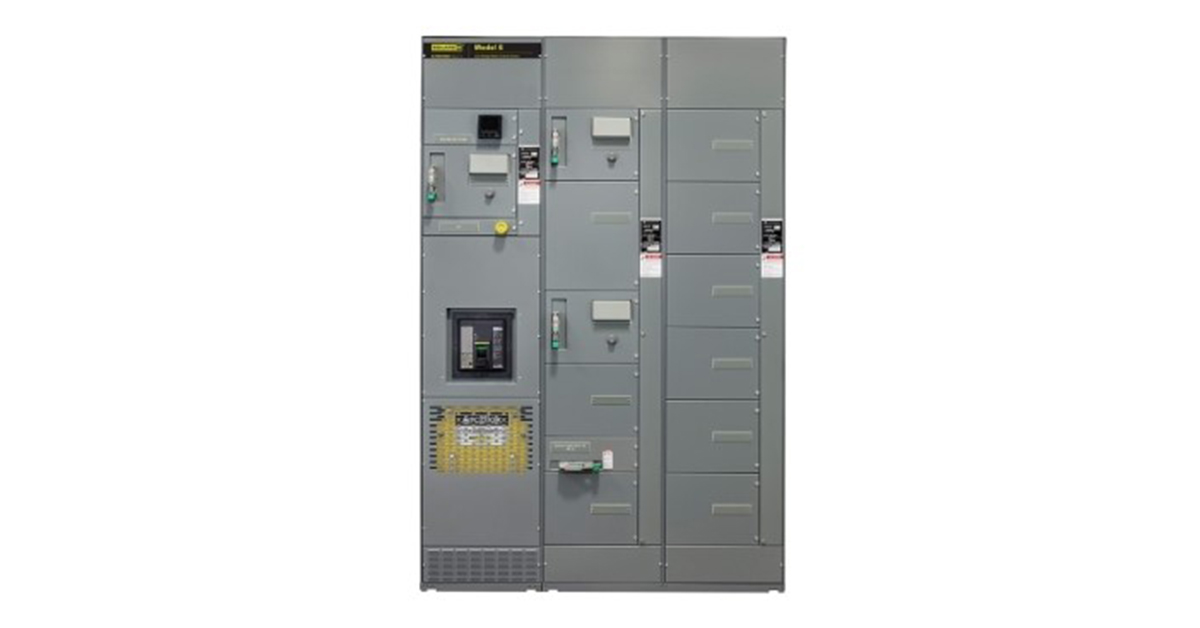
The new ArcBlok technology within their Motor Controls Centers or MCCs, brings a new level of performance to arc flash mitigation. The passive system provides arc isolation for even the most dangerous area in any line-up, the line side conductors. The line side is where the power comes into the equipment and typically presents a high-incident energy risk in the electrical line-up. At the same time, it is also the most difficult zone to protect due to utility dependency for de-energizing the equipment.
With ArcBlok, Schneider has developed a solution to address that area – the line side. ArcBlok is the only product UL verified to limit the incident energy exposure to below 1.2 cal/cm2 on the line side. It is a passive system; once the module is properly installed in the electrical equipment, it is always protecting whether during operation or maintenance. This is what Schneider calls “safety by design.” Unlike other more complex solutions that require light detectors, arc flash relays, and/or some upstream protective device to ultimately clear the fault, ArcBlok is a passive system and is inherently self-clearing within less than one cycle (16.6 ms).
In addition to these benefits, ArcBlok does not require any powering, special commissioning, testing or user intervention – and there are no special maintenance procedures required other than periodic cleaning on a similar basis to standard electrical equipment. Best of all, ArcBlok is available as a productized offer in Schneider Electric Motor Control Centers and Switchboards AND as a Service retrofill solution for Schneider Electric and other third-party equipment. To sum it up, ArcBlok is a simple and cost-effective solution to protect people and equipment from high incident energy arc flash events on the line side.
A Look at ArcBlok’s Sensors
Another feature of the ArcBlock MCC is wireless thermal sensors. Critical connections in ArcBlok 2500 are equipped with wireless, battery powered temperature sensors that communicate via Zigbee protocol. These CL110 sensors are located on the bottom of each ArcBlok heat sink and continuously measure the temperature of the line side lugs. This makes it unnecessary to perform infrared thermagraphy in this area, and thus workers can avoid exposure to the line conductors.
With EcoStruxure Power Monitoring Expert, data can be viewed in real time and as a trend-over-time, allowing for early detection of gradual changes. This information can be easily read on your smart phone while standing outside the arc flash boundary. Using this expert, phase temperatures and phase to phase temperature discrepancy are continuously compared to pre-alarm and alarm thresholds, notifying users of an abnormal temperature rise.
In addition to the thermal sensors, ArcBlok is equipped with an arc flash event indicator – a pressure sensor to monitor and indicate when an arc flash has occurred and been contained. With an EcoStruxure Service Plan subscription, Schneider Electric’s Connected Services Hub can leverage ArcBlok data when analyzing the electrical system to interpret its status and history, providing expert insights for the installation.
A Look at Sustainability
ArcBlok fully complies with the Schneider Electric Green PremiumTM claim, and therefore fulfills environmental regulations for hazardous material like REACH and RoHS. It also supports Schneider Electric’s journey towards green packaging, e.g. using recycled cardboard instead of single use plastic.
In addition, ArcBlok ties into sustainability due to its compact design that comes with a much smaller carbon footprint compared to some other arc flash protection solutions. Moreover, ArcBlok is guaranteed to clear and withstand multiple arc flash events, protecting the equipment from damage caused by an arc flash event – no need to replace ArcBlok or the gear it’s protecting.
Main Take-Aways:
Arc Flash incidents can occur for a number of reasons. Foreign objects like tools or rodents reaching into live areas are some common reasons why it happens. Degradation of insulating materials and connections over time can also contribute to an arc flash, as can abrupt energy spikes or loose electrical connections. There is no comprehensive statistical information on how often objects cause an issue, but it is an area that Schneider is investigating together with third party experts.
The main take-away is that there is no prediction for an arc flash. ArcBlok reduces the likelihood of an arc flash event before it happens, and greatly reduces the duration and intensity of an arc flash event at the line side. With the ArcBlok isolating cable vault, line side conductors are tightly enclosed, which prevents foreign objects from entering live areas. ArcBlok’s isolating phase barriers limit the duration of the arc and reduce the incident energy release during an arc fault event. ArcBlok controls where the arc can exist and interrupts the arc using circuit breaker design principles with self-extinguishing features outside the breaker on the line side of the electrical system.
Because of this, ArcBlok has been recognized as a method to isolate energy on the line side of a circuit breaker as per the 2021 NFPA 70E Annex O.2.3(5). Phase barriers in the ArcBlok module are a tested solution to prevent, isolate, and extinguish an arc fault. ArcBlok contains the arc flash energy and cools vented gases to below restrike temperature – then purposefully directs exhaust away from user (<1.2 cal/cm2) through bottom or top vents (depends on whether equipment is bottom or top fed).
Line side arcs don’t stand a chance inside the isolated ArcBlok vault – they extinguish and self-clear in less than a cycle (16.6 ms), ensuring fast recovery for up to 5 arc flash events. Whether you are updating your existing MCC or buying a new one, get a new level of arc flash detection with ArcBlok technology from Schneider Electric.