2013 Underground Economy Remains Stable at 2.4% of GDP
June 31 2016
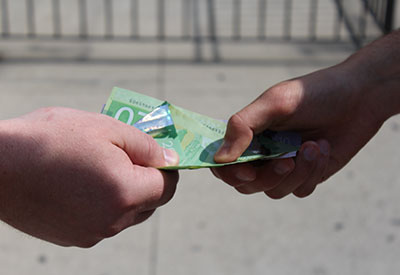
Underground economic activity for 2013 totalled $45.6 billion in Canada, or about 2.4% of gross domestic product (GDP). Three industries accounted for more than half of the total underground economy value added: residential construction (27.8%), retail trade (12.5%), and accommodation and food services (11.7%).
The proportion of underground activity to GDP has been stable since 2002. The highest proportion was 2.7% in 1994, while the lowest was 2.2% in 2000.
From the perspective of expenditure-based GDP, household final consumption expenditure accounted for 65.2% of underground economic activity. Business gross fixed capital formation accounted for 27.9%, and net exports represented the remaining 6.9%.
Underground activities related to household final consumption expenditure were $2,156 per household in 2013. The top five categories of underground expenditure per household were food and beverage services ($461 per household), rental fees for housing ($406), tobacco ($211), alcoholic beverages ($160), and the operation of transportation vehicles ($117).
From the perspective of income-based GDP, the largest share of the underground economy income went to employees (46.9%) in the form of labour compensation, followed by corporations (28.3%) in the form of surplus and unincorporated businesses (24.8%) in the form of mixed income.
Wages not accounted for in payroll records and tips on undeclared transactions totalled $21.4 billion in 2013, equivalent to 2.2% of official GDP data of compensation of employees. This amount represented $1,518 for every job in the business sector in 2013.
Underground economy by province and territory
The total value of underground economic activity in 2013 was highest in the four largest economies: Ontario ($16.7 billion), Quebec ($11.1 billion), British Columbia ($6.3 billion) and Alberta ($5.3 billion).
Despite changes in the value of underground activity, the underground economy as a proportion of GDP was relatively stable in every province and territory in 2013. The underground economy as a proportion of GDP was the largest in Quebec, while it was smallest in Nunavut and the Northwest Territories.
Chart 2: Underground economy as a proportion of gross domestic product by province and territory

The underground economy accounted for 3.1% of GDP in Quebec in 2013. Industries such as retail trade, which are more prone to underground production, make up a greater share of Quebec’s economy compared with other provinces and territories. Conversely, industries such as mining, quarrying and oil and gas extraction, which tend to have a lower incidence of underground activity, are less important in Quebec’s economy compared with other provinces and territories.
As a proportion of GDP, Nunavut (0.7%) and the Northwest Territories (1.0%) had the smallest underground economy. This study assumes that there is no underground activity in the government sector and that underreporting of revenues (or over-reporting of expenses) is less likely to occur in highly-regulated industries or in large businesses. Public administration and mining, quarrying and oil and gas extraction make up large shares of the economies of Nunavut and the Northwest Territories.
From 2007 to 2013, underground economic activity as a share of GDP was fairly stable across all provinces and territories. The largest variations occurred in Prince Edward Island (from 3.6% in 2007 to 3.0% in 2013) and Nunavut (from 1.1% to 0.7%).
Source: Statistics Canada, http://www.statcan.gc.ca/daily-quotidien/160620/dq160620b-eng.htm.


![Guide to the Canadian Electrical Code, Part 1 – 26th Edition[i] – A Road Map: Section 54](https://electricalindustry.ca/wp-content/uploads/2022/11/Guide-CE-Code-2-768x432.png)



![Guide to the Canadian Electrical Code, Part 1 – 26th Edition[i] – A Road Map: Section 54](https://electricalindustry.ca/wp-content/uploads/2022/11/Guide-CE-Code-2.png)