Ontario’s Multi-Family Component Leads Residential Sector Increases in October Building Permits
December 15, 2025
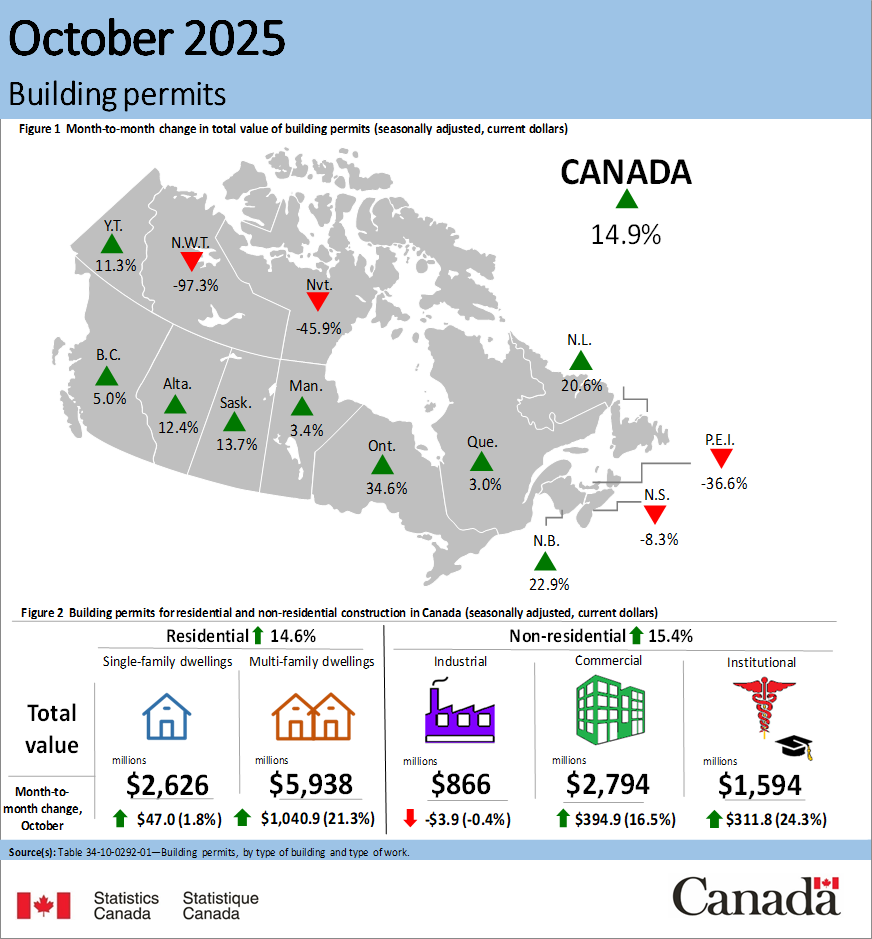
In October, the total value of building permits issued in Canada rose $1.8 billion (+14.9%) to $13.8 billion. The increase in construction intentions was led by the residential sector (+$1.1 billion). An increase was also observed in the non-residential sector (+$702.8 million).
On a constant dollar basis (2023=100), the total value of building permits issued in October grew 14.9% from the previous month and was up 5.9% on a year-over-year basis.
Ontario’s multi-family component leads residential sector increases
In October, residential construction intentions increased $1.1 billion (+14.6%) to $8.6 billion. Ontario (+$882.6 million) contributed the most to the national growth.
The multi-family component grew $1.0 billion to $5.9 billion in October. The largest increase was recorded in Ontario (+$876.4 million), specifically the Toronto census metropolitan area (CMA) (+$408.9 million), followed by Quebec (+$81.4 million). Overall, seven provinces and one territory contributed to the increase in this component.
The single-family component was up $47.0 million to $2.6 billion in October, with the gains being primarily attributed to Alberta (+$28.7 million).
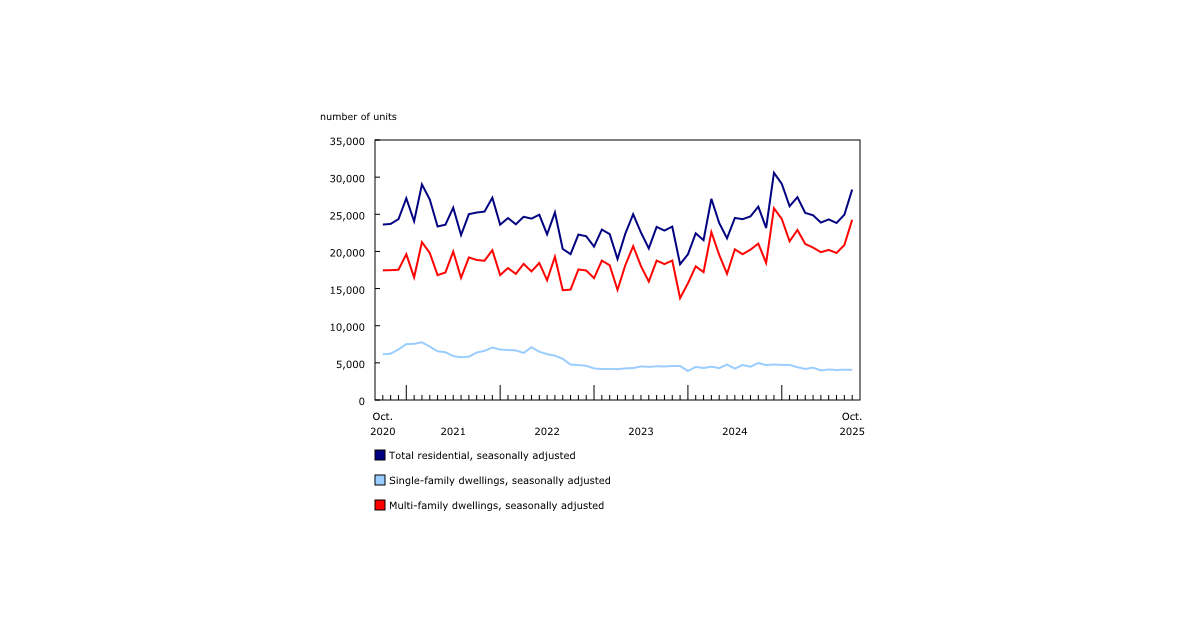
Across Canada, a total of 24,300 multi-family dwellings and 4,100 single-family dwellings were authorized in October, marking a 13.6% increase from the previous month. Year-to-date, the average number of multi-family dwellings authorized is 21,500 per month, up from 19,100 during the same period in 2024.
Commercial and institutional components lead increase in non-residential sector
In October, the value of non-residential building permits rose $702.8 million to $5.3 billion. The commercial component (+$394.9 million) drove the increase, followed by the institutional component (+$311.8 million). Meanwhile, the industrial component edged down $3.9 million.
In October, commercial component gains were led by Ontario (+$392.3 million), specifically permit values for office buildings in the Toronto CMA. Meanwhile, decreases in six provinces and two territories moderated the gains in the component.
The increase in the institutional component in October was driven by British Columbia (+$132.2 million), with eight other provinces posting gains.
In October, the industrial component experienced a minor decline, mainly attributed to Quebec (-$118.6 million). Gains from Ontario (+$71.2 million) and British Columbia (+$24.4 million) mitigated the component’s decline.
![Guide to the Canadian Electrical Code, Part 1[i], 26th Edition– A Road Map: Section 74 — Airport installations](https://electricalindustry.ca/wp-content/uploads/2026/05/EIN-Stock-Guide-Code-Canada-Map-1200-768x403.png)



![Guide to the Canadian Electrical Code, Part 1[i], 26th Edition– A Road Map: Section 74 — Airport installations](https://electricalindustry.ca/wp-content/uploads/2026/05/EIN-Stock-Guide-Code-Canada-Map-1200.png)