Utilities, Smart Grids, and the Convergence of IT and OT
March 15 2016
The goal for any utility that invests in smart grid technology is to attain higher efficiency and reliable performance. At the heart of this evolution is the convergence of operations technology (OT) and information technology (IT), which changes every aspect of a utility’s operations.
Understanding the dynamics of OT and IT
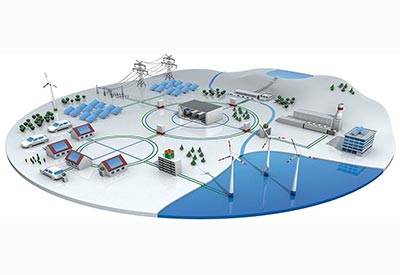
In basic terms, OT comprises the grid physical infrastructure assets and applications, and IT is the human interface that enables rapid and informed decision making.
Today, the smart grid is transforming utility operations and pushing IT across its traditional boundary into OT at a remarkable pace. The growth in grid modernization is driving the way utilities are deploying equipment and automation, influenced by these trends:
- continuous growth in OT deployment
- continuous implementation of IT to model, monitor, and manage distribution systems
- an urgent requirement to integrate IT and OT networks
Integrating IT and OT
The convergence of IT and OT means bringing together applications and devices in new ways, and tying together systems that have primarily operated in isolation. Along with growth in numbers of devices and increased functionality, bringing the systems together introduces integration on a new scale.
Addressing the needs of the IT/OT-integrated distribution grid requires advances in communications, adherence to expanded standards, and a focus on architecture and security. Points to consider include:
- communications and protocols — the IT/OT-integrated world involves a federation of networks that combine private and public infrastructure, and integrate standards-based, open technologies such as IP with existing proprietary legacy solutions. No operating utility can afford to design its communications infrastructure from point zero; however, it’s important to maintain the parameters that support OT in mission-critical applications to ensure reliability, availability, security, and predictable performance.
- standards — developing interoperability standards plays a key role in supporting grid modernization. National, industrial, and trade groups are all contributing to establishing the definitions and specifications for connecting grid devices. Processes are already in place to close the gaps in current standards.
- architecture — in addition to addressing the core requirements of reliability, security, and performance, the new smart grid IT/OT architecture must support the integration of existing enterprise systems within the grid modelling, monitoring, and management environment. As with communications infrastructure, no operating utility has the luxury of designing and implementing its architecture from scratch. But industry-proven architectural roadmaps exist to help utilities work through the design process.
Transforming to a smart grid operation
The move to the smart grid is an evolution, not a revolution. The change begins with a simple awareness of the significant influence of IT on operational equipment.
Next is the recognition of a need to create a clear, long-term roadmap for a smarter network. With the roadmap as a guide, an IT/OT-converged approach will allow utility personnel to deploy each grid modernisation application project as a part of a connected whole.
Finally, utility personnel should carefully consider decisions involving network systems. Deployment of an advanced distribution management system (ADMS) will help a utility to succeed in achieving IT/OT technology acceleration.
This article was first published as a Schneider Electric insight; www.schneider-electric.ca/en/.

![Guide to the Canadian Electrical Code, Part 1 – 26th Edition[i] – A Road Map: Section 54](https://electricalindustry.ca/wp-content/uploads/2022/11/Guide-CE-Code-2-768x432.png)




![Guide to the Canadian Electrical Code, Part 1 – 26th Edition[i] – A Road Map: Section 54](https://electricalindustry.ca/wp-content/uploads/2022/11/Guide-CE-Code-2.png)