The Data Are In: Wind Energy Has Become the Leading Choice for New Electricity Generating Capacity
Robert Hornung
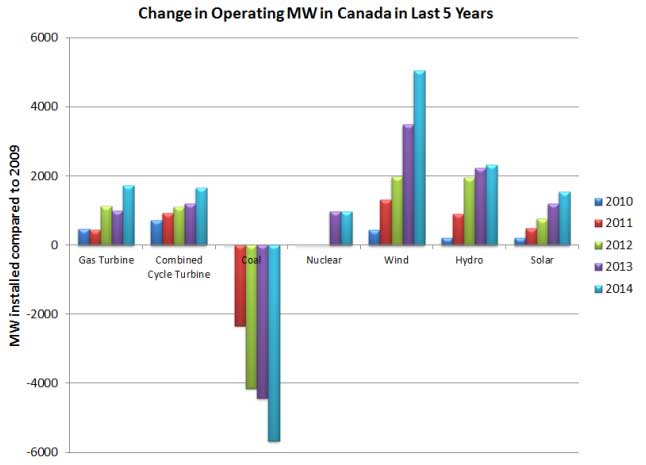
Some critics of wind energy love to point out that while wind energy is making a significant and rapidly growing contribution to electricity generation in Canada and around the world, its overall contribution is still relatively small compared to conventional sources of electricity generation. What these critics fail to recognize is that the contribution made by conventional sources of electricity generation represent a historical legacy — they do not reflect modern investments in the electricity grid.
In Canada, for example, there has been more new wind energy capacity installed over the last five years (5,690 MW) than any other form of electricity generation — more than natural gas, hydro, nuclear or solar. Indeed, wind energy represents 38% of all new electric generation capacity installed from these sources in Canada in this period – and Canada’s coal-fired generating capacity has actually fallen at the same time.
A similar trend is evident in the United States, where wind energy was the largest source of new electricity generation in 2014 and represented 28 per cent of all new electricity generation capacity additions in the United States between 2010-2014 — second only to natural gas.
These trends have been in place even longer in the European Union. According to Wind Power in Europe, wind energy was not only the leading source of new electricity generation in 2014 (representing 44% of new installed capacity), it has been the largest source of new electricity generating capacity in Europe over the last 15 years. Between 2000-2014, there were 117 GW of new wind energy capacity installed in Europe, 101 GW of new natural gas fired capacity and 88 GW of new solar capacity. Over that same time period, nuclear generating capacity in Europe fell by 13 GW and coal-fired generation fell by 25 GW.
We are now at the leading edge of a fundamental transformation of global electricity systems that is creating systems that are more diverse, decentralized and low carbon. As the data show, wind energy has been, and will continue to be, a leader in that transformation because of its cost competitiveness, environmental attributes, scalability, and local economic benefits.
*Canadian data on capacity additions are from the National Energy Board (which underestimates capacity additions for wind energy). Data on capacity additions for solar energy was provided by the Canadian Solar Industries Association.
Robert Hornung is President of the Canadian Wind Energy Association. This article was first published by CanWEA on its website: http://canwea.ca/the-data-is-in-wind-energy-has-become-the-leading-choice-for-new-electricity-generating-capacity/

![Guide to the Canadian Electrical Code, Part 1 – 26th Edition[i] – A Road Map: Section 54](https://electricalindustry.ca/wp-content/uploads/2022/11/Guide-CE-Code-2-768x432.png)




![Guide to the Canadian Electrical Code, Part 1 – 26th Edition[i] – A Road Map: Section 54](https://electricalindustry.ca/wp-content/uploads/2022/11/Guide-CE-Code-2.png)