Autodesk Expands Preconstruction Offering with Global Launch of Autodesk Takeoff
April 6, 2021
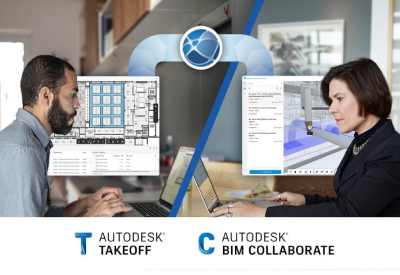
Autodesk, Inc. has announced the worldwide availability of Autodesk Takeoff, a new product that empowers estimators to perform 2D and 3D quantification workflows from a common data environment to increase collaboration, speed and accuracy during the estimation process. Originally announced at Autodesk University in November 2020, Autodesk Takeoff will join Autodesk Build and Autodesk BIM Collaborate as part of the Autodesk Construction Cloud unified platform. The announcement comes one month after Autodesk Build and Autodesk BIM Collaborate were made available globally for Autodesk Construction Cloud customers.
“Between our BIM coordinators, estimators and self-perform teams, we often work in parallel paths on different iterations of project design data using a variety of tools for coordination, takeoff and budgeting, and to track our productivity and work-in-place. This approach can lead to duplicate work, mistakes and wasted time,” said Andy Leek, vice president – technology and innovation at PARIC. “With Autodesk BIM Collaborate and Autodesk Takeoff, we are working smart to centralize all our project information and workflows, which increases transparency, enhances collaboration and creates a better experience for the entire project team. A unified environment empowers our teams to get projects out the door faster with less errors, tackle takeoff more efficiently and produce more accurate results and value for our clients. We are delivering on the promise of BIM and using our data to continuously refine our budgeting, planning and scheduling expertise – these are exciting times!”
Now available worldwide, Autodesk Takeoff allows estimating teams to:
- Better visualize project scope with aggregated 2D and 3D takeoff – Takeoff types can be used across both 2D and 3D quantification workflows, allowing teams to leverage aggregated quantities from plans and models in an organized, customizable view. Teams can visualize project scope from detailed 3D takeoffs to identify gaps in producing accurate costs and estimates.
- See updates in real-time with cloud-based document management – Estimating teams can access the most up-to-date construction documents, drawings and models within Autodesk Docs, the centralized document management solution that underpins both Autodesk Build and Autodesk BIM Collaborate. Working from one centralized platform gives teams access to updates in real time for improved collaboration across projects. With data stored in one location, teams can feel confident they are not duplicating efforts and doing takeoffs more than once.
- Provide multi-user access to projects – Multiple estimators can simultaneously access the same project files to review and perform 2D and 3D takeoff, creating a synchronous workflow experience. Estimating teams are notified when a document set is updated to ensure they are always working from the latest information.
“The takeoff process has historically been disjointed, cumbersome and time consuming, which creates a lack of transparency, missed deadlines and an increase in errors,” said Sameer Merchant, vice president of construction technology at Autodesk. “With an integrated 2D and 3D quantification solution that leverages Autodesk Construction Cloud’s centralized document management, Autodesk Takeoff enables teams to update quantities in real-time and ensure they’re working from the latest design files. Autodesk Takeoff allows estimators to easily collaborate to reduce errors, speed up their takeoff process, produce more compelling bids and ultimately win more work.”
Reduce constructability issues before breaking ground with Autodesk BIM Collaborate
Autodesk also recently announced the release of Autodesk BIM Collaborate, which empowers VDC teams to align and execute on design intent. Teams can now manage the entire design collaboration and coordination process – including model review and markups, clash detection, issue management and design change analysis – within a single, cloud-based common data environment.
“Information silos between general contractors and trade partners have historically been a challenge in construction, especially during preconstruction workflows,” said Weston Short, vice president of engineering and innovation at Gaylor Electric. “Automated clash detection in BIM Collaborate empowers BIM managers from both general contractors and trades to easily coordinate on the same models simultaneously to improve their constructability. Access to these coordinated models, paired with the increased cross-team transparency and collaboration that comes with it, gives teams a massive advantage when planning a project.”
“Bringing the entire design coordination process under one roof helps teams secure design intent, reduce rework in the field and improve multi-discipline collaboration,” said Richard Parker, director, product management at Autodesk. “Autodesk BIM Collaborate leverages advanced automation for clash detection, empowering designers and trade teams to self-check their work and improve the quality of construction documents – enabling BIM experts to focus more strategically on the important constructability issues. The collaborative nature of the product keeps the entire project team on the same page, reducing costly errors.”
As part of Autodesk Construction Cloud, a subscription to Autodesk Takeoff and Autodesk BIM Collaborate includes and is reinforced by:
- Autodesk Docs – A centralized document management solution that underpins the Autodesk Build, Autodesk Takeoff and Autodesk BIM Collaborate common data environment, providing users with seamless navigation and integrated workflows to create a single source of truth across the project lifecycle.
- Insights – Analytics capabilities that support the ability to collect, interpret and export project data; encompasses Construction IQ artificial intelligence to identify and mitigate risk.
- Administration – Project setup tools including centralized user management and permissioning capabilities, templates and single-sign-on.
Go HERE for more information


![Guide to the Canadian Electrical Code, Part 1[i], 26th Edition– A Road Map: Section 76 — Temporary Wiring](https://electricalindustry.ca/wp-content/uploads/2026/05/EIN-Stock-Guide-Code-Canada-Map-1200.png)