Siemens and BASF Collaborate on Driving Circular Economy
June 14, 2024
- Siemens circuit breaker is the first electrical safety product to use plastic components where fossil raw materials have been replaced by biomethane derived from recycled biowaste
- The material changeover in the SIRIUS 3RV2 circuit breaker production will reduce the emission of carbon dioxide equivalents by ~270 tons per year1
- SIRIUS 3RV2 is one of the first products covered by the recently launched Siemens EcoTech label
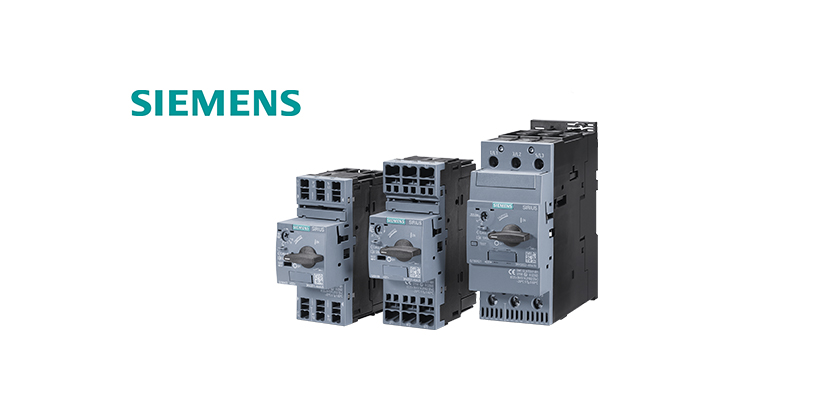
Siemens Smart Infrastructure and BASF have today announced the first electrical safety product to include components made from biomass-balanced plastics. Used across industrial and infrastructure applications, Siemens SIRIUS 3RV2 circuit breaker is now being manufactured using Ultramid® BMBcertTM and Ultradur® BMBcertTM from BASF, where fossil feedstock at the beginning of the value chain is replaced by biomethane derived from renewable sources such as agricultural waste. Both materials offer the same quality and performance as conventional plastics. The material changeover in the SIRIUS 3RV2 circuit breaker production will reduce the emission of carbon dioxide equivalents by ~270 tons per year1. Customers using these products contribute to a circular economy towards a more sustainable future.
The move supports Siemens´ sustainability goals in the areas of decarbonization and resource efficiency, outlined within its DEGREE framework, with the company following a 1.5°C science-based decarbonization target, including a 90 percent reduction target for scope 1 and 2 until 2030, and the application of a Robust Eco Design for 100 percent of relevant product families by 2030.
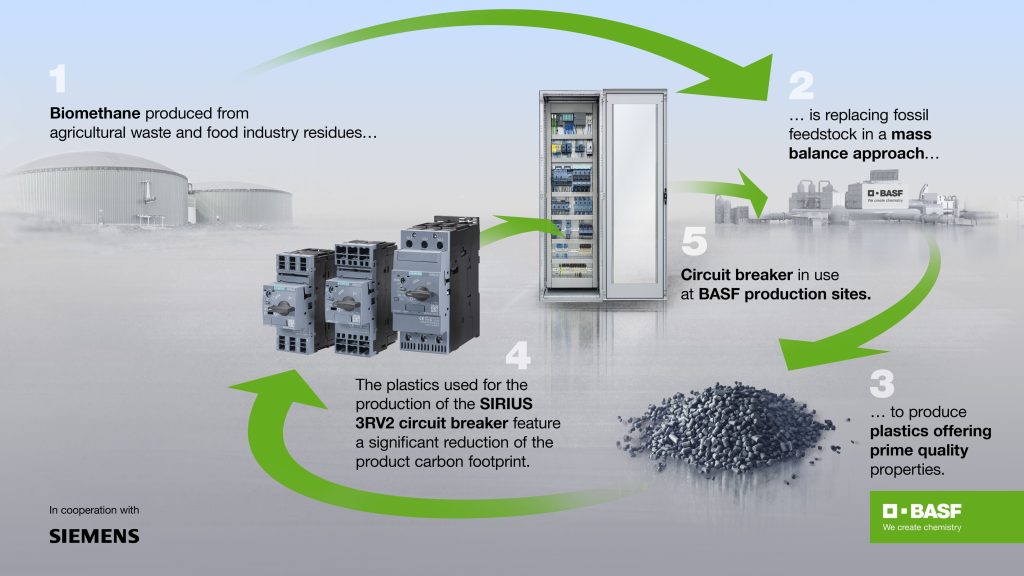
In the coming months, Siemens plans to expand the use of sustainable materials across the broader SIRIUS industrial controls portfolio. In addition to product design and features, as well as manufacturing and supply processes, the choice of materials plays a major role in further reducing carbon emissions and conserving natural resources. The SIRIUS 3RV2 circuit breaker meets the strict criteria of the recently introduced Siemens EcoTech label, designed to give customers a comprehensive insight into product performance across selected environmental criteria. In addition to most of the product housing and functional parts being made from biomass-balanced plastic, the product also offers lower power consumption over its lifetime compared to its predecessor.
“With our products, we help customers to improve asset performance, availability, and reliability, through resource-efficient and circular products which optimize energy use, production, and supply chains throughout their entire lifecycle. In BASF, we have found a strong partner that supports us with its innovations in the field of sustainable plastics,” said Andreas Matthé, CEO of Electrical Products at Siemens Smart Infrastructure.
By increasingly relying on renewable and recycled raw materials for the manufacture of its products, BASF is committed to make its contribution to the circular economy and de-fossilization. This is achieved through a process that gradually replaces fossil raw materials with bio-based and recycled feedstock. According to the mass balance approach, renewable or recycled raw materials are introduced into production at the beginning of the complex BASF value chains. If customers decide in favor of a certified product from such a value chain, BASF feeds sustainable raw materials into ongoing BASF Verbund production.
“The mass balance approach is a game-changing solution that enables the gradual replacement of fossil raw materials in sometimes complex production processes. The advantages of this approach are obvious, and the greater the demand for alternative products, the higher the proportion of alternative raw materials in the production network. This aligns with our goal of achieving a circular economy and net zero operations as soon as possible,” explains Martin Jung, President BASF Performance Materials. “In addition, the special thing about this project is that the SIRIUS 3RV2 circuit breaker is also used in our BASF production plants. This circuit breaker not only protects the motors but also increases their efficiency and reliability, making a double contribution to our sustainability objectives.”
With the mass balance approach, various alternative raw materials, such as biomethane, bio-naphtha or pyrolysis oil, can be integrated into the value chain. The bio-naphtha and biomethane used by BASF are certified as sustainable according to established systems such as ISCC PLUS and REDcert. The SIRIUS 3RV2 circuit breaker is a proof for resource-efficient plastics production and a milestone on BASF’s #ourplasticsjourney.
“The use of such an innovative material in an important safety component, without compromising its safety functionality and performance, is a unique achievement for Siemens,” underlines Andreas Matthé.
Circuit breakers are used in factories and buildings around the world and protect machines or electrical cables in the event of faults such as short circuits. They help prevent major damage, for example from fires. The SIRIUS 3RV2 circuit breaker, using sustainable plastic components, will be presented for the first time on Booth E3, Hall 11 at the ACHEMA trade fair in Frankfurt, June 10-14, 2024. Here, you can also find out more about Siemens EcoTech.
1) The calculation of Product Carbon Footprint of materials is according to TfS Methodology and compares the CO2 reduction of the BASF Biomass Balanced product vs the conventional BASF product.
Go HERE for more information on the project
Further information on Siemens EcoTech is available HERE
Go HERE for more information on Siemens Smart Infrastructure