McMaster University Building $11M ‘living lab’ to Study Energy Use
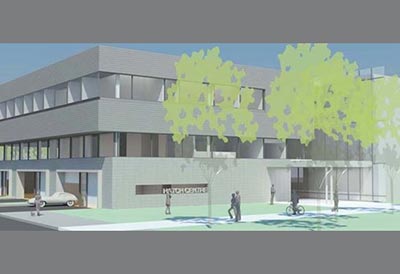
The future Living Lab at McMaster University in Hamilton, ON will be focused on demonstrating local-energy creation with hands-on research. The $11-million building is scheduled to open next year as the only test facility of its kind in North America for community-based-energy creation.
Mechanical engineer Jim Cotton, who is part of a multi-disciplinary team of 16 McMaster energy experts working on the project, says the design and construction of the building will be an opportunity for undergraduate and graduate engineering students to have hands-on experience.
The Gerald Hatch Centre for Engineering Experiential Learning will be a three-storey, 24,000-square-foot students’ centre that will also function as “living lab” where engineers, scientists and students can research integrated energy systems for urban use.
“When you generate electricity … there is an awful lot of lost energy during that production in waste heat,” said Cotton. He says as much as 70 per cent of potential energy is wasted when traditional, giant generation facilities create and deliver electricity. Those operations are unable to harness the thermal energy that’s created, and energy is also lost as it travels through the grid from the generation facility to the user.
“When you factor in the impact on the environment, the lack of sustainability and our vulnerability to power loss due to weather, it’s clear we need to improve how we use our energy resources,” he says.
But in small generation systems — such as those that will be used in the Hatch Centre, powered by natural gas, wind or other fuel sources — the heat from the process can be harnessed.
Cotton believes that developing smaller, community-based facilities is far more energy efficient, and he hopes the Hatch Centre will be able to prove it. He also hopes to develop technologies that could, someday, make existing community projects even more energy-efficient.
The research effort recently received a $1.9-million award from the Canada Foundation for Innovation.Community-based energy systems are common in some European countries.
In Hamilton, a multimillion-dollar community energy project provides winter heating and a portion of the electrical requirements of several buildings downtown, including FirstOntario Centre and City Hall.
The Gerald Hatch Center for Engineering Experiential Learning will be a multi-storey facility located adjacent to the John Hodgins Engineering Building. The centre will serve as a common meeting ground for Engineering students from all disciplines. It will provide a home for student clubs and societies, collaborative workspaces, display and demonstration spaces, areas for students to meet, relax and work together, as well as selected student services. Intended to enhance the student learning experience in the Faculty of Engineering, the proposed Hatch Centre building will provide a venue for hands-on learning as well as serving as a living laboratory. Open concept cutaways will show construction techniques and building materials. The building’s energy use data will be available in real time, showing the energy cost of the building’s operation.The building will also enhance the student experience and support professional development.
The Hatch Centre will bring together students in all engineering departments and programs and will foster collaboration and interdisciplinary learning. It will house the engineering student lounge, the McMaster Engineering Society office, engineering related clubs and teams offices as well as social space to create an inclusive environment for all engineering students. To help develop the skills of successful engineers, the building will support both curricular programming as well as extra-curricular activities that have been identified as key to developing essential engineering skills outside the classroom. The building will include collaborative meeting rooms that will provide active learning environments to support student-led initiatives. The building will also host workshop space for students to build prototypes of what they have designed whether as individuals, course projects or clubs and teams.
The above description was taken from: http://www.eng.mcmaster.ca/hatchcentre/goals.html
Article originally published in The Hamilton Spectator: mmcneil@thespec.com