Non-residential Construction Dips 0.5% in Q1 2017
Apr 24, 2017
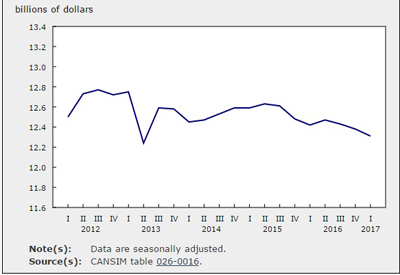
Investment in non-residential building construction totalled $12.3 billion in the first quarter of 2017, down 0.5% from the previous quarter. This marked the sixth decrease in seven quarters. Nationally, the decline largely reflected lower spending on the construction of institutional buildings and, to a lesser extent, on the construction of industrial buildings.
Overall, total investment fell in five provinces in the first quarter, with Ontario posting the largest decline and Saskatchewan a distant second.
Following a string of four consecutive quarterly advances, Ontario posted declines in all three components (institutional, industrial, commercial), with the decrease mostly attributable to lower spending on institutional buildings.
Saskatchewan registered a fourth straight quarterly decline, with investment down in all three components.
The largest increases were recorded in Manitoba and Alberta. In Manitoba, investment rose for the fourth consecutive quarter, mainly the result of higher spending on commercial buildings. Following seven consecutive declines in total investment, spending was up in Alberta for all three components, mostly attributable to increased investment in commercial and institutional buildings.
Census metropolitan areas
Among the 36 census metropolitan areas, 19 posted decreased investment in non-residential building construction in the first quarter. Ottawa and Toronto recorded the sharpest declines.
In Ottawa, the decrease was largely attributable to a reduction in commercial and institutional spending, while in Toronto, lower spending on industrial and institutional buildings contributed heavily to the decline.
The largest gains were reported in Winnipeg and Edmonton for the second straight quarter. Growth in Winnipeg resulted from higher investment in the construction of commercial buildings, while in Edmonton the increase was primarily the result of higher spending on industrial projects.
Institutional component
In the institutional component, investment fell 1.7% to $3.4 billion. The national decrease was due to the decline in investment in educational buildings and health care facilities, which more than offset increased spending on nursing homes.
Declines in investment in institutional projects were recorded in seven provinces, with Ontario posting the largest drop, followed distantly by Saskatchewan.
In Ontario, investment fell 4.7% to $1.2 billion in the first quarter. Lower investment in educational buildings and health care facilities were primarily responsible for the decline.
In Saskatchewan, lower spending on the construction of health care facilities was most responsible for the decrease.
Conversely, Alberta and Quebec reported the largest increases in institutional building construction. The advance in both provinces was the result of greater spending on nursing homes, along with higher investment in health facilities in Alberta and educational buildings in Quebec.
Industrial component
Investment in industrial projects decreased 0.4% to $1.7 billion in the first quarter. At the national level, the decline was attributable to lower investment in the construction of farm and maintenance buildings, which offset growth in investment in manufacturing plant construction.
Declines were reported in four provinces, with Ontario contributing the most to the overall decrease.
In Ontario, investment fell 3.0% to $731 million, marking a fourth straight quarterly decline. Reduced spending on farm and maintenance buildings were the leading contributors to the decrease in that province.
In contrast, Quebec and Nova Scotia posted the largest advances. Investment rose in Quebec for the sixth consecutive quarter, with increased spending on manufacturing plants driving the growth. Higher investment in all types of industrial buildings was responsible for the increase in Nova Scotia.
Commercial component
Spending on commercial buildings remained stable at $7.2 billion in the first quarter. While spending on the construction of recreation centres, office buildings and warehouses increased, it was offset by a decline in investment in shopping centres and restaurants.
Investment in commercial projects rose in four provinces, with Manitoba posting the largest gain. The advance in Manitoba was mainly the result of increased investment in office buildings.
Conversely, Ontario and Quebec recorded the largest declines. In Ontario, lower investment in shopping centres, passenger terminals and restaurants more than offset gains in recreation centres and warehouses. In Quebec, decreased spending in recreation centres more than offset advances in spending on shopping centres.
Source: Statistics Canada, www.statcan.gc.ca/daily-quotidien/170418/dq170418b-eng.htm