Electrical Engineer Builds Tiny Home to Showcase Affordable Power Source
Tiny Home

January 4, 2018

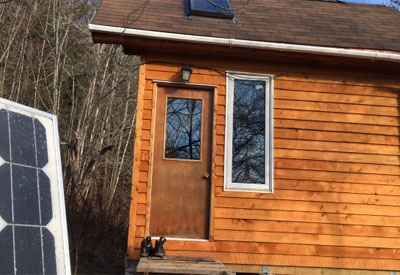
Caleb Grove built an eight-by-12 foot house – a micro home – in six months, for $10,000.

But it’s not to showcase his building skills. It’s to shine a light on his scalable, and cheap, power set-up.

Powered by solar, 12 volt batteries store enough power to run lights, a laptop, and a fan in the home.

Grove has installed 40 similar systems on a small island in Africa called Mbissa.

The first place to get electric light was a health clinic. Grove says it was greeted with a hushed awe.

For almost a decade, Grove grew up on that island, when his missionary parents decided to settle their family there in 2000.

To get to Mbissa, you pass through the mainland that has a spotty electrical grid that most people can’t afford to tap into. Then you get to the end of the road, take a boat, and arrive at the 3000 person island of subsistence farmers and fishers.

Grove was eight then.  At 17, he decided to get an electrical engineering degree from the University of New Brunswick. While completing his degree, he convinced various UNB funding agencies to donate more than $30,000 dollars as he went back and forth to Africa to perfect his power system.

“The people in Cameroon, have, through our technology, a plug and play system,” says Grove, holding up something about twice the size of an insulated coffee mug.

“So someone who wants to put in their solar electricity, it’s extremely simple. They don’t need a background in electrical engineering to come up with this product.”

“And so to be able to take that and do that here would be the same idea.”

When developing the system, Grove said he had to make something that was cheap, could be made with local materials, and would be easy to install..

“I have to make sure that it’s done so that when I leave, if I leave it will continue. So that means is that it is not the white man coming in to do work. That makes it sustainable. It is theirs,” says Grove.

“And that has been a long and difficult battle. The word for electricity in their language is ‘munong micra’, it means ‘the fire of the foreigner’. And I’ve been trying to tell them you need to call this ‘munong Mbissa’:’the fire of Mbissa,’

Grove adds: “Something that even if a foreigner is not there to give it to you, you can still do it, because you have the power, you have the tools and you have the knowledge and education you need to do it.”

Source: http://www.cbc.ca/news/canada/new-brunswick/micro-home-power-system-1.4440658

Related Articles


Latest Articles

  • Guide to the Canadian Electrical Code, Part 1[i], 26th Edition– A Road Map: Section 56

    Guide to the Canadian Electrical Code, Part 1[i], 26th Edition– A Road Map: Section 56

    February 6, 2026 The Code is a comprehensive document. Sometimes it can seem quite daunting to quickly find the information you need. This series of articles provides a guide to help users find their way through this critical document. This is not intended to replace the notes in Appendix B or the explanations of individual Read More…

  • 3D Printing: Inside Lighting’s Next Revolution

    February 5, 2026 While 3D printing in mass production was once a dream, advancements in the technology have moved it more into the mainstream. The technique, which is also referred to as additive manufacturing, has rapidly evolved from a niche prototyping tool into a transformative production method for many sectors, including the lighting industry. As Read More…

  • Microgrids & Power Quality: Designing Resilient, Clean Facility Power

    Microgrids & Power Quality: Designing Resilient, Clean Facility Power

    February 5, 2026 In an era of extreme weather, aging infrastructure, and ever‑rising energy demands, many facility managers are rethinking their relationship with the grid. Microgrids offer a way to take control and operate autonomously when necessary. A microgrid is more than just backup, when designed properly, it becomes a platform for resiliency, efficiency, and Read More…

  • ITC 101: Understanding NEMA Ratings for Electrical Enclosures

    ITC 101: Understanding NEMA Ratings for Electrical Enclosures

    February 5, 2026 Understanding NEMA Ratings for Electrical Enclosures NEMA Ratings are an essential classification system used across North America to define the environmental and mechanical protection provided by electrical enclosures. Developed by the National Electrical Manufacturers Association (NEMA), these ratings help engineers, installers, and specifiers identify the appropriate enclosure type for industrial, commercial, and outdoor Read More…


Changing Scene

  • Lighting What’s Next: Stanpro Celebrates 65 Years

    Lighting What’s Next: Stanpro Celebrates 65 Years

    February 6, 2026 “We didn’t get here by standing still. For 65 years, we’ve shaped how we think, how we design, and what responsibility means,” the company said in a LinkedIn post. “Today, that thinking takes a new form. Not to change who we are, but to express our evolution more clearly. This is Stanpro, Read More…

  • Housing Priorities on Track in New Brunswick, but More Work to do: Hickey

    Housing Priorities on Track in New Brunswick, but More Work to do: Hickey

    February 6, 2026 Efforts to support the creation of new affordable housing and reduce chronic homelessness are on track, but there is still lots of work to do, according to David Hickey, the minister responsible for the New Brunswick Housing Corporation. New data indicates progress has been made on three key government priorities related to Read More…

  • BJ Electric is now Bernie’s Electric Supplies Ltd

    BJ Electric is now Bernie’s Electric Supplies Ltd

    February 6, 2026 BJ Electric has announced the company has rebranded as Bernie’s Electric Supplies Ltd, a nod to their founder. “BJ Electric Supplies is now Bernie’s Electric Supplies—in honor of our founder, Bernard Joseph Thompson, and the values that have guided the company for nearly 50 years. As we grow and evolve, this name Read More…

  • The Government of Canada Introduces the Build Canada Homes Act

    The Government of Canada Introduces the Build Canada Homes Act

    February 6, 2026 The Government of Canada has introduced the Build Canada Homes Act, legislation that will establish Build Canada Homes as a Crown corporation whose mandate will be dedicated to building affordable housing in communities across the country. As Canada’s affordable housing builder, this legislation will equip Build Canada Homes with the necessary tools to Read More…